





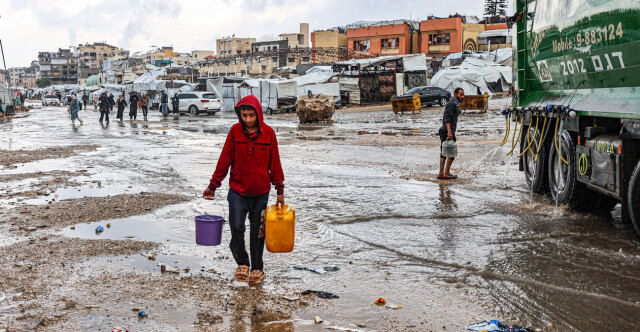
The Board of Peace, established at the initiative of US President Donald Trump, has called on Israel to “act immediately” to address the “humanitarian emergency” caused by torrential rainfall in the Gaza Strip.
Since late last week, heavy rain has flooded tens of thousands of tents housing displaced Palestinians, while at least five people, including three children, have lost their lives.
“This situation is not merely a threat as winter approaches, but an immediate humanitarian emergency,” the Board of Peace warned in a post on X.
It also called on the Israeli government to “allow the entry of essential materials for temporary shelters, water and sanitation infrastructure, and wastewater management” and to “fulfil its obligations” under Trump’s plan to end the war in Gaza.
🇵🇸Displaced families in Gaza survived a year of strikes and death only to be struck by freezing floods. This is heartbreaking… Gaza is literally drowning and the mainstream media are ignoring this. https://t.co/bdOuTE7UoJ
— Hosam From ih gaza🇵🇸🚨 (@pem9tc) November 8, 2026
The Board of Peace, which is responsible for overseeing the implementation of the ceasefire agreement in the Palestinian enclave, acknowledged “the steps being considered by the Israeli government” but insisted that “the response remains insufficient”.
On Tuesday, COGAT, the Israeli Defence Ministry agency responsible for coordinating civilian affairs in the Palestinian territories, announced that it had drawn up a “winter preparedness plan for the Gaza Strip” in coordination with the United Nations and the Board of Peace.
“More than 91,000 tents and 8,200 trucks” carrying winter essentials and vaccines have entered Gaza, COGAT said, also reporting progress on plans for “water and sanitation infrastructure”.
Heavy rainfall triggered flooding through displacement camps in Gaza City, with Palestinians saying their belongings, including their bedding, have all become soaked https://t.co/Y6cEO4xdvn https://t.co/Yl6voFKlWI
— Reuters (@Reuters) November 7, 2026
Risk of flooding and infectious diseases
UNICEF, meanwhile, accused Israel of refusing to allow equipment needed to repair a water retention basin into Gaza, warning that the facility could overflow, exposing nearby residents to flooding and disease.
Local authorities have accused Israel of destroying water infrastructure and vehicles used for pumping water during its war against Hamas.
One of the damaged facilities is the Sheikh Radwan stormwater collection basin in Gaza City, which is now contaminated with sewage and at risk of overflowing following the heavy rainfall, according to UNICEF spokesperson James Elder.
Elder told reporters that the UN agency had been working with Israeli authorities and the Board of Peace for a year on a $3 million project to repair the facility, but COGAT had rejected it.
“Toxic sewage could flood the streets and tents of Gaza City, forcing children and families to flee their makeshift shelters yet again, while dramatically increasing the risk of disease. So we are somewhat stunned,” he told a press briefing in Geneva.
Rainwater floods tents in Gaza as Israel continues to prevent the entry of tents and humanitarian aid. https://t.co/y42zuf9ovZ
— Mustafa Barghouti @Mustafa_Barghouti (@MustafaBarghou1) November 7, 2026
“Let’s get the repairs done before this becomes yet another cause of death for children in Gaza, something that could very well be prevented,” he added.
COGAT has not responded to a Reuters request for comment.
World Health Organisation spokesperson Christian Lindmeier told the same briefing that there was a significant risk of infectious disease outbreaks in Gaza because of flooding, poor sanitation and inadequate healthcare and water services.
Nearly one million displaced people in the Palestinian enclave face a moderate or high risk of flooding, he added.
Ask me anything
Explore related questions




