





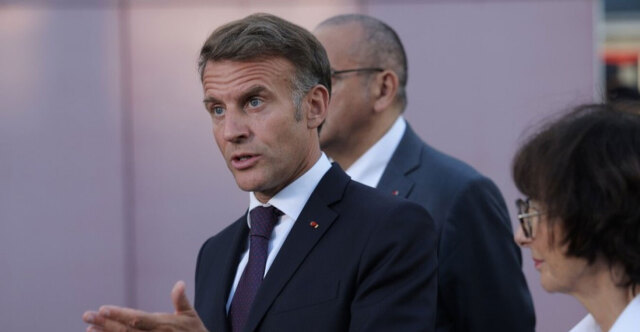
Revealing conversations with French President Emmanuel Macron, in which he speaks candidly about political allies and opponents, defends controversial decisions, complains about his treatment by the press and offers glimpses of his plans for life after leaving the Élysée Palace, feature in a new book by Françoise Degois entitled You Are All Too Harsh on Me (Vous êtes tous trop durs avec moi).
A former adviser to politician Ségolène Royal, former political journalist at France Inter and regular commentator on television political discussion programmes, Degois published her book last week. It is based on her private conversations with the French president, excerpts of which have already appeared in the newspaper Le Figaro and the weekly magazine Marianne.
Following A President Shouldn’t Say That… (Un président ne devrait pas dire ça…) by Gérard Davet and Fabrice Lhomme, which overshadowed the final months of François Hollande’s presidency, it is now his successor Emmanuel Macron’s turn to find himself at the centre of a publication containing unusually candid personal revelations.
Unlike the former Socialist president, however, the current French head of state only learnt a few days ago that the thoughts he had shared via Telegram with journalist and columnist Françoise Degois were about to be made public.
Des échanges privés entre Emmanuel Macron et la journaliste Françoise Degois sont dévoilés dans le livre "Vous êtes tous trop durs avec moi". L’ouvrage révèle notamment des SMS échangés avec le président de la République pendant deux ans. #canal16 https://t.co/d6P25H3GU1
— franceinfo (@franceinfo) November 4, 2026
How the conversations began and Macron’s defence of Brigitte
The exchanges began at Macron’s own initiative in the summer of 2024, when he sent Degois a message thanking her for defending his wife, Brigitte Macron, on X, at a time when she had become the target of conspiracy theories falsely claiming that she was a man.
“Thank you, and my wife thanks you too. Beyond our political differences, what matters is what you said,” he wrote, signing the message with his initials, “EM”.
Degois seized the opportunity to continue exchanging messages with the president of the French Republic.
Among other things, her book confirms that Emmanuel Macron never intended to ask the New Popular Front coalition, which emerged with the most seats in the 2024 parliamentary elections, to form a government.
‘Le Pen’s party won the election’: Macron defends dissolving parliament
“Only she and all of you believe that she could one day make it to Matignon,” Macron wrote, referring to Lucie Castets, the New Popular Front’s proposed candidate for prime minister.
For the French head of state, “the winner was the National Rally (RN)”, France’s far-right party, following his unsuccessful decision to dissolve the National Assembly, a move that drastically narrowed his political room for manoeuvre during his second presidential term.
Macron, however, rejects the suggestion that dissolving parliament was a reckless political decision. “That dissolution, which cost me so much in every respect, nevertheless managed to stop the National Rally at that moment. I am convinced of it. They were ready for the autumn, but not for June,” he wrote in another message.
10:27 Sa démission, CNews, les riches et sa vie d’après… Des messages chocs d’Emmanuel Macron révélés dans un livre Pendant sa présidence, François Hollande s’était longuement confié à des journalistes qui en avaient tiré des livres à la fin de son quinquennat. L’un de ces ouvrages, Un président ne devrait pas dire ça (Éditions Stock), de Gérard Davet et Fabrice Lhomme, avait achevé ses derniers espoirs de se représenter pour briguer sa succession en 2017. Un contre-modèle pour Emmanuel Macron, qui, une fois à l’Élysée, a toujours tenu la presse à distance. Mais s’il est beaucoup moins friand d’entretiens avec les journalistes que son prédécesseur, le président échange abondamment avec d’autres correspondants. Souvent tard le soir, par écrit, via la messagerie cryptée Telegram. Le philosophe Bernard-Henri Lévy avait ainsi évoqué ses échanges nocturnes avec le chef de l’État dans Nuit blanche (Grasset, 2025). Françoise Degois, éditorialiste clairement engagée à gauche, en tire pour sa part tout un ouvrage, à paraître ce jeudi 5 novembre, que Le Figaro a pu lire en avant-première. Alors qu’Emmanuel Macron a toujours veillé à tenir la presse à distance pour éviter les écueils des présidences passées, un nouvel ouvrage de l’éditorialiste Françoise Degois vient lever le voile sur les coulisses de sa communication privée. Basé sur de multiples échanges écrits et nocturnes envoyés via l’application cryptée Telegram, le livre révèle des prises de position sans filtre du chef de l’État sur des sujets brûlants comme une éventuelle démission, la chaîne CNews, le rapport aux riches ou sa vision de « l’après-présidence ». Cette parution offre une plongée inédite dans les confidences intimes du président, confirmant sa pratique d’échanges directs et informels avec un cercle restreint d’interlocuteurs en dehors des canaux officiels. Source : Le Figaro Medias @PAT_SB79
— MediaActuMonde (@mediactumonde) November 10, 2026
Criticism of Gabriel Attal and support for Olivier Faure
In their conversations, the journalist and the president also discuss the wider French political landscape.
Macron is particularly critical of Gabriel Attal: “We gave him far too much. Constantly. Far too much.”
As for Jean-Luc Mélenchon’s La France Insoumise (LFI), he remarks: “LFI’s strategy is crazy, but I don’t believe it will succeed.”
By contrast, Emmanuel Macron is full of praise for Olivier Faure, the Socialist Party’s first secretary. “He’s a good guy, a really good guy, Olivier,” he wrote, suggesting that the politician, who has since suffered a heavy defeat at the hands of Raphaël Glucksmann, should put himself forward as a candidate.
“Let Olivier go for it. The others are hopeless. Just look at them one by one!” he declared.
In another message, he offered even stronger encouragement: “Come on, he has to do it. He has to throw himself into it. He can take on Méluche,” he wrote, using Jean-Luc Mélenchon’s nickname. “I took him on myself. It’s not easy at all, but you can do it,” he added.
‘You are all too harsh on me’: Macron’s complaints about journalists
In other exchanges, Macron complains about the way he is treated by the press, criticising articles which, in his view, are intended to damage him, as well as those who feed information to journalists producing such reports.
“Three articles don’t make the difference,” he insisted, criticising journalists who, he argued, feel entitled to write about his actions and decisions without ever having met him.
“Often, you and your colleagues are all too harsh on me,” he complained, in the remark that ultimately gave Degois’s book its title.
Des échanges privés entre Emmanuel Macron et la journaliste Françoise Degois sont dévoilés dans le livre "Vous êtes tous trop durs avec moi". L’ouvrage révèle notamment des SMS échangés avec le président de la République pendant deux ans. #canal16 https://t.co/d6P25H3GU1
— franceinfo (@franceinfo) November 4, 2026
Macron’s plans after leaving the Élysée Palace
Unable to seek another consecutive presidential term because of the constitutional limit of two successive terms, Macron is taking stock of his time in office just months before his departure from the Élysée Palace.
“We have made progress in eight years. We have done a great deal to tackle separatism and improve purchasing power,” he said in June 2026.
But what does he intend to do after leaving the Élysée Palace next spring? Although he does not reveal specific plans, he offers some clues about his intentions.
On 5 July, Le Journal du Dimanche (JDD), owned by billionaire Vincent Bolloré and known for its far-right editorial stance, suggested that the French president might go to work for billionaire businessman and investor Xavier Niel.
“Complete, utter nonsense,” Macron replied when Degois asked him to verify the report, also mentioning the names of other billionaires as possible future employers.
“I am not going to work for anyone. I would rather have a small house of my own than a big house belonging to someone else. In any case, if I get involved in business, it will be my own ventures, and I am thinking more about doing so abroad, outside France. But I will neither be their employee nor beholden to them. Never,” the French president made clear.
Ask me anything
Explore related questions




