





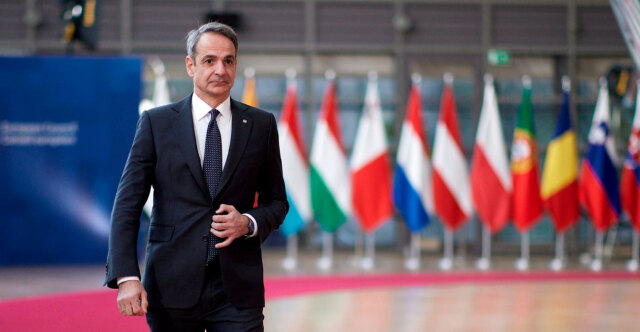
Dublin is being placed under tight security ahead of the arrival of around 50 leaders, but attention is focused on more than the police officers deployed across the Irish capital. Behind the unprecedented security measures, involving more than 5,000 police officers, elite military units and provisions for sniper deployment, intense diplomatic activity is unfolding, with significant implications for Greece. Prime Minister Kyriakos Mitsotakis is preparing a targeted expression of gratitude to his European partners, while Ankara appears to be opting for low-level representation, as its claims stretching from Libya to Kasos return to the forefront.
According to information obtained by protothema.gr, the Prime Minister intends to thank his 26 European counterparts for their support against the Turkey-Libya maritime memorandum, while all indications suggest that neither Recep Tayyip Erdogan nor Hakan Fidan will attend the Dublin meetings. The timing is particularly significant, as the French vessel Abeille Marengo has meanwhile departed to carry out work on the Greece-Cyprus electricity interconnection project, despite Turkish objections.
Athens is keeping Ankara firmly on its radar and is not underestimating developments around Kasos. Mitsotakis has already clearly set out Greece’s positions, both at the United Nations and, more recently, at the Greece Talks event organised by Proto Thema and Travel.gr, where he recalled the country’s response in 2020. In Dublin, however, he is not travelling solely to discuss Turkey. Greece has positions and proposals on Europe’s major challenges, ranging from the economy and energy to technology, and the Prime Minister intends to use his international presence to advance these priorities as well.
The Turkish diplomatic backdrop
The level of Turkish representation is one of the notable aspects of today’s European Political Community summit.
Recep Tayyip Erdogan is unlikely to attend the gathering in the Irish capital, while reports suggest that Foreign Minister Hakan Fidan is also not expected. The name emerging as Turkey’s possible representative is Feridun Sinirlioğlu, the experienced Turkish diplomat who currently serves as Secretary General of the Organisation for Security and Co-operation in Europe (OSCE).
If these reports are confirmed, Ankara will have opted for a low level of political representation at a time when its activities in the Eastern Mediterranean are once again attracting European scrutiny.
On the Greek side, Mitsotakis’s planned expression of gratitude at tomorrow’s informal summit of the 27 EU leaders is intended to highlight the significance of recent European support regarding the Turkey-Libya maritime memorandum. The European Union has reiterated that the agreement produces no legal consequences for third countries, a position Athens regards as an important diplomatic achievement.
The Prime Minister, however, does not need to initiate another round of public confrontation to reiterate Greece’s positions. At Greece Talks, he had already made clear that the country was prepared to defend its rights, referring to its response in 2020. Addressing Turkey’s Blue Homeland doctrine, he also stressed that “geography does not change”.
The moment of truth off Kasos
That determination is being tested in practice in the waters southeast of Kasos, where the movements of the French vessel Abeille Marengo represent the next test of Turkey’s challenges.
The vessel has departed from Heraklion and is proceeding in accordance with Greek and Cypriot plans for the electricity interconnection cable. Athens considers that the most effective response to Ankara’s claims lies in what is already taking place at sea.
Officials have played down the significance of Turkey’s latest NAVTEX, pointing out that it was issued after the French vessel’s route had become known. According to these sources, Turkey is attempting to create the impression that the surveys are being conducted with its consent, even though authorisation was sought exclusively from Greece and Cyprus.
Both countries have responded to Turkish claims by issuing their own counter-NAVTEX notices, while Athens has clarified that even French communication with Turkey was purely informative and did not constitute a request for permission.
The real test will therefore come at sea, where it will become clear whether Ankara intends to confine its response to an exchange of maritime notices or seek to challenge the progress of the surveys in practice.
The cable, moreover, is not merely a Greek-Cypriot undertaking. It is a project of common European interest, supported by more than €600 million in European funding and involving significant French participation. This European dimension strengthens Athens’ arguments against Turkish claims, although the project is not formally included on the agenda of the Dublin summits.
Dublin on high alert
Meanwhile, the largest police operation in Ireland’s history is under way in the country’s capital.
More than 5,000 police officers have been mobilised for the two summits, with 500 armed officers from specialist units and another 500 public order officers being deployed each day.
The Irish Defence Forces are also involved in security planning, including the elite Army Ranger Wing, the country’s special operations unit, which has counter-terrorism capabilities and can deploy snipers.
Particular emphasis is being placed on potential hybrid threats, with specialised drone detection and counter-drone systems deployed. Restrictions extend to roads, transport and airspace, with tightly controlled security zones established around the Convention Centre Dublin, where the meetings are taking place.
The extraordinary nature of the security arrangements is illustrated by the fact that even accredited journalists staying in hotels just a few hundred metres from the convention centre cannot travel directly to the venue. Instead, they must first go to Croke Park, approximately two kilometres away, undergo special security screening and then return to the summit venue aboard buses provided by the organisers.
The negotiations over Ukraine
Adding to the heightened security alert is the presence of Volodymyr Zelensky, who is expected to meet Donald Trump’s envoys, Jared Kushner and Steve Witkoff, in Dublin.
The two Americans plan to travel to Ireland following their talks with Vladimir Putin in Moscow to brief the Ukrainian president on the latest contacts and examine the next steps towards ending the war.
The Ukraine issue is also generating diplomatic activity within the European Union, with Giorgia Meloni raising a particularly sensitive question about Europe’s role in the negotiations.
In a letter to European Council President António Costa, the Italian Prime Minister is seeking clarity over who will represent Europe in negotiations aimed at ending the war. Meloni has expressed concern that numerous uncoordinated European initiatives are weakening the common position of the 27 member states, creating a risk that the European Union could be sidelined from decisions affecting the security of the continent itself.
She has also requested that the issue be discussed at tomorrow’s informal summit, paving the way for a decision in December. Costa has agreed to allocate time for the discussion, although no immediate agreement is expected on who should assume the role.
Thus, while the Americans seek to bring Moscow and Kyiv closer together, European leaders are looking for ways to secure a stronger presence at the negotiating table.
Greece’s agenda
Against this backdrop, Kyriakos Mitsotakis is participating today in the ninth European Political Community summit, where he will co-chair a discussion on competitiveness, innovation, connectivity and affordable energy prices.
Participants in the same panel will include European Commission President Ursula von der Leyen and Canadian Prime Minister Mark Carney, among others.
The Prime Minister is expected to emphasise the need for Europe to develop a stronger economy and greater technological autonomy through increased investment, fewer barriers for businesses and more effective use of innovation. For Athens, competitiveness is not simply an economic issue but is directly linked to the security and prosperity of European citizens.
On energy, he will focus on affordable prices, diversification of supply sources and the development of new energy, trade and digital corridors. He will also highlight Greece’s role as an energy and transit hub, as well as the importance of protecting maritime routes and freedom of navigation.
The artificial intelligence challenge
Tomorrow, Friday, the informal summit of the 27 EU leaders will focus on artificial intelligence and how Europe can strengthen its position in global technological competition.
Representatives of the technology industry, including Mistral AI chief executive Arthur Mensch, will also participate in the discussions. The agenda will cover the investments and infrastructure Europe needs, alongside the risks posed by the new technology to society and democracy.
Kyriakos Mitsotakis is expected to renew his proposal for strong and binding international rules governing the development of artificial intelligence. As he stressed during his address to the United Nations General Assembly last September, self-regulation by major technology companies is insufficient, as the risks arising from uncontrolled AI development require meaningful oversight and international cooperation.
In this context, he will also highlight Greek initiatives to protect minors in the digital environment, with particular emphasis on banning access to social media for children under the age of 15.
Ask me anything
Explore related questions




