





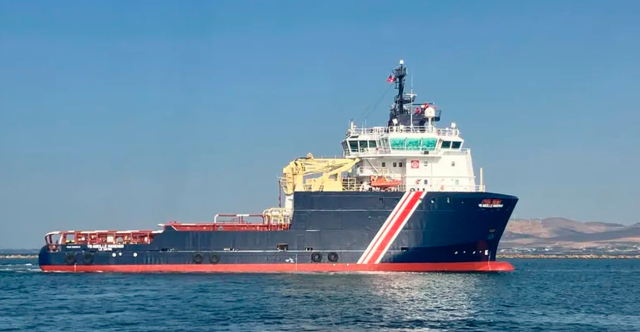
The research vessel Abeille Marengo is entering international waters on Thursday morning, marking the start of survey operations for the Greece-Cyprus electricity interconnection project following the completion of its calibration work.
The vessel, chartered by French company Nexans, has completed the calibration of its equipment to verify the readings recorded by its research instruments and is now beginning its surveys.
Against this backdrop, Athens and Nicosia have already issued the relevant authorisations and responded almost immediately to Turkey’s attempt to project an image of jurisdiction over the area, with the Republic of Cyprus issuing its own counter-NAVTEX on Wednesday.
The position of the French research vessel shortly before 9am on Thursday.
Cyprus also responds
More specifically, the Cypriot NAVTEX states that “the survey activities to be carried out by the vessel V/B ABEILLE MARENGO within the Exclusive Economic Zone (EEZ) and continental shelf of the Republic of Cyprus have been authorised under permit 05/2026 of the Republic of Cyprus and announced through navigational warning NW 345/26 issued by JRCC Larnaca / CYPRUS RADIO / 5BA”. Nicosia further clarifies that “the only authorised station within the NAVTEX service area of the Republic of Cyprus is JRCC Larnaca / CYPRUS RADIO / 5BA”, adding that the current notice remains valid until 20 March 2027.
It is worth noting that Turkey attempted on Wednesday, through leaks to the press, to suggest that it had given its consent for the research vessel’s operations in order to prevent, as Ankara claimed, another Greek attempt to establish faits accomplis in the Eastern Mediterranean. Nevertheless, the fact that Ankara does not have the initiative, as demonstrated by its decision to issue a counter-NAVTEX following the authorisations granted by Greece and Cyprus, highlights its attempt to insert itself into the electricity interconnection project.
The fibre-optic cable precedent
In this context, the research vessel’s entry into international waters today could be accompanied by a verbal challenge, known as “hailing”, from a Turkish vessel, as happened in January when a commercial vessel was laying a fibre-optic cable in the Aegean, despite Athens having issued the relevant NAVTEX.
However, this established practice of making contact with vessels to establish their identity was not followed by any further escalation on Ankara’s part, while the fibre-optic cable-laying operations are proceeding normally and are expected to be completed shortly, following a two-week extension.
In any event, officials at the Greek Ministry of National Defence are monitoring the research vessel’s movements while maintaining a discreet distance. Meanwhile, warships are stationed at various locations across the Aegean as designated standby vessels, meaning they are ready to sail at short notice, as part of the Hellenic Navy General Staff’s operational activities.
Ask me anything
Explore related questions




