





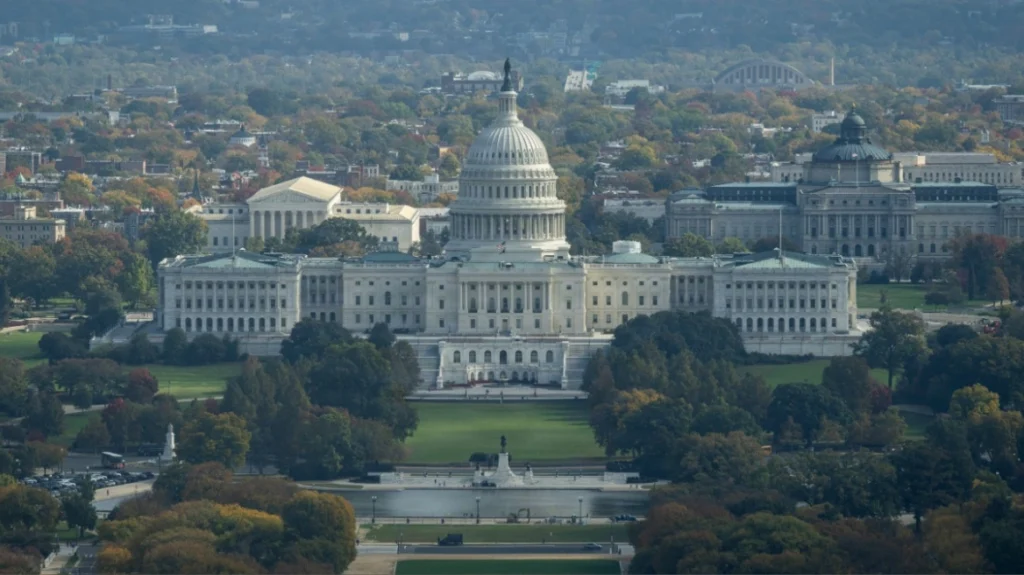
US intelligence agencies have identified Iranian plans for a possible attack involving a “dirty bomb” or chemical weapons in Washington, targeting senior members of the Trump administration, according to an explosive CNN report citing seven American officials. The intelligence has prompted intense activity among security agencies, as it reportedly includes specific targets and locations, although there is no evidence that Tehran has made a decision to carry out an attack.
The concern is so serious that the US Secret Service moved Treasury Secretary Scott Bessent to a military residence last week, while a series of meetings are being held to address potential threats on American soil.
According to CNN, new intelligence gathered by US agencies indicates that Tehran is examining scenarios for attacks against senior Trump administration officials in the US capital, using either an improvised device designed to disperse radioactive material or chemical weapons.
Sources familiar with the classified intelligence describe the planning as an effort by Iran to keep operational options available, rather than as an indication that an attack is imminent.
However, two of the sources point out that the plans identified are particularly specific, as they include locations and potential targets, prompting US authorities to develop contingency plans.
“Whether they actually have the personnel needed to carry out such an attack remains a matter of debate,” one of the sources said.
According to two officials, several meetings have taken place in recent days to assess the threat and prepare response measures. One of the sources described this planning as a “prudent” precautionary measure.
White House: There are currently no credible threats
Despite the heightened activity among intelligence agencies, the White House has sought to reassure the public.
Its spokesperson, Lauren Biss, said that the United States was “monitoring every potential threat, but at this time there are no credible threats against the US homeland.”
This assessment coexists with growing concern among officials about Tehran’s willingness to consider actions that could lead to an even greater escalation.
US agencies believe that continued military pressure and the economic blockade of Iran may have changed the Iranian leadership’s incentives, leading it to consider attacks even inside the United States.
Senior government officials have described the economic consequences of the blockade as “devastating” for the Iranian economy.
US Treasury Secretary relocated to a military residence
Concerns about possible Iranian actions had already prompted the Secret Service to take additional protective measures for senior government officials.
Last week, Treasury Secretary Scott Bessent was moved to a military residence as authorities assessed threats linked to Iran.
This intelligence comes on top of a long series of Iranian plots identified by US agencies against current and former government officials.
This activity dates back to Donald Trump’s first presidential term and, until recently, focused primarily on opportunities to assassinate American officials while they were travelling abroad.
Among the cases that have attracted the authorities’ attention is a plot to assassinate Trump himself in 2024, involving the recruitment of a hired killer.
The new development is that intelligence agencies are now examining the possibility of attacks using unconventional weapons inside the United States.
What is a “dirty bomb” and why does it cause concern?
A “dirty bomb” is fundamentally different from a nuclear weapon. It does not cause a nuclear explosion through fission, but instead uses conventional explosives to disperse radioactive material.
Although its destructive power is incomparably smaller than that of a nuclear bomb, it can cause radioactive contamination in an area, with serious consequences for public health and the ability to use the affected locations safely.
Experts estimate that most immediate deaths resulting from such an attack would probably be caused by the conventional explosion itself, rather than by exposure to radiation.
“Such a weapon is a weapon of terror, not a precision weapon, much like a suicide bomber who blows himself up,” a source familiar with the new intelligence said.
“It can cause serious illnesses and render certain areas uninhabitable,” the source added.
According to American officials, constructing such a device is not necessarily more complicated than building a conventional bomb. The main difficulty lies in obtaining the necessary radioactive material.
At the same time, there is concern that an attack would not necessarily require the deployment of trained Iranian agents to the United States, as it could be attempted by recruiting someone already present in the country.
Intelligence about the possible concealment of dangerous materials on US soil
One of CNN’s sources said that US intelligence agencies had intercepted Iranian communications containing claims that bomb-making materials had been pre-positioned inside the United States.
Officials disagree over the reliability of this particular intelligence, and the existence of such materials has not been confirmed.
Nevertheless, some believe it would have been relatively easy for Iran to have transported and concealed radioactive materials or chemical agents in the past, which could be used in combination with conventional explosives.
One source argued that problems with US border controls over the past decade could have facilitated the entry of individuals capable of acquiring and planting components for explosive devices.
Another source said that several national security officials consider it possible that such materials have been present in the United States for years, potentially even decades. These are, however, assessments rather than confirmed findings.
“In other words, Iran’s capabilities to carry out such an attack have not increased. What has changed is its motivation,” one of the sources explained.
The US Department of Defense referred questions on the matter to the Office of the Director of National Intelligence, which declined to comment.
Iran’s response
Iran’s mission to the United Nations categorically rejected the reports concerning the possible use of chemical weapons.
In a statement, its spokesperson stressed that “Iran considers the use of chemical weapons under any circumstances to be absolutely illegal and categorically rejects and unequivocally denies the false and fabricated allegations being circulated in this regard.”
However, the Iranian side did not explicitly respond to the reports about the possibility of planning a “dirty bomb” attack.
Concerns also over the possible use of chemical weapons against American troops
US intelligence agencies are also examining a second category of intelligence suggesting that Iran may use chemical weapons against American military forces stationed in the Middle East.
These specific concerns were initially reported by The New York Times, while two officials confirmed to CNN that the matter is being closely monitored.
Several American officials argued that military forces in the region do not have adequate protective equipment or the necessary training to deal with such an attack.
As a result, separate operational planning is under way to ensure that diplomatic personnel and members of US intelligence agencies in the Middle East have the appropriate equipment and necessary training to protect themselves.
The problem with surveillance legislation and the warning to Congress
Growing concern over potential attacks coincides with a critical unresolved issue in American surveillance legislation.
A key law allowing intelligence agencies to collect communications involving foreign nationals expired in June, amid a dispute between the White House and Congress over the then-acting Director of National Intelligence, Bill Pulte.
Surveillance orders that had been approved before the law expired remain in force until March 2027.
However, national security officials warn that if Congress does not renew the legislation, the agencies will lose one of their most important tools for identifying terrorist plots.
Last week, Attorney General Todd Blanche, Director of National Intelligence John Ratcliffe and CIA Director John Ratcliffe?
The three officials — Attorney General Todd Blanche, Director of National Intelligence Jay Clayton and CIA Director John Ratcliffe — sent a letter to the Republican and Democratic leadership in the House of Representatives and the Senate, requesting the reauthorization of the law.
In the letter, they warned that any delay could “put at risk the lives of Americans at home as well as our troops serving abroad, amid the elevated threat level about which the Gang of Eight was briefed.”
This refers to the so-called “Gang of Eight”, the group comprising the four leaders of the two chambers of Congress and the leading members of both parties on the House and Senate intelligence committees.
Its members had been briefed on Iran a few days before the letter was sent. It has not been clarified, however, whether the briefing specifically included the intelligence about a possible attack involving radioactive materials or chemical weapons in Washington.
Deadlock in negotiations and fears of a new escalation
The new intelligence comes as the United States and Iran remain locked in a military and diplomatic confrontation over the Strait of Hormuz.
Talks aimed at ending the American blockade, reopening the critical shipping route and halting hostilities have so far failed to produce a result.
Although Donald Trump said last week that the war would end “fairly soon”, the possibility of attacks inside the United States highlights the risks of further escalation in the conflict that began in February.
A source from the region said that both sides want an agreement, but for the time being neither appears willing to make substantial concessions.
The coming weeks are considered critical for reaching an agreement, while fears are growing that certain actors could attempt to undermine the diplomatic process.
At the center of these concerns are hardline figures within the Iranian regime or groups that may be operating without full central control and which, according to the same source, have benefited from the continuation of the war.
Such groups could have an incentive to carry out an attack in order to prevent the conflict from ending.
A US official pointed out that Tehran understands that the use of a chemical weapon or a “dirty bomb”, whether in the Middle East or in the United States, would trigger severe retaliation.
However, if the Iranian leadership concludes that the very survival of the regime is under threat, it may consider even such an enormous risk acceptable, according to the official’s assessment.
Ask me anything
Explore related questions




