





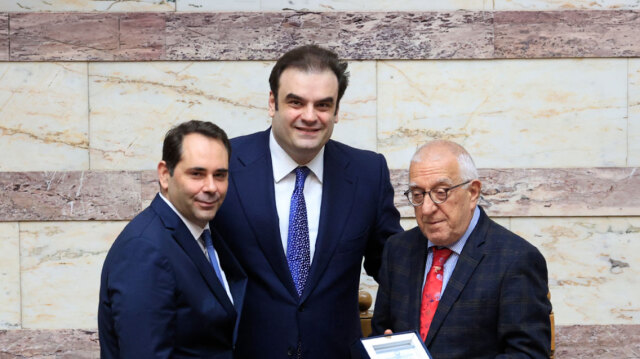
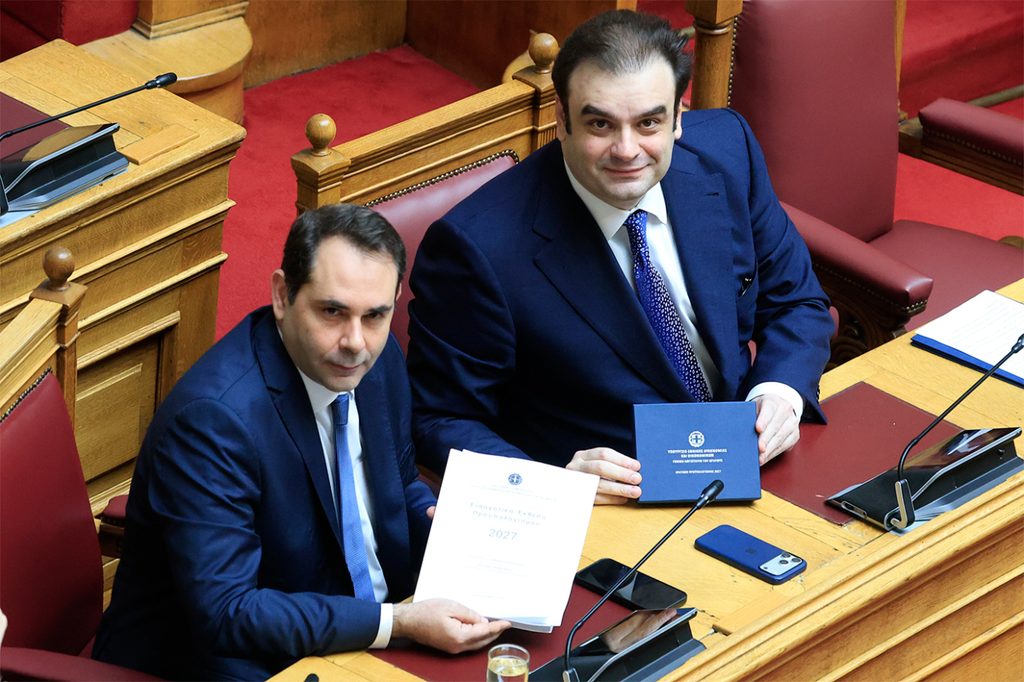
Greece’s 2027 state budget was submitted to Parliament today, Friday 20 November, by National Economy and Finance Minister Kyriakos Pierrakakis, accompanied by Deputy Minister Thanos Petralias.
The new budget forecasts growth of 2.3% in 2027, with unemployment falling to 7.9% and inflation easing to 2.8%, and includes a series of measures to boost incomes, reduce taxes and support businesses.
Key measures include an increase in annual support for pensioners to €400, a €500 Christmas bonus for public sector employees from December 2027 and a target of raising the minimum wage to €1,000 through two successive increases in April 2027 and January 2028.
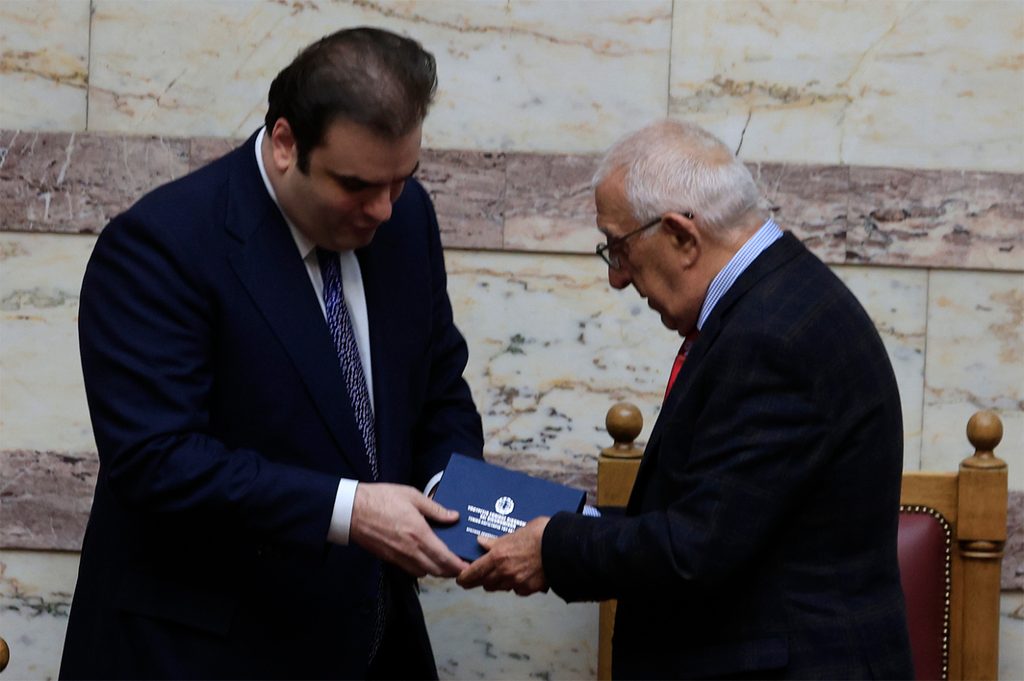
The budget also provides for the new €2 billion ‘My Home III’ housing scheme and tax relief for farmers, families with three children and self-employed professionals. For the first time, the state budget was submitted to Parliament entirely in digital form, marking a change in the submission process.
As Newmoney reported earlier, meeting the targets depends on public investment continuing to rise in 2027 at three times the rate the European Commission forecasts for Greece. The Commission’s announcement, expected today, on its assessment of Greece’s request for the final tranches of Recovery Fund financing, worth €11.3 billion in total, will therefore be decisive.
Growth of 2.3% and easing inflation
In their explanatory letter to MPs, Pierrakakis and Petralias said the Greek economy was expected to continue growing faster than the eurozone average, despite international economic and geopolitical uncertainty.
Growth is forecast at 2% in 2026 and 2.3% in 2027, compared with the European Commission’s forecast of 1.2% for the eurozone in both years.
Nominal gross domestic product is expected to rise from €263.4 billion in 2026 to €275.9 billion in 2027.
Inflation is expected to ease from 4% in 2026 to 2.8% in 2027, while investment is forecast to increase by 7.9% next year, compared with just 1.4% in the eurozone.
Investment as a share of GDP is expected to rise from 18.9% in 2026 to 19.8% in 2027.
Unemployment to fall to 7.9% as pay rises
The finance ministry also expects the labour market to improve.
Unemployment is forecast to fall from 8.4% in 2026 to 7.9% in 2027, which the finance ministry says would be Greece’s lowest unemployment rate since 2008.
Pay per employee is forecast to rise by 3.9% in 2027, following an increase of 3.7% in 2026.
As part of its measures to boost incomes, the government is aiming to raise the minimum wage to €1,000 through two successive increases in April 2027 and January 2028.
The budget also provides for a further 0.5% reduction in private sector social insurance contributions.
€400 payment for pensioners and €500 bonus for public sector staff
The budget places particular emphasis on measures to boost disposable income.
From November 2026, the annual payment for pensioners, people with disabilities and older people without social insurance rises to €400 net.
The measure is extended to all pensioners over the age of 65, while disability benefits will be adjusted in line with inflation.
A separate measure provides for a €500 Christmas bonus for all public sector employees and officials from December 2027.
Tax breaks for farmers, families with three children and self-employed professionals
The 2027 budget also incorporates new tax measures announced at the 90th Thessaloniki International Fair.
Building on the 2026 tax reform, the tax rate on income up to €20,000 will be reduced to zero for those whose main occupation is farming and for parents with three children.
Self-employed professionals who meet their tax obligations will receive significant tax cuts, while businesses that invest in machinery will be able to write off the cost more quickly.
The budget also provides for the abolition of the business levy, starting in Greece’s regions and Thessaloniki, alongside a gradual reduction in advance tax payments.
To support small and medium-sized businesses, a new €1.5 billion lending and loan guarantee scheme will be funded through the loan component of the Recovery and Resilience Facility.
€2 billion for ‘My Home III’ and a new savings account for the younger generation
Tackling housing difficulties is also a priority in the new budget.
The budget provides for the launch of the €2 billion ‘My Home III’ scheme and the extension of existing tax incentives for home purchases.
It also introduces a new measure to encourage saving for the younger generation.
A dedicated investment account will receive a government contribution matching the parent’s annual deposit, up to €1,200 a year.
Public debt to fall to 128.5% of GDP
The budget forecasts a primary surplus of 3.6% of GDP in 2026 and 3.2% in 2027.
The overall general government balance is forecast to show a surplus of 0.6% of GDP in 2026 and 0.1% in 2027.
Public debt as a share of GDP is expected to continue falling, from 135.8% in 2026 to 128.5% in 2027.
The finance ministry expects Greece to record the largest reduction in public debt in the European Union for a seventh consecutive year.
In 2026, Greece is expected to lose its position as the EU country with the highest public debt-to-GDP ratio for the first time in 20 years.
International risks and challenges for 2027
In their letter to MPs, Kyriakos Pierrakakis and Thanos Petralias said the international economic outlook remained highly uncertain.
Geopolitical tensions, particularly in the Middle East, disruptions to global trade, fluctuations in energy prices and fiscal pressures on European economies are weighing on the outlook.
Rapid advances in technology and artificial intelligence, as well as the effects of climate change, add to that uncertainty.
Despite these challenges, the finance ministry expects Greece to maintain growth above the eurozone average, supported by rising investment, higher incomes and continued fiscal adjustment.
Ask me anything
Explore related questions




