





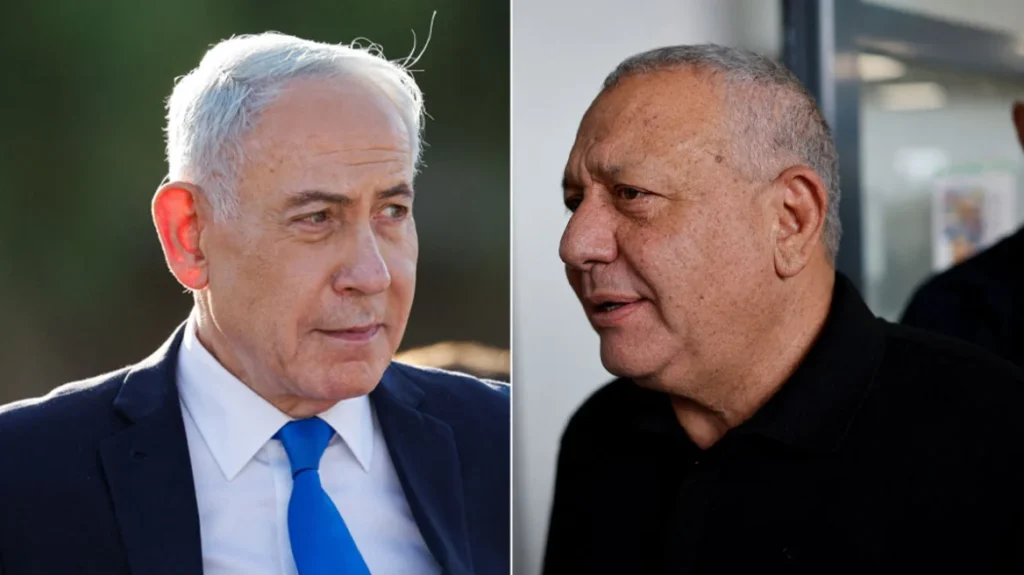
Negotiations to form a new government in Israel have reached a critical juncture, with the leader of the Yashar party, Gadi Eisenkot, declaring that he is determined to present a proposed government to the Knesset for approval, even if he fails to secure a broad parliamentary majority.
At the same time, outgoing Prime Minister Benjamin Netanyahu, who lost his parliamentary majority in the 27 October elections, has renewed his call for the formation of a national unity government, arguing that the country is at a historically critical moment.
Eisenkot: “I do not intend to waste time – I will bring a new government before the Knesset”
In a post on Friday, Gadi Eisenkot confirmed reports in Israeli media that he intends to put a new government to a vote, even if negotiations to form a broad coalition fail.
“I intend to continue working towards significant progress along every avenue available to us, in order to form the broadest possible governing coalition,” he said, while warning that negotiations cannot continue indefinitely.
“All parties must understand that I do not intend to waste time. They must know that, at the appropriate moment, I will bring a new and good government under my leadership before the Knesset for approval,” he stated.
The leader of Yashar made clear that his decision was neither a negotiating manoeuvre nor an attempt to put pressure on his interlocutors.
“This is not a threat for negotiating purposes. It is a decision I have made with full awareness of the responsibility and the role entrusted to me in this state of emergency,” he stressed.
The plan for a minority government with the support of Arab parties
Eisenkot’s plan envisages the possibility of forming a minority government based on a coalition of parties seeking political change in Israel.
A key condition for the success of this initiative is the support or tolerance of Arab parliamentary groups.
According to reports, the Arab party Ra’am could support the government in Parliament without formally joining the governing coalition and without requiring the signing of a cooperation agreement. Meanwhile, the Joint List has already announced that it will not oppose the effort to replace Netanyahu’s government.
However, the plan is also facing resistance within the anti-Netanyahu camp. The leader of the Yisrael Beiteinu party, Avigdor Lieberman, has made it clear that he will vote against such an arrangement.
“We cannot afford to miss this historic opportunity”
Eisenkot argued that the political deadlock must be resolved immediately, as the country is facing an opportunity that may never arise again.
“It would be foolish to believe that we can afford to delay and miss the window of opportunity that has opened up, a window that will be difficult to open again,” he said.
He then adopted a particularly dramatic tone in his remarks.
“What is at stake is the future of Israel, our future, the future of our children and our grandchildren. What is at stake is the imperative for us to prove worthy of our responsibility,” he stated.
The Yashar leader stressed that if efforts to form a broad-based government fail, he will proceed with the formation of a national emergency government, which he will seek to expand either before or after it takes office.
At the same time, he called on members of Parliament to accept responsibility for their decisions.
“All members of the Knesset must listen to their conscience and decide whether a new government will be formed or whether they are willing to drag the State of Israel and its citizens into new elections, with Netanyahu remaining as caretaker prime minister,” he said.
Negotiations with the ultra-Orthodox parties and the issue of military service
One of the biggest obstacles to forming a government remains the position of the ultra-Orthodox Jewish parties.
At the centre of the discussions is the issue of compulsory military service, as a significant part of the ultra-Orthodox community is seeking special status for students attending religious schools.
Eisenkot said that serious negotiations are under way, with the aim of finding a compromise that will meet the needs of the Israeli military without abolishing the special status of those who devote their lives to studying the Torah.
“Serious dialogue is under way with the ultra-Orthodox parties, with the aim of finding solutions and forms of agreement that will strengthen the Israel Defense Forces, meet security needs and preserve the status of Torah scholars, as we promised during the election campaign,” he said.
At the same time, he assured that he had no intention of abandoning his commitments to a fairer distribution of military obligations.
“This is not an attempt to square the circle or to surrender on the issue of military service,” he argued.
As he explained, the aim is to establish a framework based on the principles of Yashar’s plan for “military service for everyone”.
Eisenkot on Likud: “There is a wide gap between words and actions”
The Yashar leader also referred to negotiations with Netanyahu’s Likud party, making clear his criticism of its position.
He argued that his side was making sincere efforts to reach an agreement, but that Likud’s statements were not accompanied by a corresponding practical willingness to cooperate.
“With regard to contacts with Likud, sincere and genuine efforts are being made on our side. Unfortunately, however, there is a wide gap between rhetoric and actions, as well as between words and Likud’s actual willingness to cooperate,” he said.
Eisenkot stressed that national unity cannot be limited to a simple agreement on the distribution of ministerial positions.
“As I have said many times, unity is not a political arrangement, but an expression of cooperation and shared values,” he said, adding:
“Anyone who ignores this distorts the truth and misleads a public that genuinely, wholeheartedly, wants to see unity.”
Nevertheless, Eisenkot appeared willing to give the negotiations one more chance.
“I intend to give this direction one more opportunity. We must try to persuade Likud members to rise to the occasion,” he said.
Netanyahu: “We are at a historic crossroads – Responsibility means unity”
For his part, Benjamin Netanyahu renewed his call for the formation of a national unity government, citing the seriousness of the security threats facing Israel.
The caretaker prime minister revealed that in recent days he had briefed political leaders Gadi Eisenkot, Naftali Bennett and Avigdor Lieberman on the security situation.
“In recent days, I held briefings with opposition leaders Gadi Eisenkot, Naftali Bennett and Avigdor Lieberman regarding the difficult security situation we are facing,” he said, stressing that Israel is facing decisions of decisive importance.
“We are at a historic crossroads. This is neither a publicity stunt nor an exaggeration. All the relevant information has been presented to them, and what is needed now is responsibility. Responsibility means unity,” he stated.
Netanyahu sought to present the formation of a broad-based government as a necessary condition for addressing the security challenges.
At the same time, he launched a particularly fierce attack on the proposal to form a minority government with the support of Arab parties.
“It is truly astonishing that the possibility of forming a narrow government based on the votes of supporters of terrorism, who seek the destruction of the Jewish state, is even being considered,” he argued, adding:
“This is incomprehensible. I say this in the clearest possible terms: it must stop immediately.”
“The fate of Israel is at stake”
Netanyahu concluded his statement with another appeal to his political opponents to move forward with the formation of a national unity government.
“Responsibility means unity. This is what must happen now, and every hour we wait is an hour wasted,” he said, concluding:
“The fate of Israel is at stake.”
Ask me anything
Explore related questions




