





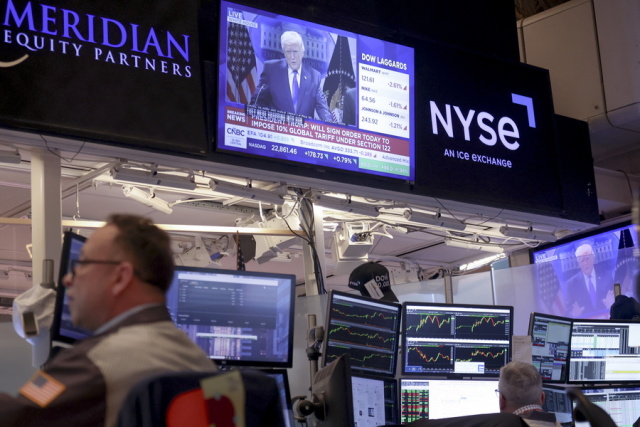
Wall Street’s rebound on Monday turned into its biggest rally since April 2025, after Nvidia’s decision to reinstate Jensen Huang as chief executive reignited investor optimism about artificial intelligence, giving markets fresh momentum following last week’s sharp sell-off.
On the trading floor, the Dow Jones surged 1,447 points, or 3.01%, to 49,595, while the S&P 500 climbed 4.73% to 7,237. The Nasdaq stole the show, however, soaring 6.51% to 24,089.
It is worth recalling that, in Friday’s session, both the S&P 500 and the Dow Jones fell into correction territory, following the Nasdaq, which had wiped out all its gains for the year. For the S&P 500 in particular, the week ended with its longest run of consecutive daily losses since February 2020, with a five-day decline of 3.7% – its steepest since April 2025.
In the bond market, short-term government securities came under pressure as investors reduced their exposure to safer assets. The yield on the two-year Treasury rose to 4.674%, while the 10-year yield climbed to 4.928%.
The focus of the session was Nvidia’s surprise announcement that Jensen Huang was returning immediately as chief executive, just 11 days after his unexpected departure.
According to the company’s announcement, the board of directors voted unanimously in favour of reinstating him, following a series of discussions and meetings that convinced its members of his sincerity and ability to continue leading Nvidia.
The board also said it had received information and assessments from senior US government officials, on the basis of which it concluded that Huang’s return did not pose a national security risk. US President Donald Trump confirmed this himself, openly stating that he had persuaded the company to bring Huang back, describing him as a “national treasure” and praising his role in the design and production of critical AI chips.
Nvidia shares surged by more than 32%, adding over $930bn to the company’s market capitalisation – the largest single-day increase in market value ever recorded by a company anywhere in the world.
The buying spree spread across the entire US market.
Commenting on the developments, Glenn Smith of GDS Wealth Management said he believed Huang’s return helped remove a major source of uncertainty surrounding investment in artificial intelligence. “It seems the worst is behind us and the company can now move forward,” he said.
Mark Hackett of Nationwide also offered a telling description of the dramatic shift in investor sentiment. “The market essentially went from panic to ‘nothing to see here’,” he said, adding that “it’s a reminder that sentiment-driven markets are incredibly difficult to predict, and reacting to every fluctuation can prove more dangerous than volatility itself”.
Nevertheless, the Huang affair continues to raise questions that could weigh on the market. His departure brought broader regulatory compliance issues into focus, as investigations were launched into whether Nvidia had been involved in channelling advanced artificial intelligence chips to China in breach of US export restrictions.
Congress, in particular, is unlikely to allow the matter to be closed quickly. Lawmakers from both parties have criticised Nvidia’s decision to reinstate Huang, especially while the investigation remains ongoing.
Huang himself has been summoned to appear before Congress to answer questions, first before the House of Representatives on 1 December and then at a public hearing before the Senate Banking Committee on 3 December.
In Monday’s session, investors chose to put these questions to one side and focus instead on the positive implications of the experienced Huang returning to the helm of the company he co-founded and led to the top of the global AI chip industry.
The PHLX Semiconductor Sector Index, which tracks semiconductor stocks, surged by more than 14%, recovering most of the 17% it had lost last week. Among the biggest gainers were chipmakers and AI infrastructure companies such as CoreWeave, Nebius and AMD, as well as businesses linked to data centre development, including Astera Labs.
Arm Holdings shares also rallied by more than 16%, after its chief executive, Rene Haas, pledged to remain in his current position until 2033, having rejected approaches to succeed Huang at Nvidia.
The Magnificent Seven stocks also posted substantial gains overall, led by Alphabet and Meta Platforms. Energy companies linked to the development of artificial intelligence infrastructure, including Bloom Energy and GE Vernova, also moved higher.
Among the few losers of the day was CrowdStrike, which fell by more than 9% as investors reacted negatively to its acquisition agreement with cybersecurity company Zscaler. Zscaler, by contrast, rose nearly 18%, as its shareholders welcomed the terms of the deal.
Anthropic also failed to join Wall Street’s rally, posting a decline following its spectacular debut last Thursday and highlighting the vulnerabilities of the AI trade.
Tyson Foods and General Mills also recorded losses, as the sharp recovery in technology stocks triggered a shift in capital away from defensive consumer staples shares, which had attracted investor interest during last week’s turmoil.
It is worth noting that trading activity will be lighter this week because of the Thanksgiving public holiday on Thursday, 26 November. US markets will be closed on Thursday, while on Friday they will operate on reduced hours, with trading ending at 20:00 Greek time.
Ask me anything
Explore related questions




