





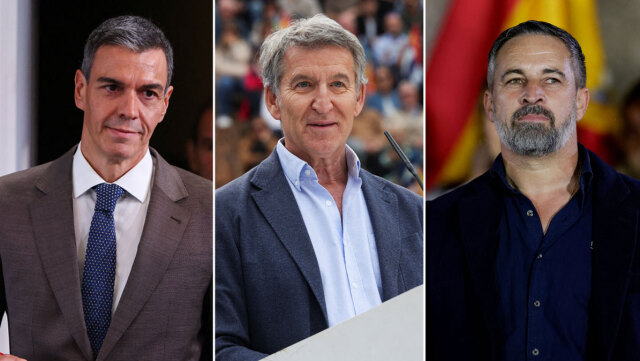
Spanish voters go to the polls on Sunday, with Prime Minister Pedro Sánchez seeking another term in office. The Socialist prime minister’s main challenger is Alberto Núñez Feijóo, leader of the conservative People’s Party. Santiago Abascal, the leader of the far-right Vox party, is seeking to become a kingmaker after the election and pave the way for a right-wing coalition government.
Smaller left-wing parties and regional groups could also play a decisive role if neither of the major parties secures a parliamentary majority on its own.
Pedro Sánchez has been in power since 2018
Pedro Sánchez, 54, leads the Spanish Socialist Workers’ Party (PSOE) and has been in office since 2018, making him one of Europe’s longest-serving leaders.
He has voiced strong opposition to US President Donald Trump’s policies, the US-Israeli war against Iran and Israeli military operations in the Gaza Strip.
He has also maintained a positive stance on immigration at a time when many Western governments are adopting stricter immigration policies.
Under Sánchez, Spain has recorded the fastest growth among Europe’s major economies for several years. Public discontent over rising housing costs has persisted despite that growth.
An economist by profession, Sánchez has repeatedly weathered political crises and prevailed over rivals both within his own party and in the opposition.
The 2023 regional elections were a case in point. The Socialists suffered a heavy defeat, and just one day later Sánchez surprised Spain’s political establishment by calling a snap general election. He focused his campaign on the prospect of the far right entering government. The strategy paid off, allowing him to remain prime minister and form a new left-wing coalition government.
This time, however, he faces a particularly difficult election. Court cases involving allegations of corruption against a former minister and senior figures in his party have added to the political pressure, as has a case involving his wife, who denies any wrongdoing.
His chances of staying in power depend on both the Socialists’ performance and that of the smaller left-wing parties, which have lost ground in the polls.
Alberto Núñez Feijóo brings 13 years of experience governing Galicia
Alberto Núñez Feijóo, 65, leads the People’s Party (PP) and comes from a background in public administration. He has built his political profile around his reputation as a moderate and effective centre-right politician, emphasising his experience in government.
Widely known in Spain by his second surname, Feijóo governed Galicia, the region in the country’s north-west, for 13 years and won successive elections there.
Galicia is less economically developed than some other Spanish regions and has produced several prominent figures in the country’s political history, including dictator Francisco Franco and former prime minister Mariano Rajoy. Rajoy governed Spain from 2011 to 2018, the last period in which the People’s Party held power.
Feijóo favours lower taxes and less government regulation and, like Sánchez, is a firm supporter of the European Union. If he takes office, he is expected to seek closer relations between Madrid and both the United States and Israel.
Feijóo took over as People’s Party leader before the previous general election, when he failed to unseat Sánchez.
In this election, he will seek to turn the support his party has retained since then into a path to government.
Feijóo takes a more restrained tone than his political rivals and can draw on a strong party organisation, with a substantial presence both in Madrid and in many of Spain’s rural provinces.
Santiago Abascal seeks a role in government for Vox
Santiago Abascal, 50, wants his far-right Vox party to have a role in the next government if the People’s Party needs its support to secure a parliamentary majority.
Abascal is from the Basque Country. His political career and ultranationalist views were shaped largely by his opposition to the activities of ETA, the Basque separatist organisation that disbanded in 2018.
He began his political career in the People’s Party, leaving with other party figures to found Vox in late 2013. He soon took over as leader and has held the post ever since.
His positions are part of the broader right-wing populist movement that has grown in the United States and Europe.
He is a staunch supporter of Israel and has sharply criticised the Sánchez government’s stance towards it. On the economy, he backs sweeping cuts to business regulation and taxation and has openly expressed admiration for Argentina’s president, Javier Milei.
Vox takes a less openly hostile stance towards the European Union than some other European far-right parties. Abascal blames immigration for Spain’s cost-of-living problems. The far right has been out of national government since Spain restored democracy following Franco’s death in 1975.
After losing parliamentary seats in 2023, Vox is now seeking to expand its presence in parliament and gain enough leverage to demand cabinet posts in a potential Feijóo government.
The smaller parties that could decide who governs
Smaller parties on both the right and the left are also expected to influence the balance of power after the election.
To the right of Vox is Se Acabó la Fiesta (‘The Party’s Over’), a group founded by a far-right influencer that appeals to voters who consider Abascal’s party too moderate.
On the left, internal disagreements prevented the re-formation of the electoral alliance that helped keep Sánchez in power in 2023. This time, Frente Amplio (‘Broad Front’) and Podemos (‘We Can’) are competing separately for left-wing voters, a split that weakens their electoral prospects and makes it harder for Sánchez to form another coalition government.
Long-established regional parties in Catalonia, the Basque Country, Galicia and the Canary Islands, which focus on defending their regions’ interests, could also play an important role.
What the latest polls show
The vast majority of Spain’s latest polls point to a parliamentary majority for the conservative People’s Party and the far-right Vox, even as support for Sánchez’s Socialists has risen.
Monday was the final day on which polls could be published, as Spanish law bars their publication in the last few days before an election.
With the exception of the survey by the state polling institute CIS, all the polls put the People’s Party and Vox above the 176 seats required for an absolute majority in Spain’s 350-seat parliament.
The 40dB poll of 7,500 people for El País puts the People’s Party on 31.8% and projects 127 to 136 seats. The Socialists follow on 30.9% and 116 to 127 seats, while Vox is on 17.3%, which would give it 51 to 61 seats.
The NC Report poll of 1,000 people for La Razón puts the Socialists on 27.2%, up from 26.1% a week earlier, giving them 108 to 111 seats. It projects 130 to 133 seats for the People’s Party and 64 to 66 for Vox, giving the two parties at least 194 seats between them.
The IMOP survey of 1,500 people for El Confidencial paints a similar picture, projecting a combined 195 seats for the People’s Party and Vox, against 110 for the Socialists.
The Ipsos poll for La Vanguardia, published on Sunday and based on a sample of 1,999 people, puts the People’s Party on 30.3% and 127 seats, the Socialists on 29.8% and 119 seats, and Vox on 63 seats.
The GAD3 survey of 1,501 people for ABC projects 131 seats for the People’s Party, 110 for the Socialists and 63 for Vox.
The state polling institute CIS offers a different picture in its survey of 8,034 people. It puts the Socialists in the lead on 34.4%, followed by the People’s Party on 24.9% and Vox on 15.6%. The survey leaves open the possibility of a parliamentary majority for the Socialists, the left-wing Frente Amplio and regional parties.
Ask me anything
Explore related questions




