





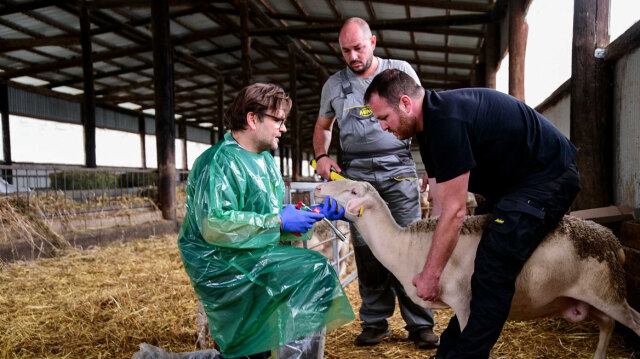
The Minister of Rural Development and Food, Margaritis Schoinas, on Friday, 27 November, attended the fitting of the first electronic rumen bolus in a sheep at a livestock farm in Achilleio, Magnesia.
The ewe fitted with the bolus was named “Avgi” (Dawn), symbolising, according to the minister, a new era in the identification and traceability of livestock.
The procedure took place at the livestock farm owned by brothers Konstantinos and Vasilis Moschos and was carried out by the farm’s veterinarian, Giorgos Gatos. The minister was accompanied by Deputy Minister of Rural Development and Food Thanasis Kavvadas and Secretary-General Spyros Protopsaltis.
It took the farm’s veterinarian, Giorgos Gatos, just a few seconds to insert the bolus into the young ewe, which was given the name Avgi, marking the beginning of a new era in livestock registration in Magnesia.
“We decided together with the business owners and the veterinarian to name her Avgi. This little ewe will be called Avgi because she also symbolises the dawn of a new era for Greek livestock farming,” Margaritis Schoinas said.
At the same time, he sent a message to livestock farmers regarding the link between electronic identification and subsidy payments.
“From here, from Magnesia, I want to address all livestock farmers across the country and tell them that the animal traceability system using rumen boluses is now a legal obligation of the Hellenic Republic. We have committed to implementing it, and we will do so.”
The minister announced that an information campaign would begin in the coming weeks to ensure producers know when they will be required to fit the rumen boluses and what they must do to identify and register their animals.
Linking the reform to support for compliant livestock farmers and the reliability of payments, Mr Schoinas noted: “The country has suffered greatly from the practices of the past. We are turning a new page. We are settling the accounts of yesterday.”
What changes for subsidies
The electronic bolus carries the animal’s unique identification code, which corresponds to the number displayed on its ear tag. The code is read using a special device and linked to the animal’s details in the Digital Sheep and Goat Traceability Database. This enables inspection authorities to cross-check which animals are being declared for subsidy payments. Registration also helps monitor animal movements and retrieve information in the event of an animal disease outbreak.
For the 2026 Single Aid Application, the requirement applies to farms declaring more than 900 sheep and goats aged over six months. For these farms, every animal falling under the requirement must be identified and registered in the digital database to be eligible for the relevant subsidies. The deadline is 19 February 2027. From 2027, the measure is expected to be extended to all sheep and goat farmers.
Livestock farmers can order the boluses through the dedicated service on gov.gr. They must be fitted by an authorised veterinarian, with the cost borne by the producer.
The full statements by the Minister of Rural Development and Food, Margaritis Schoinas, are as follows:
“Our presence here today, at this model livestock farm, together with the responsible Deputy Minister, Thanasis Kavvadas, and the Secretary-General, Spyros Protopsaltis, signifies four things. First, that we are settling accounts with the shortcomings of the past. Second, that we are supporting honest livestock farmers. Third, that we are restoring the country’s credibility and image in Europe. And fourth, that we are making use of European funds.
“From here, from Magnesia, I want to address all livestock farmers across the country and tell them that the animal traceability system using rumen boluses is now a legal obligation of the Hellenic Republic. We have committed to implementing it, and we will do so.
“The new system is linked to the payment of subsidies to livestock farmers. Every Greek livestock farmer must therefore understand that only through such a system will their subsidies be secured in the long term. And precisely to ensure that this message reaches even the most remote livestock farm in the country, we legislated on this yesterday in the Hellenic Parliament and will organise a major information campaign across the country’s mass media in the coming weeks, so that Greek livestock farmers can quickly become familiar with the boluses.”
“This is therefore a historic day for Greek livestock farming. A short while ago, a bolus was fitted in a young ewe from Magnesia. Together with the business owners and the veterinarian, we decided to name her ‘Avgi’, because she also symbolises the dawn of a new era for Greek livestock farming. We will monitor her closely, because the bolus fitted by the veterinarian connects her to the digital database at the ministry. I therefore wanted to mark this day and express my hope that today will be the beginning of the new start that Greek livestock farming needs so much.”
Vasilis Moschos, livestock farmer and co-owner of the farm: “Today we had the pleasure of welcoming the minister to our livestock farm to witness with us the fitting of a rumen bolus. We raise 2,300 animals and I believe this is the right thing to do, because subsidies will be distributed properly.”
Giorgos Gatos, the farm’s veterinarian: “As regards electronic boluses, this is now a compulsory procedure. This year it applies to farms with more than 900 animals, and from next year it will apply to everyone. It is a relatively straightforward process: you order the boluses, have them fitted and then register the animals in the traceability database. It applies to all sheep and goats aged over six months.”
Ask me anything
Explore related questions




