





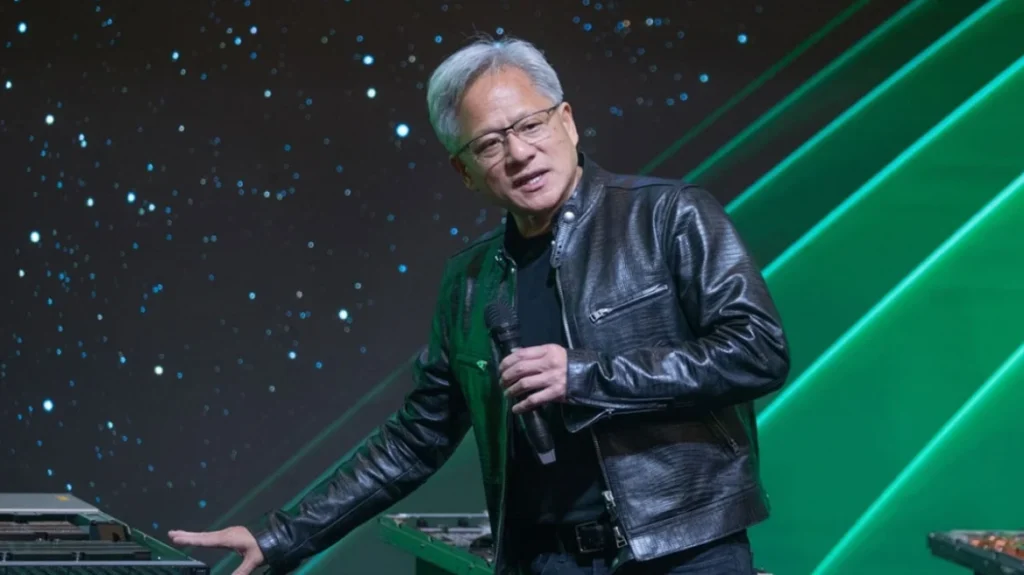
Jensen Huang promised to become a “better CEO the second time around” as he returned to the helm of Nvidia after an 11-day absence from the company he founded.
However, in the wake of the scandal that triggered a leadership crisis at the technology giant, Nvidia employees, analysts and legal experts are questioning whether Huang can continue running a company valued at $3.6 trillion in the same way: surrounded by a close circle of loyal associates and backed by a board of directors that has faced widespread criticism for its handling of both his departure and his reinstatement.
Returning to Nvidia’s Silicon Valley headquarters on Tuesday for a meeting with employees, Huang offered few indications that he intended to make radical changes to the company’s management model and corporate governance, although he acknowledged that he needed to moderate his authoritarian leadership style. Instead, he reiterated his longstanding opposition to establishing a formal succession plan and defended Nvidia’s flat organisational structure, under which dozens of senior executives report directly to him.
Nvidia’s market capitalisation increased by nearly $1 trillion on Monday when news emerged that Huang was returning to the AI chipmaker, which is regarded as one of the key pillars of the global artificial intelligence boom.
The euphoria, however, proved short-lived, as the company’s shares have fallen by approximately 10% since Monday’s closing price, amid a broader sell-off across the semiconductor sector.
“He experienced something akin to a near-death experience”
Some analysts believe, according to the Financial Times, that Huang will have no choice but to change the way he runs the company.
“What is clear is that Jensen will lead as a different person,” said Gene Munster, managing partner at investment firm Deepwater Asset Management, adding: “He had a near-death experience and is grateful to be back in the leadership position.”
Following renewed criticism of Huang’s longstanding habit of shouting at subordinates in front of their colleagues, Munster predicted that “some of the intensity with which he pushes employees, partners and politicians will be toned down”.
“The most likely consequence is that the company will lose a little of its momentum,” he added. “But I believe that loss will be more than offset by the fact that Jensen has something to prove for the first time in a decade.”
Two of his closest associates under scrutiny
Huang’s return has drawn attention to two of his closest associates, who played a pivotal role in the recent leadership crisis, as well as to the board of directors, whose back-and-forth over his reinstatement resulted in the loss of more than $1 trillion in market value.
Nvidia’s chief financial officer, Colette Kress, and its general counsel, Tim Teter, two of the four members of the company’s inner circle of top executives, are now facing increased scrutiny over their roles in the crisis.
The scandal was triggered by Huang’s romantic relationship with an executive at Singapore-based company Megaspeed, who is suspected of spying on behalf of China.
Kress oversaw Nvidia’s accounting, which is now under scrutiny by the US Securities and Exchange Commission (SEC), as investors demand greater transparency about the extent to which the company depends on revenue generated by the Chinese market.
Teter, meanwhile, was responsible for Nvidia’s compliance with US export restrictions. According to multiple sources in Washington who spoke to the Financial Times, he had developed a reputation as an executive who played down national security concerns surrounding Nvidia’s sales.
Teter, who worked for many years as an intellectual property lawyer at law firm Cooley, is expected to testify alongside Huang at closed-door congressional hearings next week.
Internal conflicts and the role of Huang’s son-in-law
It has emerged that Kress had previously clashed with Huang’s son-in-law, Nico Caprez, a former professional skier and business adviser who rose rapidly through the company’s ranks, taking charge of major customers in Asia and assuming responsibilities previously held by the CFO’s team, according to two sources familiar with the relationship between the executives.
Nevertheless, one Nvidia employee believes Huang is likely to stand by his close associates. Although he is known as an exceptionally demanding and tough employer, Huang does not tend to fire employees. In the past, he has even said that he prefers to “torture them until they become great”.
“It’s not Jensen’s style to get rid of people,” an Nvidia employee said. “His approach would be: We need to hug Tim and Colette tightly.”
Relations with Washington and exports to China
As the company’s de facto head of regulatory compliance, Teter oversaw Nvidia’s aggressive response to efforts to restrict the flow of its artificial intelligence technology into China.
“What set Nvidia apart from every other company was that it essentially had no professionally organised mechanism for managing its relationships with the government,” said a former senior US Department of Commerce official. “I have never seen a compliance team take its job less seriously,” the official added.
A person familiar with Nvidia’s lobbying activities in Washington argued that the company simply “disagreed with its critics about the best way to protect national security”. The company believed that being able to make certain sales in China in order to compete with Huawei would ultimately serve US interests.
Nvidia’s board of directors has since announced that it will appoint a formal chief compliance officer, implicitly acknowledging that the company’s relations with policymakers in Washington require a different approach. It has also established an oversight committee dealing with national security and export controls.
Nvidia board chairman Harvey Jones made clear that the company is “committed to constructive engagement with government and industry partners to safeguard national security while supporting continued technological innovation”.
The board’s responsibilities and the threat of an S&P downgrade
The question nevertheless remains as to how much longer Nvidia’s board of directors will retain its current composition.
Despite Monday’s surge in the share price, some investors have expressed dissatisfaction with the board’s sudden reversal in the Huang affair, following pressure from US President Donald Trump.
The board reinstated the businessman and company founder as chief executive just days after Jones had ruled out the possibility of his return.
In this context, Nvidia’s failure to put a succession plan in place was “disastrous” and represents “the kind of thing that you would expect the market to punish a company for”, said Ann Lipton, a professor at the University of Colorado Boulder Law School and a former distinguished lawyer specialising in corporate and securities matters.
“The board is responsible for creating mechanisms to ensure that issues like this are brought to its attention,” she added.
At the same time, pressure is mounting on Nvidia to implement further changes, as the scandal that triggered the leadership crisis has “revealed weaknesses” in the company’s management and corporate governance that could threaten its credit rating, S&P Global Ratings analysts said on Wednesday.
The ratings agency warned that it could downgrade Nvidia’s AA credit rating by one notch if substantial shortcomings in corporate governance are not addressed.
Ask me anything
Explore related questions




