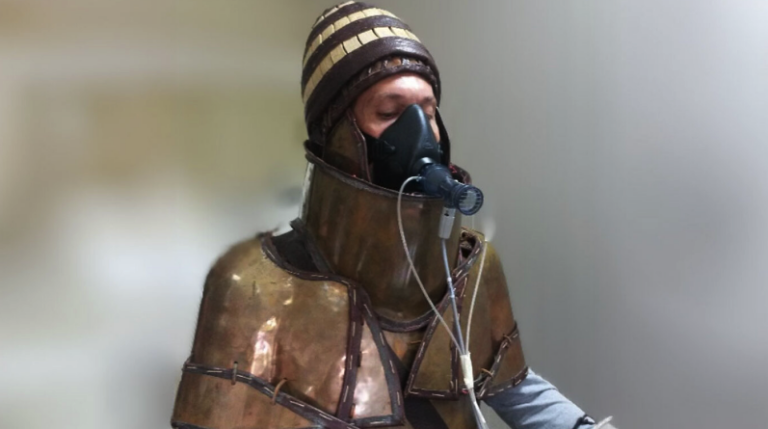
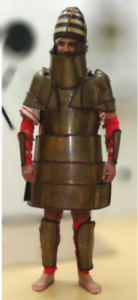
A replica of a 3,500-year-old full-body bronze armor was studied at the University of Thessaly, which was worn by trained Greek marines following a demanding battle simulation protocol.
The study was recently published in a prestigious international scientific journal. The results showed that the armour in question could well be used on the battlefield, and was not just a ceremonial outfit as originally formulated.
“The best preserved and almost complete example of a full-body armour of the Mycenaean period, consisting of hammered copper plates and dating from the 15th century BC, was found in the village of Dendra in Argolid by Swedish and Greek archaeologists in May 1960.
However, from the day of its discovery, the question that occupied experts was: was it used only for ritual purposes or was it also intended as an effective war instrument?
The lack of a documented answer until now has limited the full understanding of the conditions that prevailed in the warfare of the period, which determined the social transformations of the prehistoric world”, says Dr Ken Wardle, Professor of Archaeology at the University of Birmingham, England, and member of the research team, to the Athens-Macedonian News Agency.
Professor Emeritus and initiator of this study Dr. Yannis Koutedakis continued by stressing also to ‘APE-MPA’, that “in order to answer the above question, the innovative cooperation of two seemingly unrelated sciences, archaeology and sports physiology, was needed to evaluate precisely the loads caused by the armor on the bodies and biological functions of the volunteers.
The results overturn the previous perception that the armour in question was simply a ceremonial costume, mainly due to its supposedly cumbersome construction, thus shedding light on an important aspect of the Bronze Age in Greece and the Eastern Mediterranean in general. Moreover, the findings show the potential of collaborations between different disciplines. I hope that the new specialty that has been created, that of “archaeophysiology” will be the vehicle for new studies in the future.”
Professor Dr Andreas Flouris, who led the whole effort explains: “The replica armour used in our study had the same dimensions and similar weight as the original. Our volunteers strictly followed a ‘Homeric diet’ of about 4,500 calories, based on relevant descriptions in the Iliad.
During an 11-hour combat protocol, which was also designed following relevant descriptions from the Iliad, we measured the energy expenditure as well as the loads on the bodies of the volunteers at temperatures of 30-36 degrees Celsius, which were typical for the summer period in Greece at the end of the Bronze Age.
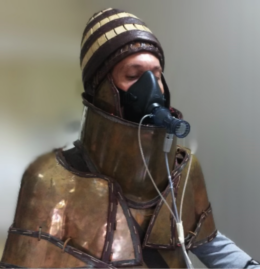
We measured heart rate, energy consumption, core body temperature, fluid loss, muscle function and haematological indicators.
Stavros Petmezas and Panagiotis Asimoglou, members of the scientific team, tell APE-MPA that “in no case was a malfunction of the armour found with regard to the movements of the volunteers, or excessive strain on their bodies.
Thus, more than 60 years after its discovery in the village of Dendra in Argolida, we could say with certainty that the specific armor not only allowed all the necessary movements of the Mycenaean fighter, but also protected him from enemy attacks.”
“The technology developed by the Mycenaeans in the construction of a combat-effective armor explains, at least in part, their strong presence in the eastern Mediterranean.
Only a powerful military force such as that of the Mycenaeans could, for example, have stood up to the Hittites (who in the second half of the second millennium BC dominated from Asia Minor to Mesopotamia) and won their respect, as the latter’s records show.
Skopje: After the president, the prime minister also insists on the name Macedonia
Finally, it should be noted that the results of our study weaken the theory that the references to bronze armour in the Iliad are later additions, and reinforces the view that the relevant technology existed long before the Trojan War,” concludes Professor of Archaeology Dr Ken Wardle.
*The authors would like to thank the retired General Ken Ken Wardle. and Honorary Chief of the General Staff Mr. Alkiviades Stephanis, Lieutenant General (retired). and Honorary Director of the Third Army Corps Mr. Dimitrios Bikos, Lieutenant General (retired). and Honorary Commander of the 98th ADTE, Mr. Dimitrios Tsipidis, as well as all the volunteers of the 505th Marine Battalion, for their unreserved support in the completion of the study. The study is dedicated to research team member Diana Wardle who did not get to see it in its published form.
Ask me anything
Explore related questions