





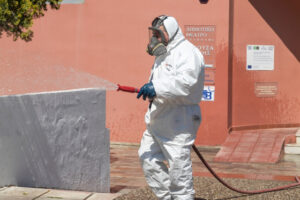
Six years ago today, on February 26, 2020, the first case of coronavirus was announced in Greece. The then 38-year-old Ms Dimitra Voulgaridou, a businesswoman and fashion designer from Thessaloniki, has just returned from Milan – she is declared “patient 0”.
The transmission of the virus in China has been known 2 months ago, in December 2019 – until that day, however, it seems like something distant, which does not concern us. Ms Voulgaridou herself would later describe the shock of the diagnosis as a sense of utter uncertainty: “Like walking in a desert with no direction.” Information was scarce, fear was immense, and society does not yet know what it has come up against.
The Shock of the New Reality
What would follow soon became clear: people were entering a new reality that would last for months. They were called to live their entire daily lives at home. Shops shut down, except for those providing basic goods. Schools closed, offices closed. Parents and children alike continued their routines from inside the house. Movement was restricted to what was strictly necessary and was monitored. Everyday conversations were flooded with terms like “contact tracing,” “cases,” “quarantine,” “ICU,” and “negative/positive test.”
The text message to 13033, movement permits, masks, and hand sanitizers became routine. Along with them, the sense of time changed: weeks that felt like months, plans postponed indefinitely, social life continuing through screens, holidays and celebrations passing unnoticed within the four walls of home. Nothing was the same anymore. The pandemic brought fear, loss, and social tension — but also an unprecedented mobilization of science.
The Return of Hope
At the end of that same year came the first major “breath of relief”: the vaccines. The vaccination campaign became a turning point, not only in public health terms but psychologically as well. For the first time in months, there was a collective sense of a way out of the nightmare. Despite the difficulties, the disagreements, and the fatigue, science served as the most stable counterbalance to fear.
Six Years Later: How the Pandemic Changed Our Lives
Today, six years later, COVID-19 is no longer the “unknown monster.” It is a virus that can be prevented, monitored, and treated — but it has not disappeared. From a daily emergency, it has become a seasonal threat, mainly for the elderly and vulnerable populations. The pandemic left behind a new relationship with health and public healthcare systems, greater familiarity with the concept of collective risk, and a society more sensitive to crises.
The idea of “I stay home when I have symptoms” has become more accepted. Masks are no longer taboo in healthcare settings. Employees request remote work when they are sick. The concepts of contact tracing, testing, and individual responsibility have been integrated into daily life.
The pandemic functioned as a “stress test.” In Greece, ICU capacity was strengthened, hospital information systems were upgraded, and healthcare digitalization accelerated. At the European level, joint vaccine procurement mechanisms were established and the role of surveillance organizations was reinforced. The experience of 2020 showed that no country can face a global health crisis alone.
Vaccines remain the most important “weapon” against the virus. Today, updated versions of vaccines circulate in the European Union, adapted to the dominant variants that emerge each season. The prevention strategy now resembles that of influenza: seasonal vaccination for vulnerable groups — the elderly, people with chronic conditions, and healthcare workers.
However, the challenge is not availability, but participation.
Recent data show that vaccination coverage has declined significantly. According to the ECDC surveillance report for the 2024–25 season, Greece recorded very low coverage in target age groups:
-
Ages 60–69: 0.5%
-
Ages 70–79: 1.7%
-
Ages 80+: 1.4%
This picture reflects pandemic fatigue. After years of restrictions, confrontations, and information overload, part of society has relaxed its stance toward the virus. COVID-19 infection no longer triggers the same collective panic — but that does not mean it has stopped threatening the vulnerable.
What Ultimately Remained?
Six years later, life has largely returned to its pace. Yet the sense of vulnerability remains. The pandemic taught us that “normality” is not a given. COVID-19 is no longer the “nightmare” of 2020. This paradoxical “anniversary” serves as an important reminder: health is a collective matter. The next crisis — whenever it comes — should find us better prepared.
Ask me anything
Explore related questions




