





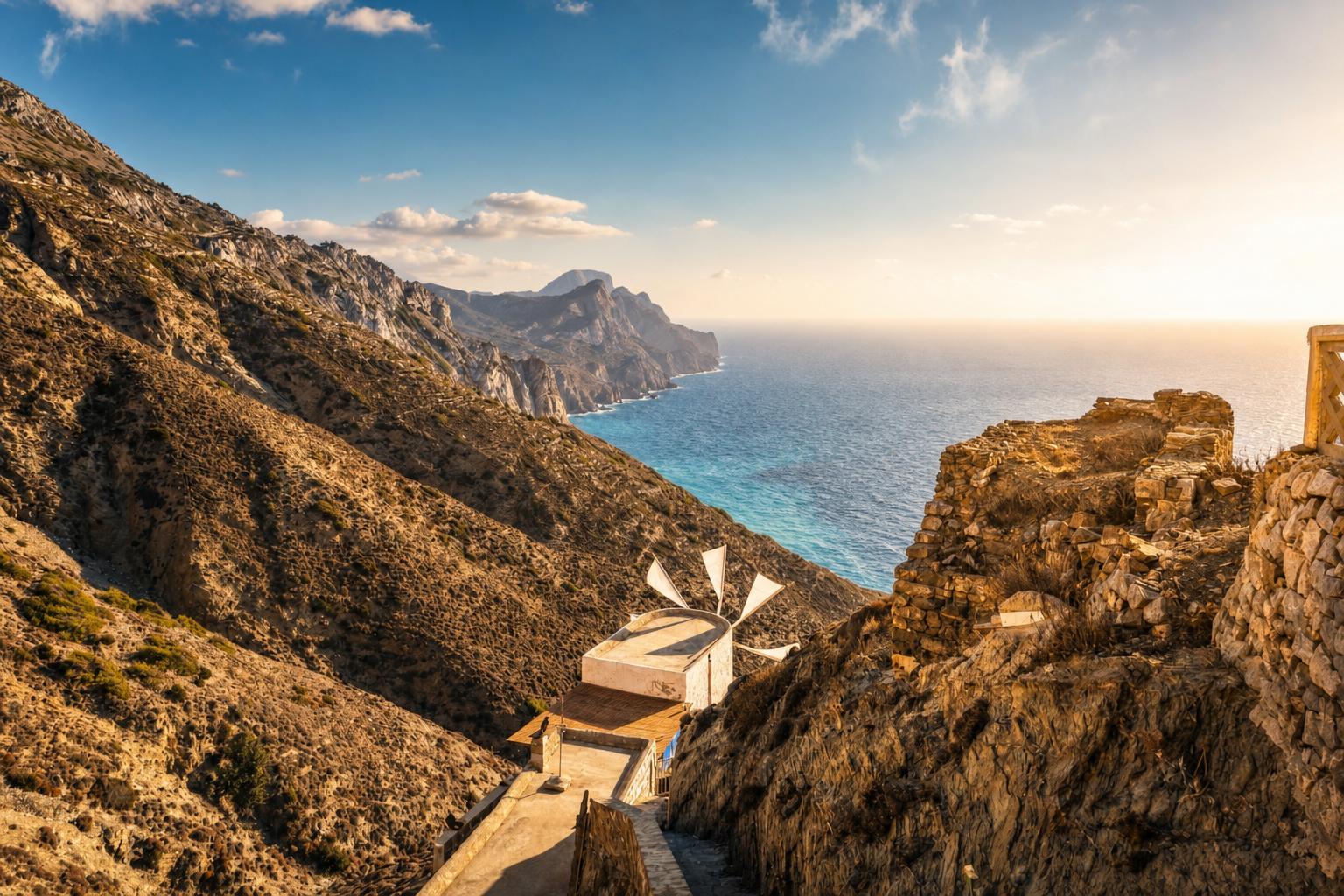
Karpathos is not simply another Greek island with gorgeous beaches and a harbour town. Set between Rhodes and Crete, it unfolds almost in stages: pale southern bays, wind-beaten plains, mountain villages, western sunsets, severe northern roads and, finally, Olympos, where tradition still has sound, costume, bread, ritual and consequence.
The island’s force lies in these contrasts. In a single day, Karpathos can move from shallow turquoise water to dry-stone terraces, from fishing tavernas to high settlements, from easy port-town life to a north that feels almost outside the present tense. Its distances are longer than they look, its winds matter, and its villages are not interchangeable. The south is open and practical, the west more maritime and sunset-facing, the centre shaped by memory and altitude, and the north by isolation, music and vertical drama.
Karpathos also has a rare kind of loyalty around it. Visitors who understand the island tend to return with unusual devotion, while its diaspora remains deeply present: restoring houses, supporting feasts, sustaining family ties and helping keep customs from becoming decorative relics. That continuity is part of what gives the place its emotional weight. It is beautiful, certainly, but it is also lived-in, worked for and defended.
This is the part of Karpathos that rarely fits into the usual international travel-magazine recommendations. The real story is not only where to swim, eat or sleep, but how many separate worlds the island manages to hold without softening their edges. Somehow, as always, we beg to differ.
Read the full mini guide on Travel.gr/en
Ask me anything
Explore related questions




