Christmas is one of the the most important — and perhaps the most treasured — celebration of Christianity, filled with joy and love. Countries around the world celebrate with different customs which have deep roots within history and tradition. If you look closely, you can see a variety of similarities between the commemoration of the birth of Christ and the worship of Dionysus in ancient Greece.
In December, the ancient Greeks celebrated the birth of Dionysus, calling him “Savior” and “divine infant.” According to Greek mythology, his mother, Semele, was a mortal woman, but his father was Zeus, the king of all gods. The priest of Dionysus held a pastoral staff, as did the Jesus, the Good Shepherd. Ancient Greeks commemorated his rebirth on December 30th every year.
One of the most well-known Christmas customs throughout the Christian world is singing carols, songs which have been written for the occasion. But in ancient Greece there also were specific “carols” celebrating the rebirth of Dionysus.
The great writer Homer himself composed some of the Dionysian carols during his stay on the island of Samos, along with a group of children. In ancient Greece, carols symbolized joy, wealth and peace, and the children sang the carols only in the homes of the rich.
Children would go from house to house, holding an olive or a laurel branch adorned with wool (a symbol of health and beauty) and different kinds of fruits. The children then brought the olive branch to their homes and hung it on the doors, where it would remain for the rest of the year.
The modern Christmas tree appeared for the first time in Germany at the end of the 16th century. However, it was first used as a symbol of Christianity by St. Boniface of England, who served as a missionary in pagan Germany in the 700’s.
The local tribes there worshipped trees, and believed the world would end if their largest tree, in a central area of what is now Germany, was cut down. St. Boniface cut the tree down himself, showing the tribes that the world indeed did not end with the downing of the tree. Thereafter, a living tree was the symbol of Jesus’ resurrection throughout Germany.
Christmas trees emerged from Germany to became globally popular in the 19th century as beautiful symbols of rejoicing over the birth of Jesus Christ. The tree was adorned first with fruit, and later with candles. The modern Christmas tree tradition made its way to Greece for the first time in 1833, when Bavarians arrived to decorate the palace of King Otto.
Ancient Greeks also used to decorate the ancient temples with trees, symbolizing sacrifices made to the gods.
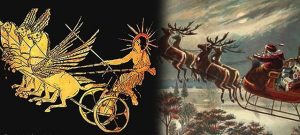
Santa Claus, who travels around the world on Christmas Eve delivering gifts in a sleigh pulled by flying reindeer, is another impressive likeness to ancient pagan times. A similar tradition also existed during the celebration of Dionysus in ancient Greece. On December 30th every year, his chariot was believed to transform into a sleigh, and horses transformed into flying horses to celebrate their god of light.
The New Year’s cake, which since early Christian times has been called Vasilopita, or St. Basil’s cake, also holds a bit of resemblance to an ancient Greek custom. Ancient Greeks used to offer Gods the “festive bread” during the rural festivals, such as the Thalysia or the Thesmophoria.
In Christian times, St. Basil was believed to have stuffed a cake with the jewelry which people had used to pay their taxes to the government. The saint thought the tax was excessive, and ordered that the jewelry be returned to the people.
By that time it was impossible to determine whose jewelry belonged to whom, so all the items were baked into a cake, and the pieces were proportioned out to everyone.
Source: Maria Papathanasiou/greekreporter
Ask me anything
Explore related questions