





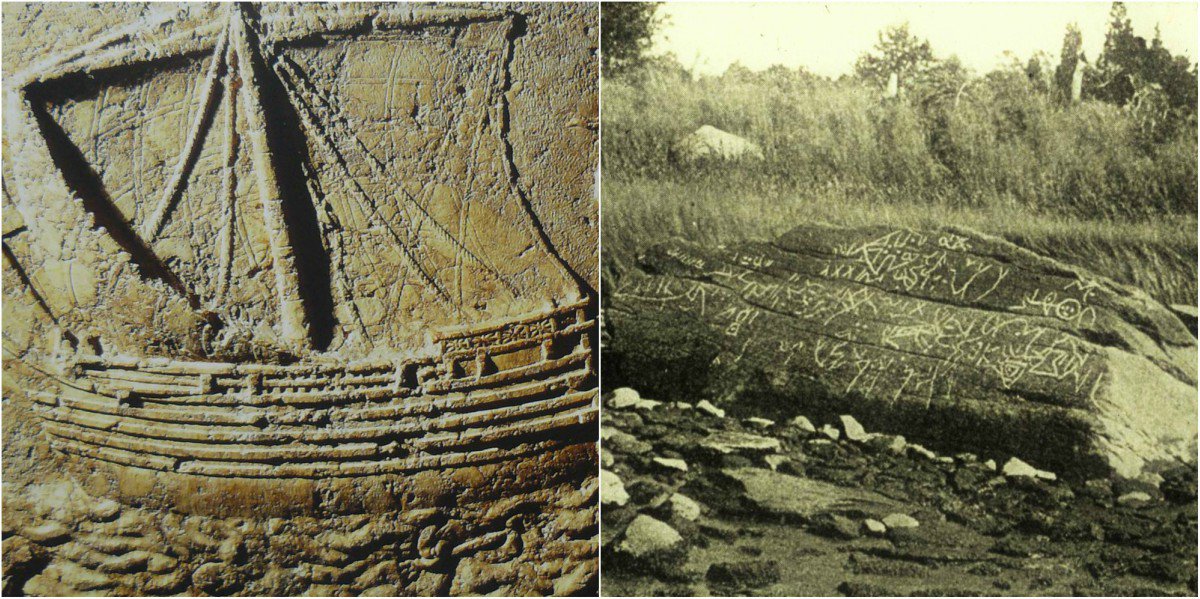
Among the many theories about which civilization first sailed to the Americas and discovered them, there is also the theory that the ancient Phoenicians were the first.
This theory became popular in the 18th century and is closely connected with the petroglyphs on Dighton Rock which are still of unknown origin. This theory is not quite as popular as the one that says that the Norse made the discovery first, but still, it is worth mentioning.
Back in the 18th century, a lot of scholars started to offer ideas about the true origin of the inscriptions on the rock. Ezra Stiles, a theologian, author, and also the seventh President of Yale College, claimed that the inscriptions are in Hebrew. Antoine Court de Gébelin, who is mainly known for the popularization of the Tarot, had his own idea about the rock. He believed that the inscription was made by Carthaginian sailors who commemorated their journey to the shores of Massachusetts.
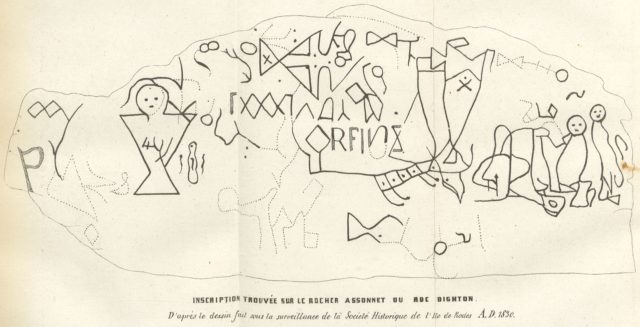
(A copy of the symbols on Dighton Rock)
In the 19th century, the theory that a group of Israelite people visited the New World was widely adopted in the Mormon community.
Later, Ross T. Christensen, an American archeologist, speculated that the Mulekites, who are mentioned in the Book of Mormon, were probably of Phoenician ethnic origin.
The Phoenician theory is also supported in a book written in 1871, by John Denison Baldwin, an American anthropologist. In Ancient America, Baldwin wrote,
“The known enterprise of the Phoenician race, and this ancient knowledge of America, so variously expressed, strongly encourage the hypothesis that the people called Phoenicians came to this continent, established colonies in the region where ruined cities are found, and filled it with civilized life. It is argued that they made voyages on the ‘great exterior ocean,’ and that such navigators must have crossed the Atlantic; and it is added that symbolic devices similar to those of the Phoenicians are found in the American ruins, and that an old tradition of the native Mexicans and Central Americans described the first civilizers as ‘bearded white men,’ who ‘came from the East in ships’.”
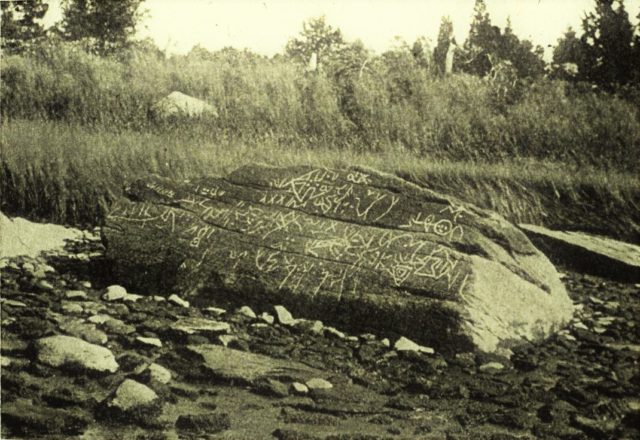
(Photograph of the Dighton Rock taken in 1893)
A stone tablet with an inscription that was supposed to be of Phoenician origin appeared in Brazil in the 1870s. The tablet was given to Ladislau de Souza Mello Netto, who was the director of the National Museum of Brazil at that time, and he immediately acknowledged the artifact as genuine. The inscription allegedly told the story of some Sidonian Canaanites who visited the shore of Brazil. It was later discovered that the symbols that appear on the tablet were variations of letters that appeared in different periods over a span of 800 years. It was impossible for all the letters to appear on the same tablet at the same time, so the artifact and the inscription were dismissed as fake.
In the 20th century, a few new artifacts appeared that again spiked the theory of Phoenician or Semitic discovery. One of these artifacts was the Bat Creek inscription. Cyrus Herzl Gordon, Near Eastern cultures and ancient languages expert, believed that the inscription of this tablet was in Paleo-Hebrew. Gordon thought that this was proof that Semitic people visited the continent prior to Columbus. Later, the Bat Creek inscription, together with another artifact called the Las Lunas Decalogue Stone, were proven to be forgeries and Gordon’s claim was dismissed.
‘Missing link’ of Alphabet found in Israel dating 3,450 ago
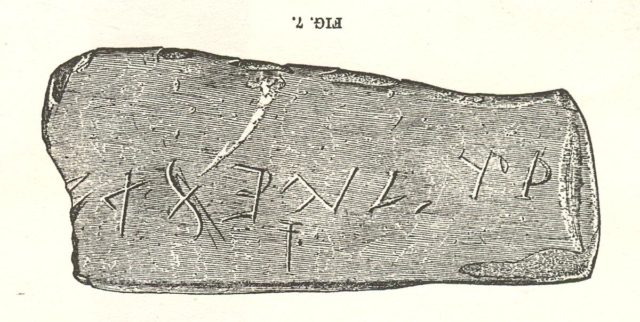
(The Bat Creek inscription)
In 1996, Mark McMenamin, an American paleontologist, speculated that Phoenician sailors visited the Americas around 350 BC. He based his theory on some gold stater coins that were allegedly made by the state of Carthage. On the back of the coins was a map of the Mediterranean and another land on the west, across the Atlantic. McMenamin interpreted that land as the Americas but later discovered that those coins were actually a modern forgery.
Another form of written evidence that slightly goes in favor of the arrival of Phoenicians in the Americas can be found in Ptolemy’s Geography. Lucio Russo, an Italian physicist, mathematician, and historian of science, analyzed Ptolemy’s book and noticed that he gives the coordinates of the Fortunate Isles.
The fortunate Islands were a group of legendary islands mentioned by various ancient Greek writers. Russo also noticed that the size of the world in Ptolemy’s Geography is smaller than what Eratosthenes measured. After he gave the same coordinates of the Fortunate Islands to the Antilles, the map irregularities in Ptolemy’s descriptions disappeared. According to Russo, Ptolemy could have known about the Antilles from his source, Hipparcos, who lived in Rhodes. It is possible that Hipparcos heard about the Antilles from Phoenicians sailors who controlled the western Mediterranean in those days. This is a far-fetched idea, but still, an interesting one.
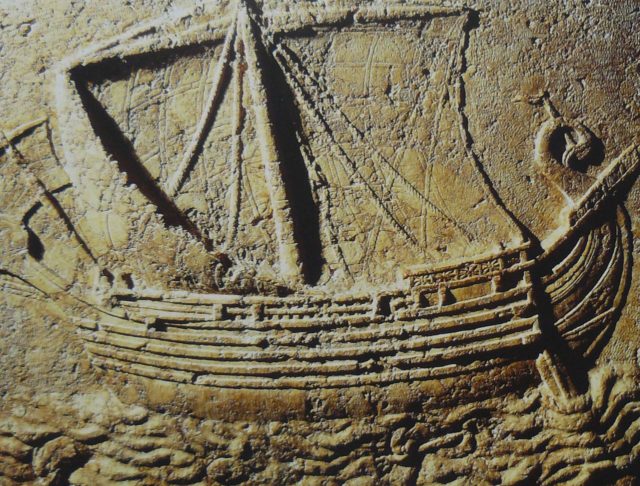
(A carving of a Phoenician ship)
Most of the modern-day scholars deny the idea that Phoenicians, Canaanites, or Carthaginians discovered the Americas first.
Ronald H. Fritze, an American historian, says that although it was technically possible for those people to reach the Americas, it probably never happened:
“No archaeological evidence has yet been discovered to prove the contentions of Irwin, Gordon, Bailey, Fell and others. Since even the fleeting Norse presence in Vinland left definite archaeological remains at L’Anse aux Meadows in Newfoundland, it seems logical that the allegedly more extensive Phoenician and Carthaginian presence would have left similar evidence. The absence of such remains is strong circumstantial evidence that the Phoenicians and Carthaginians never reached the Americas.”
Until some concrete evidence appears, this theory will remain only a fantasy.
Source: The Vintage News
Ask me anything
Explore related questions




