





“The Black Sea is gradually turning into one of the most unstable and dangerous maritime regions in the world. Recent Ukrainian drone attacks on Russian energy facilities, continuous Russian missile strikes on Ukrainian ports, and the increasing use of unmanned naval systems are creating a new risk environment for international shipping.”
This is noted by Alketas Drosos of EOS Risk Group, focusing on the new data and challenges facing the shipping industry.
“On the night of May 12–13, Ukrainian drones targeted the Tamanneftegaz oil transshipment complex on the Russian Taman peninsula. The attack caused a fire at industrial facilities near the port and brought back to the forefront a critical question: how safe can commercial navigation in the Black Sea now be considered?” he raises the concern and continues:
“This specific terminal is not a random target. It is one of Russia’s most important oil and LNG export hubs. Its targeting reveals that modern warfare is no longer limited to land fronts. Energy facilities, ports, and maritime trade routes have become key fields of strategic confrontation. The importance of the Black Sea for global trade is enormous. Oil, natural gas, grain, and raw materials pass through the region daily, directly affecting international markets. Every attack on ports or energy infrastructure increases uncertainty, affects freight rates, risk insurance premiums, and overall market confidence.”
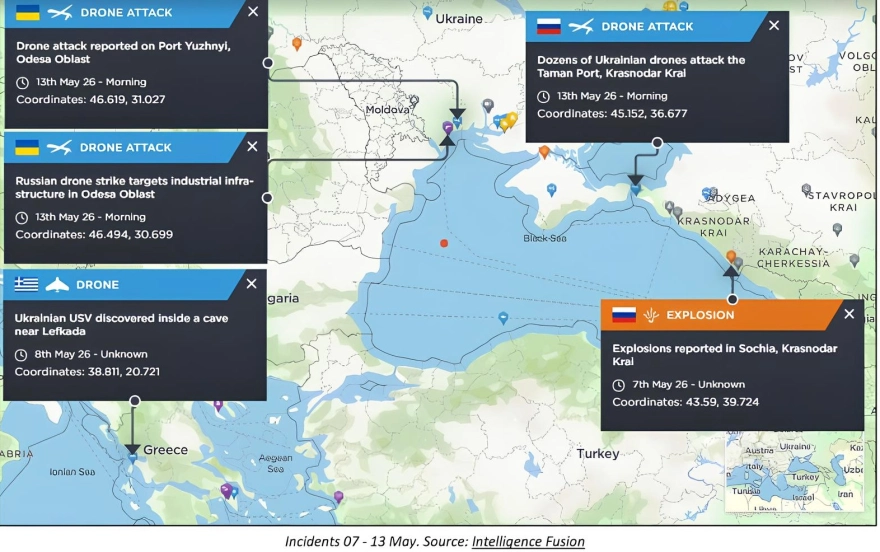
As he emphasizes, “recent developments show that tensions are not only not de-escalating, but are acquiring new characteristics. The use of drones and unmanned vessels enables low-cost but high-impact attacks. A single drone can cause a fire, shut down a terminal, or even temporarily paralyze a port.”
Even more concerning is the fact that the threat is now expanding beyond the conflict zone.
“The recent discovery of an unmanned vessel in Lefkada confirms that asymmetric naval warfare tools can appear at much greater distances than in the past. This raises reasonable concerns about the overall security of the Eastern Mediterranean and the maritime routes connecting Europe, the Middle East, and Asia,” he notes, adding:
“At the same time, the threat of sea mines remains a serious risk. Weather conditions, sea currents, and the use of unmanned systems can carry explosive devices far from their original deployment area. Authorities in Romania, Bulgaria, and Turkey continue to issue warnings to commercial vessels, as incidents of mine detection and suspicious objects remain frequent.”
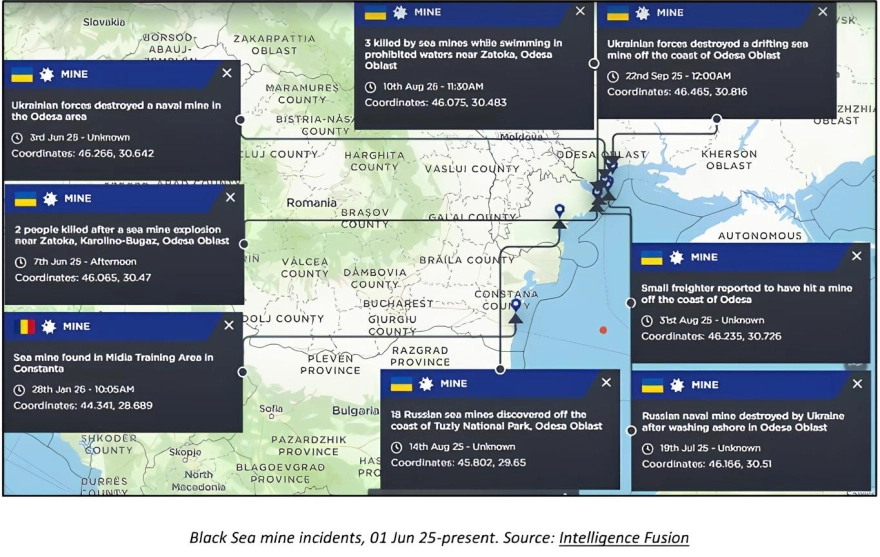
EOS Risk Group now assesses the risk for vessels operating near Ukrainian and Russian ports as “HIGH,” meaning a likely short-term incident. It also considers the possibility of misidentification of commercial ships or collateral damage during attacks as realistic.
All of this leads to a new reality for international shipping. Shipping companies are no longer required only to manage commercial risks or weather phenomena, but also to operate in environments where geopolitical tensions can shift within hours.
Information, timely risk assessment, and continuous monitoring of developments are now of strategic importance. Maritime security is no longer simply a matter of compliance or insurance coverage. It is a critical factor of operational continuity and the protection of crews, cargo, and vessels.
The most important question, however, remains open: are we facing a temporary escalation or the formation of a new, permanently unstable security environment in the Black Sea? The coming months will most likely provide the answer.
Ask me anything
Explore related questions




