





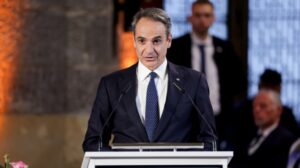
With strong political messages and clear references to critical turning points in European history, Kyriakos Mitsotakis honored Mario Draghi at the Charlemagne Prize ceremony in Aachen. The Greek prime minister spoke of a Europe at a crossroads, warning that it “risks not being the author of its own future, but a passive spectator to decisions taken elsewhere.”
At the same time, he praised the former ECB president’s role during the debt crisis, calling his historic stance decisive for saving the euro and safeguarding the resilience of the eurozone.
The prime minister began by stressing that “Europe was never a geographical construct; it was always an idea and, above all, a choice,” a choice repeatedly made by peoples with different languages and histories despite their traumatic memories.
Speaking about Mario Draghi, he described him as “a true European,” noting that for a younger generation of politicians he had been a source of inspiration for what it means to serve the public interest. He made special reference to Draghi’s role during the debt crisis, recalling the historic statement that shaped the course of the eurozone: “The ECB is ready to do whatever it takes to preserve the euro.”
Kyriakos Mitsotakis emphasized that no country suffered more than Greece during that period, expressing gratitude both to Draghi and to Jean-Claude Trichet and Jacques Delors for their support. “The Greek people proved worthy of the trust of the peoples of Europe,” he said.
He then outlined Europe’s modern challenges: the erosion of competitiveness, the innovation gap, growing dependence on third countries, and the need for strong strategic supply chains. As he said, Europe risks losing its leading role.
The prime minister called on the EU to restore its ability to innovate, invest, and develop technology, warning that without these capabilities “our strategic power will shrink.”
He also made significant reference to the concept of security, stressing that “a Europe that cannot protect itself cannot truly be sovereign.” Security, he said, goes beyond defense and extends to infrastructure, energy, supply chains, and institutions.
At the same time, he called for the mutual assistance clause of Article 42(7) to become operational so that the EU’s collective defense acquires real substance.
Kyriakos Mitsotakis also expressed support for common European borrowing, noting that the Union’s ambitions—especially in defense—must be reflected in a strengthened European budget. “Everyone must give something in order to make Europe stronger,” he stressed.
Closing his speech, he emphasized that European unity “is never automatic” and that leadership requires honesty, even when it is uncomfortable.
“We must believe in ourselves. And when Europe decides to do what is necessary, it can make history,” he said.
Ask me anything
Explore related questions




