





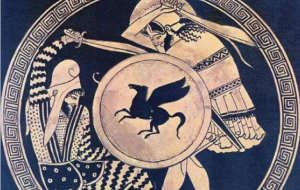
The Battle of Plataea believed to have been fought in August 479 BC, during the Persian Wars (499 BC-449 BC).
Background
In 480 BC, a large Persian army led by Xerxes invaded Greece. Though briefly checked during the opening phases of the Battle of Thermopylae in August, he eventually won the engagement and swept through Boeotia and Attica capturing Athens. Falling back, Greek forces fortified the Isthmus of Corinth to prevent the Persians from entering the Peloponnesus. That September, the Greek fleet won a stunning victory over the Persians at Salamis. Concerned that the victorious Greeks would sail north and destroy the pontoon bridges he had built over the Hellespont, Xerxes withdrew to Asia with the bulk of his men.
Before departing, he formed a force under the command of Mardonius to complete the conquest of Greece. Assessing the situation, Mardonius elected to abandon Attica and withdrew north to Thessaly for the winter. This allowed the Athenians to reoccupy their city. As Athens was not protected by the defenses on the isthmus, Athens demanded that an Allied army be sent north in 479 to deal with the Persian threat. This was met with reluctance by Athens’ allies, despite the fact that the Athenian fleet was required to prevent Persian landings on the Peloponnesus.
Sensing an opportunity, Mardonius attempted to woo Athens away from the other Greek city-states. These entreaties were refused and the Persians began marching south forcing Athens to be evacuated. With the enemy in their city, Athens, along with representatives of Megara and Plataea, approached Sparta and demanded that an army be sent north or they would defect to the Persians. Aware of the situation, the Spartan leadership was convinced to send aid by Chileos of Tegea shortly before the emissaries arrived. Arriving in Sparta, the Athenians were surprised to learn that an army was already on the move.
Marching to Battle
Alerted to the Spartan efforts, Mardonius effectively destroyed Athens before withdrawing towards Thebes with the goal of finding suitable terrain to employ his advantage in cavalry. Nearing Plataea, he established a fortified camp on the north bank of the Asopus River. Marching in pursuit, the Spartan army, led by Pausanias, was augmented by a large hoplite force from Athens commanded by Aristides as well as forces from the other allied cities. Moving through the passes of Mount Kithairon, Pausanias formed the combined army on high ground to the east of Plataea.
Opening Moves
Aware that an assault on the Greek position would be costly and unlikely to succeed, Mardonius began intriguing with the Greeks in an effort to break apart their alliance. In addition, he ordered a series of cavalry attacks in an attempt to lure the Greeks off the high ground. These failed and resulted in the death of his cavalry commander Masistius. Emboldened by this success, Pausanias advanced the army to high ground closer to the Persian camp with the Spartans and Tegeans on the right, the Athenians on the left, and the other allies in the center (Map).
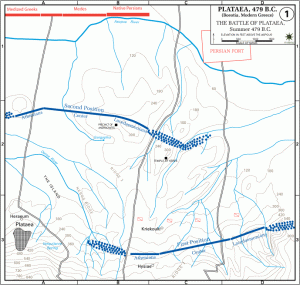
For the next eight days, the Greeks remained unwilling to abandon their favorable terrain, while Mardonius refused to attack. Instead, he sought to force the Greeks from the heights by attacking their supply lines. Persian cavalry began ranging in the Greek rear and intercepting supply convoys coming through the Mount Kithairon passes. After two days of these attacks, the Persian horse succeeded in denying the Greeks use of the Gargaphian Spring which was their only source of water. Placed in a perilous situation, the Greeks elected to fall back to a position in front of Plataea that night.
The Battle of Plataea
The movement was intended to be completed in the darkness as to prevent an attack. This goal was missed and dawn found the three segments of the Greek line scattered and out of position. Realizing the danger, Pausanias instructed the Athenians to join with his Spartans, however, this failed to occur when the former kept moving toward Plataea. In the Persian camp, Mardonius was surprised to find the heights empty and soon saw the Greeks withdrawing. Believing the enemy to be in full retreat, he gathered several of his elite infantry units and began pursuing. Without orders, the bulk of the Persian army also followed (Map).
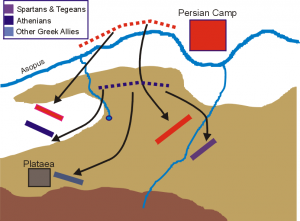
The Athenians were soon attacked by troops from Thebes which had allied with the Persians. To the east, the Spartans and Tegeans were assaulted by Persian cavalry and then archers. Under fire, their phalanxes advanced against the Persian infantry. Though outnumbered, the Greek hoplites were better armed and possessed better armor than the Persians. In a long fight, the Greeks began to gain the advantage. Arriving on the scene, Mardonius was struck down by slung stone and killed. Their commander dead, the Persians began a disorganized retreat back towards their camp.
Sensing that defeat was near, the Persian commander Artabazus led his men away from the field towards Thessaly. On the western side of the battlefield, the Athenians were able to drive off the Thebans. Pushing forward the various Greek contingents converged on the Persian camp north of the river. Though the Persians vigorously defended the walls, they were eventually breached by the Tegeans. Storming inside, the Greeks proceeded to slaughter the trapped Persians. Of those who had fled to the camp, only 3,000 survived the fighting.
Aftermath of Plataea
As with most ancient battles, casualties for Plataea are not known with certainty. Depending on the source, Greek losses may have ranged from 159 to 10,000. The Greek historian Herodotus claimed that only 43,000 Persians survived the battle. While Artabazus’ men retreated back to Asia, the Greek army began efforts to capture Thebes as punishment for joining with the Persians. Around the time of Plataea, the Greek fleet won a decisive victory over the Persians at the Battle of Mycale. Combined, these two victories ended the second Persian invasion of Greece and marked a turn in the conflict. With the invasion threat lifted, the Greeks began offensive operations in Asia Minor.
Source: thoughtco
Ask me anything
Explore related questions




