On May 29, 2019, with the anniversary of the Fall of Constantinople approaching, Turkish President Recep Tayyip Erdogan gave a municipal election campaign speech saying that Istanbul will never be called “Constantinople” again.
However, the Turkish President is probably unaware that even Istanbul is a name that the Greeks actually gave to the city. Specifically, “Istanbul” derives from the Greek phrase “Is tin poli,” which means “into the city.”
In fact, throughout the many centuries of its existence, Greeks had referred to Constantinople as simply “Polis” (City). When one was going to the Polis, they would say “Is tin Poli” — a phrase which morphed into the modern term Istanbul.
The great city was called Constantinople by the entire wider world until the 20th century. Although the Ottomans had unofficially called it Istanbul for years, the official name change took place in 1930, after the establishment of the modern Turkish Republic.
The history of Constantinople
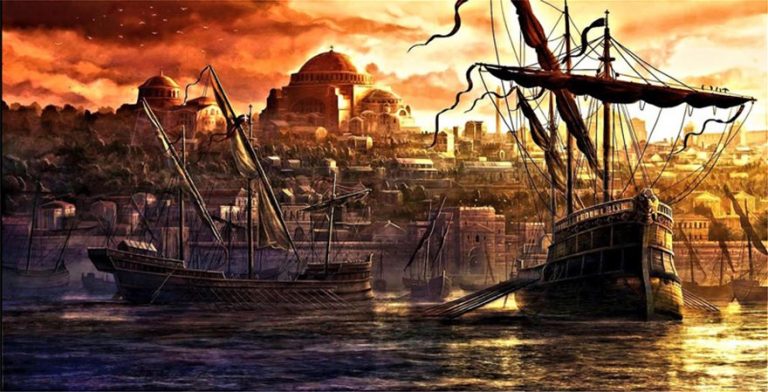
First settled in the seventh century BC, the city developed into a thriving port thanks to its prime geographic location between Europe and Asia, as well as its natural harbor. In 330 AD, it became the site of Roman Emperor Constantine’s “New Rome,” soon becoming a wealthy city with magnificent Christian architecture.
Constantinople stood as the seat of the Byzantine Empire for the next 1,100 years, enjoying great prosperity interspersed with a series of deadly sieges over the years, until it was conquered by Sultan Mehmed II of the Ottoman Empire.
In 657 BC, the ruler Byzas from the Greek city of Megara founded a settlement on the western side of the Strait of Bosporus, which linked the Black Sea with the Mediterranean Sea. Byzantium (or Byzantion) was born, quickly developing into a thriving port city.
In 324 AD, Constantine became the sole emperor of Rome and in 330 the city was established as Constantinople (the city of Constantine), also having other unofficial names such as the Queen of Cities, Istinpolin, Stamboul and Istanbul.
Greek was its spoken language and Christianity was its main religion.
The emperor Justinian I, who reigned from 527 to 565 AD, expanded Byzantium’s borders to encircle the Mediterranean Sea.
After the Great Schism of 1054, when the Christian Church split into Roman and Eastern divisions, Constantinople became the seat of the Eastern Orthodox Church, remaining so to this day, even after Muslim Ottoman rule was imposed there.
Greek Civil Protection Minister: We will build a fence at Evros to defend our interests
The original splendor of Byzantium was tarnished forever in 1204, when the armies of the Fourth Crusade, instead of saving Jerusalem from Muslim rule, instead sacked the great Christian city, and its inhabitants lived several decades under Latin misrule between the lords of Venice and their allies.
In 1261, the Byzantine Emperor Michael VIII Palaiologos liberated the city, and after its restoration under the Palaiologos dynasty, the Byzantine Empire recovered some of its glory.
That is, until May 29, 1453, when after a 53-day siege, Constantinople fell into the hands of the Ottomans.
For Greeks, it will always be Constantinople
Naturally, throughout history, Greeks never called Constantinople, “Istanbul.” This is partly due to the horror they felt since they knew that when Constantinople fell to the Ottomans on May 29, 1453, it meant the end of Byzantium, and subsequently Hellenism in the East.
It was the beginning of almost 400 dark years.
It is also partly because Greeks naturally feel nostalgic for the splendor that was the Byzantine Empire, which also helped further the spread of Orthodoxy all the way through Russia and today’s Balkan lands.
Another big part of the Greeks’ refusal to accept the name “Istanbul” for their beloved Polis is that since the 1920s the modern Turkish state has been an enemy of Hellenism and Greece itself.
Greeks can never forget the slaughter of Greeks in Smyrna in 1922, the burning of Constantinople’s Greek neighborhoods, the further persecution of Greeks in 1955, or the Turkish invasion and occupation of the northern part of Cyprus in 1974.
It is a wild dream of some Greeks that Constantinople will be Greek again and many speak of a “lost homeland.” In the hearts of the Greek people, the great cathedral of Hagia Sophia is still Greek.
And even though this is a dream that will never come true, no Greek will ever willingly call Constantinople, “Istanbul,” much like the vast majority of Greeks continue to call the Republic of North Macedonia Skopje, refusing to attach “the M word” in any way, shape or form to the Balkan country.
Source: Greek Reporter
Ask me anything
Explore related questions