

×
GreekEnglish

×
  • Politics
  • Diaspora
  • World
  • Lifestyle
  • Travel
  • Culture
  • Sports
  • Cooking
Saturday
20
Dec 2025
weather symbol
Athens 13°C
  • Home
  • Politics
  • Economy
  • World
  • Diaspora
  • Lifestyle
  • Travel
  • Culture
  • Sports
  • Mediterranean Cooking
  • Weather
Contact follow Protothema:
Powered by Cloudevo
> Science

Mystery of the disappearing star – how N6946-BH1 vanished without a trace!

The findings could shed light on the origin of supermassive Black Holes

Newsroom May 26 09:52

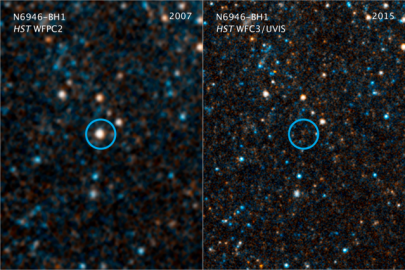
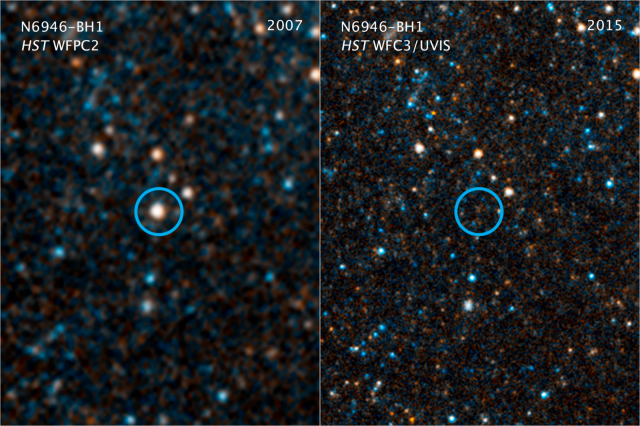
The star N6946-BH1 in a spiral formation 22 million light years away known as the ‘fireworks galaxy’, was last seen by Nasa’s Hubble Telescope in 2009. By 2015, it wasn’t there anymore.

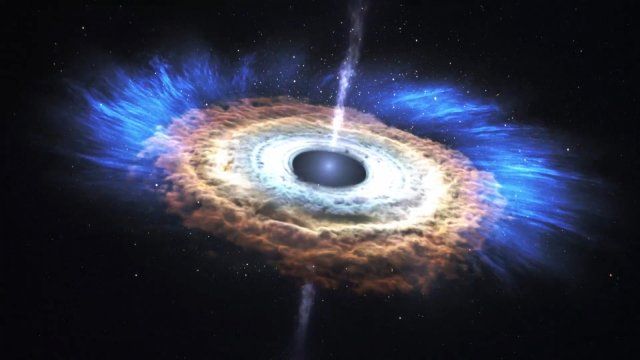
How did a star 25 times the size of our Sun simply wink out of existence? Such large stars often go out with a bang – a supernova – blasting off much of their remaining mass before collapsing to form an incredibly dense black hole.
s1


But this didn’t happen to N6946-BH1, according to a paper published in the Monthly Notices of the Royal Astronomical Society. There was a slight brightening around 2009 where the star expelled its outer layer in a gentle puff, but it wasn’t anywhere near bright enough to be a supernova.

The Hubble Telescope and the Spitzer Space Telescope were not able to detect the star when they looked with the same filters at this patch of space in 2015. One theory for what happened to it is that it formed a black hole directly without going through the usual process of a supernova first.

“The typical view is that a star can form a black hole only after it goes supernova,” said Christopher Kochanek of Ohio State University in a statement.

Although this contradicts current theories of the role of supernovas in forming black holes, it may be much more common than astronomers previously thought.
s3


“If a star can fall short of a supernova and still make a black hole, that would help to explain why we don’t see supernovae from the most massive stars.”

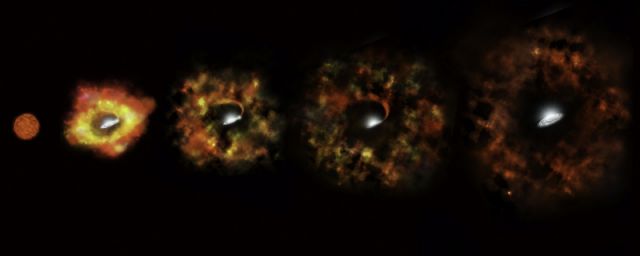
As such, the findings could shed light on the origin of supermassive black holes. Up to 30% of massive stars capable of a supernova could instead collapse to become a black hole without an explosion. Astronomers have dubbed this process a “massive fail”.

“N6946-BH1 is the only likely failed supernova that we found in the first seven years of our survey. During this period, six normal supernovae have occurred within the galaxies we’ve been monitoring, suggesting that 10 to 30% of massive stars die as failed supernovae,” said Scott Adams, a former Ohio State student.

However, another theory for what happened to the star is that it is in fact still there, shrouded in a cloud of gas. The miniature explosion noted in 2009 could have created a cloud that would hide it from instruments on Earth.
s2

>Related articles

Research: The BBC’s “first Black Briton” from the Roman era was ultimately…white and originated from southern England

The Greeks of Silicon Valley

Voyager 1 ready to make history again: in 2026 it will reach a distance of “one light-day” from Earth

But very little infra-red radiation was seen from the site where the star was. At least some radiation would be expected to seep through if N6946-BH1 was hiding behind a cloud.

Further observation of this region of space with Nasa’s Chandra X-ray Observatory could help to elucidate whether the star is really still there or not.

Source

Ask me anything

Explore related questions

#Black Holes#exoplanet#nasa#planets#science#stars#technology
> More Science

Follow en.protothema.gr on Google News and be the first to know all the news

See all the latest News from Greece and the World, the moment they happen, at en.protothema.gr

> Latest Stories

The Trump family invited to a Greek house in Davos – Contacts with Greek business leaders and a private dinner at the Cresta hotel

December 20, 2025

Chain reactions from farmers’ protests – Booking cancellations of up to 50% in Thessaly and Epirus

December 20, 2025

Tsiaras’ statement on farmers’ demands: 74% have already been met, dialogue is a matter of responsibility

December 20, 2025

Rare video shows Domna Samiou teaching Cretan Christmas carols

December 20, 2025

Weather: Rain and drop in temperatures over the weekend – Unstable conditions through Christmas

December 20, 2025

Farmers remain unmoved: Blockades continue through Christmas, toll booths open over the weekend

December 20, 2025

Payment and relief map for 2026: What applies to farmers, pensioners, tenants, landowners and employees

December 20, 2025

Ruthless cartel tactics: Cocaine hidden in tons of manure, submarines, and even rockets attached to passenger ships

December 20, 2025
All News

> Science

How was cancer treated in ancient Greece?

According to Galen, the most common types of cancer were the uterus and breast cancer found in women

July 11, 2018

Reptilian-mammal fossil changes the timeline of supercontinent breakup

May 25, 2018

Russia & US will cooperate to build moon’s first space station

September 28, 2017

Computer solves a major time travel problem

June 15, 2017

Why we can’t trust academic journals to tell the scientific truth

June 6, 2017
Homepage
PERSONAL DATA PROTECTION POLICY COOKIES POLICY TERM OF USE
Powered by Cloudevo
Copyright © 2025 Πρώτο Θέμα



