





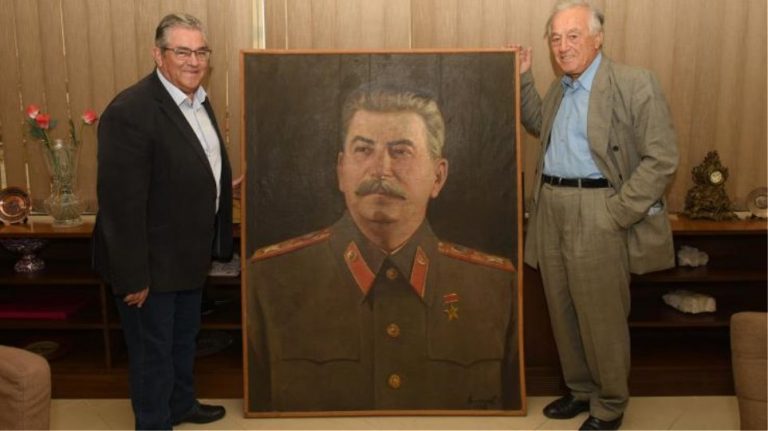
The Soviet Union suffered the greatest losses of any country as it fought the Nazis in World War II.
At the same time, Joseph Stalin’s regime attacked its own citizens, executing, incarcerating and exiling those it viewed as hostile. Here are some of the most striking statistics.
Tripling war toll
In 1946, Stalin said seven million had died in the 1941-1945 Great Patriotic War, as the conflict is known in Russia.
Stalin gave a massively understated figure that gained him kudos as a brilliant military strategist and heightened his cult of personality.
After Stalin’s death in 1953, his successor Nikita Khrushchev dismantled the personality cult and almost tripled the death figure to 20 million, blaming such huge losses on Stalin’s incompetence.
The last Soviet leader Mikhail Gorbachev opened up state archives for the first time, and historians came up with a new, even higher figure of 26.6 million deaths: 12 million among the military and 14.6 million among civilians.
One of the largest tolls came during the Siege of Leningrad from 1941 to 1942, when up to one million inhabitants of the city that is now Saint Petersburg died, lacking food and fuel in winter as they were encircled by Nazis.
The deadliest military engagement, the 1942-1943 Battle of Stalingrad, saw more than one million Soviet troops killed but proved a turning-point in the war.
‘Stalin’s samovars’
After the war, the cruel nickname for the many soldiers who had lost all four limbs was “Stalin’s samovars”, based on the shape of the traditional water heaters for tea.
The conflict left some 2.5 million people with life-long disabilities.
Hundreds of thousands had no one to care for them and were reduced to begging, fueling their resentment against the state.
In 1948, the state began organizing their removal from the public eye, putting them in former monasteries converted into sanatoriums in remote northern regions.
These institutions went on to incarcerate others on the margins, such as beggars or people with serious disabilities, whom Soviet officials wanted to hide from view.
Some of these institutions stayed open into the 1970s.
Who was the new Saint Kallinikos of Edessa
Executed for ‘defeatism’
More than 2.53 million Soviet citizens were convicted by military tribunals, including 1.43 million deserters and draft-dodgers.
Between 1941 and 1945, more than 175,000 people were executed for espionage, treason, desertion or “defeatism”.
Almost 80 million in the USSR and in the Baltic states that had been forcibly incorporated into it found themselves living under Nazi occupation.
A total of 1.24 million of these served in the German army, including 400,000 Russians, 250,000 Ukrainians, 150,000 Latvians, 90,000 Estonians and 70,000 Belarusians, said historian Viktor Gavrilov, a researcher at the Military Academy of the Russian General Staff.
Punishing peoples
From 1941 to 1942, Stalin decided to uproot minority ethnic groups he suspected of being “potential collaborators” from their long-standing homelands.
He started with the ethnic German community in Russia that had settled mainly around the River Volga and numbered more than 800,000. They were taken by train in cattle cars to Kazakhstan.
Then it was the turn of the Greeks, the Finns and others.
From 1943 to 1944, as the Soviets pushed back the German army, Stalin began forcibly removing dozens of other ethnic groups — among them Chechens, Ingush and Crimean Tatars — and sending them to live in the inhospitable steppes of Kazakhstan, Kyrgyzstan and Siberia.
Altogether, some 1.2 million people were moved to remote regions with no means of subsistence.
They were accused of collaborating with the Nazis, often with no evidence. The Soviet authorities welcomed the opportunity to break up communities with strong ethnic identities and at the same time move settlers into the immense uninhabited desert regions.
After Stalin’s death, the authorities officially exonerated them of any crime.
Source: AFP
Ask me anything
Explore related questions




