
×
GreekEnglish

×
  • Politics
  • Diaspora
  • World
  • Lifestyle
  • Travel
  • Culture
  • Sports
  • Cooking
Wednesday
11
Feb 2026
weather symbol
Athens 11°C
  • Home
  • Politics
  • Economy
  • World
  • Diaspora
  • Lifestyle
  • Travel
  • Culture
  • Sports
  • Mediterranean Cooking
  • Weather
Contact follow Protothema:
Powered by Cloudevo
> Culture

Study: Kalash people are not the descendants of Alexander the Great

New research has found that there are stronger links with Siberian hunter-gatherers than Greeks

Newsroom June 2 11:15

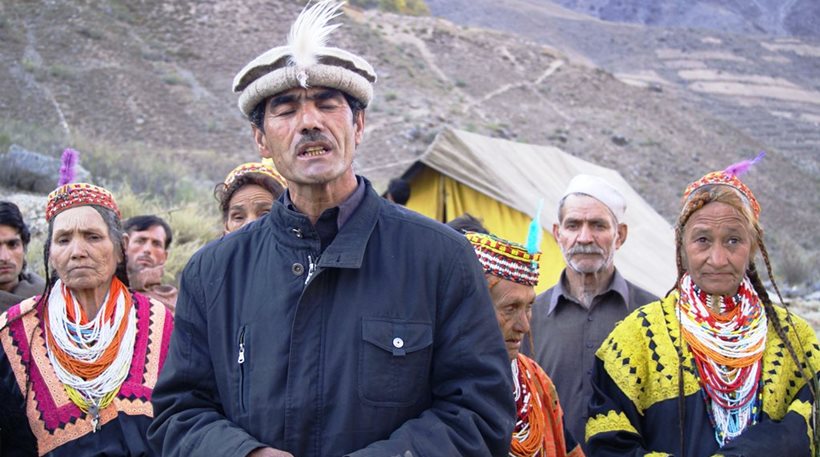
The Kalash people – the blonde-haired and blue-eyed tribe of Pakistan – claim to be the direct descendants of Alexander the Great, however extensive genetic testing has shown no connection.

DNA testing on 23 Kalash people by the Wellcome Trust Sanger Institute of Cambridge took samples from Kalash residents of three different valleys but could not confirm Greek lineage.
KALAS

>Related articles

“Astoria”: The new major production of the Pallas Theatre on Greek migration to New York

Barbara Kruger: Renowned American artist creates works in Greek

Lina Mendoni: Speech at UNESCO for the first anniversary of World Greek Language Day

According to the abstract compiled by researchers from the UK, Italy and Pakistan, with Qasim Ayub at the helm, there is nothing to support their claim to being Greek:

The Kalash represent an enigmatic isolated population of Indo-European speakers who have been living for centuries in the Hindu Kush mountain ranges of present-day Pakistan. Previous Y chromosome and mitochondrial DNA markers provided no support for their claimed Greek descent following Alexander III of Macedon’s invasion of this region, and analysis of autosomal loci provided evidence of a strong genetic bottleneck. To understand their origins and demography further, we genotyped 23 unrelated Kalash samples on the Illumina HumanOmni2.5M-8 BeadChip and sequenced one male individual at high coverage on an Illumina HiSeq 2000. Comparison with published data from ancient hunter-gatherers and European farmers showed that the Kalash share genetic drift with the Paleolithic Siberian hunter-gatherers and might represent an extremely drifted ancient northern Eurasian population that also contributed to European and Near Eastern ancestry. Since the split from other South Asian populations, the Kalash have maintained a low long-term effective population size (2,319-2,603) and experienced no detectable gene flow from their geographic neighbors in Pakistan or from other extant Eurasian populations. The mean time of divergence between the Kalash and other populations currently residing in this region was estimated to be 11,800 (95% confidence interval = 10,600-12,600) years ago, and thus they represent present-day descendants of some of the earliest migrants into the Indian sub-continent from West Asia.

The examination of DNA shows that the Kalash community has more in common with Siberian hunter-gatherers than Alexander the Great.

Ask me anything

Explore related questions

> More Culture

Follow en.protothema.gr on Google News and be the first to know all the news

See all the latest News from Greece and the World, the moment they happen, at en.protothema.gr

> Latest Stories

Chris Hemsworth on his marriage proposal to Elsa Pataki: “There was a kind of ‘I don’t have anything better to do right now vibe’

February 11, 2026

The Greek State in the markets: Re-issue of 10-year bond with a fixed interest rate of 3.375%

February 11, 2026

Two-thirds of Germans consider the US a threat to world peace

February 10, 2026

Financial assistance of €391 from OPEKA: Terms, rights, and beneficiaries

February 10, 2026

Greek Air Force squadron leader remanded in custody on espionage charges for China

February 10, 2026

Ministry of Education and its proposals for the new upper secondary school and the school-leaving certificate: Reduced curriculum and fewer exam subjects for 12th Grade

February 10, 2026

The first 11 ELTA branches will close from 20 February, and how citizens will be served

February 10, 2026

Signatures with Chevron for Hydrocarbon exploration in Crete and the Peloponnese on February 16

February 10, 2026
All News

> Culture

“Astoria”: The new major production of the Pallas Theatre on Greek migration to New York

From March 19 at the Pallas Theatre, the play Astoria tells the story of Greek migration and the lives, struggles, and dreams of Greeks who found refuge in New York

February 10, 2026

Barbara Kruger: Renowned American artist creates works in Greek

February 9, 2026

Lina Mendoni: Speech at UNESCO for the first anniversary of World Greek Language Day

February 9, 2026

CT scans reveal the faces, diseases, and secrets of two 2,000-year-old Egyptian mummies

February 8, 2026

Vinyl records make a comeback: Record stores return as an aesthetic choice, not just nostalgia

February 7, 2026
Homepage
PERSONAL DATA PROTECTION POLICY COOKIES POLICY TERM OF USE
Powered by Cloudevo
Copyright © 2026 Πρώτο Θέμα