





The Shocking Story of How the Navy Snatched A Dead Russian Submarine From the Bottom Of the Ocean
Key point: While the idea of finding a missing submarine in the Pacific Ocean, even when they had a general idea of where to search, proved so daunting to the Soviets that they’d ultimately given up looking, Bradley was fairly optimistic. He had a better way of locating it.
For the better part of two weeks, the world has watched, in hope and horror, as 13 countries embarked on a frantic search for the ARA San Juan, the Argentine sub that went missing on Nov. 15 with a crew of 44 aboard. It’s almost certain now that all hands have been lost, and it could be weeks or months before we know what caused the sub to sink. The first challenge is to locate it.
The ARA San Juan is first submarine to be lost at sea since the Kursk, which sank after an accident in 2000, causing the loss of 100 Russian lives. The remarkable string of safe patrols in the years since helped us all forget that submarine duty is one of the most perilous peacetime jobs in the armed forces. It’s certainly not something that any submariner takes for granted.
This article first appeared in 2017.
For as long as they’ve had submarines, the world’s navies have worried about losing them — and especially about how best to find them when they’re lost, ideally soon enough that a crew rescue is still possible.
Much of the technology and strategy deployed in sub-search and rescue today can be traced back to 1963, when the USS Thresher was lost at sea during routine deep-diving tests off of Massachusetts. The loss of that state-of-the-art submarine, and her crew of 129, sent a shockwave through the US Navy’s submarine program, leading to the creation of numerous deep sea programs that continue to this day.
Many of them were put to the test in 1968, the worst-ever peacetime year in submarine history. Four boats were lost in 1968, including the USS Scorpion and the Soviet Union’s ballistic missile boomer K-129, which the Soviets never did locate — until the United States handed them the wreck’s location six years later.
How did the United States find it? Credit Project Azorian, a massive top-secret CIA mission to salvage the wreck. The six-year effort cost a half-billion dollars, and involved some of the U.S. Navy’s most impressive tools, many of them still classified. It was arguably the single most impressive feat of naval engineering in history.
The hunt for the Soviet sub is the subject of journalist Josh Dean’s gripping new book, The Taking of K-129: How the CIA Used Howard Hughes to Steal a Russian Sub in the Most Daring Covert Operation in History. Here, an excerpt:
February 1968
The Soviet nuclear ballistic missile submarine K-129 left Petropavlovsk, on Russia’s remote, frigid Kamchatka peninsula, with a crew of ninety-eight after dark on February 24, 1968, for a routine but unexpected patrol. No external markings signified the sub’s name, and even its hull number was painted over so that it would be unrecognizable to any ship that happened to notice it when it surfaced to gulp air and run the diesel motors that recharged its onboard batteries.
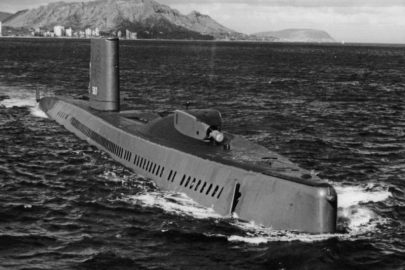
The Golf-class sub, which the Soviets called by its side number, PL-574, was under the command of an ascendant thirty-eight-year-old Ukrainian captain first rank named Vladimir Kobzar, who was leading his final mission aboard the boat he’d commanded for four years. When the submarine returned to its home base, Kobzar would move to Soviet fleet headquarters, to assume a more senior position commanding multiple subs from a desk.
Kobzar was one of the most experienced captains in the fleet, a rigorous, demanding man so highly regarded that many in the submarine service thought he might one day command the entire fleet. He had been given the Order of the Red Star for excellent service and was being rewarded for his four years at sea with a promotion that was certain not to be his last. Kobzar was loved by his crew and respected by his superiors, who noted how he personally helped train watch officers, oversaw survival training, and could capably handle any job on the sub. He had a question he liked to repeat to men under his command: “Who is the most dangerous man on a submarine? The one who doesn’t know what he’s doing!”
Read more HERE
Ask me anything
Explore related questions




