





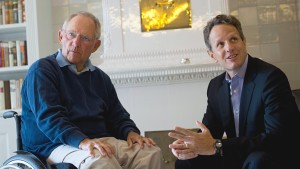
The former U.S. Treasury Secretary Timothy Geithner describes in his book the background of the debt crisis in the Eurozone. According to his book, German Finance Minister, Schaeuble, believed that Greece should be expelled from the Eurozone as he was sure that if Europeans let Greece burn, it would be easier to build a stronger Europe.
Geithner himself saw behind the scenes of the Eurozone debt crisis and he tried honestly to help along with President Barack Obama, who called many times Chancellor Angela Merkel. But unfortunately they did not manage to convince her and deal seriously and effectively the debt crisis, as it is mentioned on mignatiou.com.
Mr. Geithner describes his meeting with Mr Schäuble in July 2012 in the Sylt resort, North Sea, where he chose to meet him as the American minister was very worried about the developments and the lack of determination of Europeans to tackle the crisis. Mr. Schäuble was not in the mood for talking, although he answered to the questions and participated in the dialogue with his U.S. counterpart.
He told me, Mr. Geithner writes in his book, that there are too many people in Europe who continue to think that it is reasonable, and even desirable, to “kick” Greece out of the Eurozone. The “plan” presented by the German minister, provided basically that if Greece was expelled from the Eurozone, Germany would be able to offer the help that Eurozone needed, because German people would not consider this as a rescue aid for Greeks.
At the same time, Mr. Geithner writes describing his conversation with Mr Schaeuble, Greece’s exit from the Eurozone would have been so traumatic that it would have helped to scare the rest of the Europe. So, Europe would have been forced to grant more powers and flexibility so as to build a stronger banking and monetary union. “The argument was that letting Greece burn, they would be able to build easier a stronger Europe with a more credible firewall” Mr. Gkaithner notes and adds:
“I found this argument very scaring. Letting Greece out of the Eurozone would create a dramatic crisis of confidence regardless of what Europeans will commit to do afterwards. I had no clear idea why German voters who hated the rescue of Greece, would feel better by saving Spain, Portugal or any other country.” Mr. Geithner writes.
On his way back to US, he stopped first in Frankfurt where he met Mario Draghi, president of the ECB. Mr Draghi just recognized how bad the situation was and it seemed that he knew that the ECB had to find a solution.
Mr. Geithner mentions that President Barack Obama, other U.S. government officials and himself were talking very often with Europeans. Although some considered this interest as an “invasion”, they were welcoming them at the same time to express this interest. We were regularly asked to intervene with Mrs Merkel so as to be less stingy and with Italian and Spanish people to be more responsible.
In Washington, the then Treasury Secretary visited President Barack Obama and said “I am really worried” and Mr. Obama replied, “I know, me too”. As Mr. Gkaithner reports to his book, they were both concerned about the American economy, which “continued to grow steadily, but cautiously. A European collapse could have hit us leading to a new recession, or even a new financial crisis”.
Ask me anything
Explore related questions




