





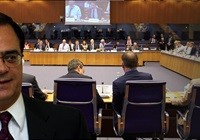
Greek Finance Minister Gikas Hardouvelis attended his first Eurogroup meeting yesterday in Luxembourg since joining the government in a cabinet reshuffle. The meeting with his European counterparts was a “baptism of fire” with concern expressed by Economic and Monetary Affairs Commissioner Olli Rehn that Greece was veering off its economic reform path and slowing down in reforms.
Mr. Hardouvelis assured his counterparts that he is committed to the country’s reform, however both Mr. Rehn and German Finance Minister Wolfgang Schäuble made it clear that no more installments would be forthcoming if Greece doesn’t adhere to agreements made. Nonetheless, Mr. Schäuble did recognize progress made by Greece prior to entering the meeting. “We should show respect for teh fact that Greece continues to make tough domestic decisions,” he said, adding certainty that Greece will move forward if it continues on the path of recent years without wavering.
Athens missed its task of reaching six milestones in May and another six in June which would each trigger the release of 1 billion euros from its 240-billion-euro international bailout. They broadly cover reforms to the tax, labour and healthcare systems; changes to the transport sector; social security reforms; and an opening up of closed professions.
Following the Eurogroup meeting, Eurogroup President Jeroen Dijsselbloem said that the new Greek Finance Minister informed the Eurogroup that the Greek authorities would meet the six milestones by the end of June, in order to secure the disbursement of the next loan tranche, worth 1 billion euros. He added that he was reassured by Hardouvelis that the new secretary general of public revenues would be chosen with transparency.
European Stability Mechanism managing director Klaus Regling reiterated that the 2 billion euros would be disbursed to Greece after the prior actions were completed, adding they had not yet been so. The European Financial Stability Facility has disbursed 139.9 billion euros to Greece so far, he said, which left 3.8 billion euros outstanding.
International Monetary Fund (IMF) managing director Christine Lagarde said it was necessary to establish the amount the Greek banks would need for their recapitalization. The IMF needs to know which percentage of the 10 billion euro available for the recapitalization would be needed, in order for the Fund “to complete Greece’s financing needs.”
The Eurogroup president said on the same issue that the amount should be determined during the troika of Greece’s lenders current (fourth) review of Greece’s fiscal adjustment programme, in order to allow the fifth review to begin after the end of the summer. “We still have work to do,” he commented.
Ask me anything
Explore related questions




