





It’s called “Athena” and it will be the largest X-ray space telescope ever built. It has a length of 12 meters and a weight of about five tonnes. It will be ready for launch in 2028.
The European Space Agency (ESA) announced today that during the meeting of the scientific programs committee in Toulouse, it decided to proceed with the implementation of the aforementioned program, which will have a budget of over one billion euros.
The new satellite observatory, fully named “Advanced Telescope for High-Energy Astrophysics” (acronym: “ATHENA”) will give a significant boost to high-energy astrophysics, including helping to answer questions such as how and why ordinary matter creates galaxies and how black holes are formed in the center of galaxies.
“Athena” will be observing the X-ray emissions from very hot matter, right before it is “swallowed up” by a black hole. Also, thanks to sophisticated scientific instruments, the new telescope will study other extreme events, such as powerful gamma-ray bursts.
Today, in the field of X-ray astronomy, Europe has the “XMM-Newton” telescope, and “Athena” will ensure the continuity and progress of research. The U.S. has X-ray telescope “Chandra” but “Athena” will be 100 times stronger than what already exists.
The telescope which is under construction and under the care of the Max Planck Germany Institute of Extraterrestrial Physics, will be placed at a distance of approximately 1.5 million km from Earth, at the Lagrange 2 point (L2).
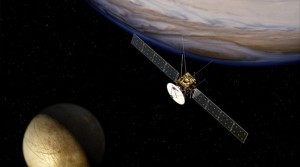
Europe continuously intensifies its scientific space investigations. Recent, it launched “Gaia” which will map the stars of the sky. “BepiColombo” will follow in 2016, in cooperation with Japan, which will study Mercury, while the “Juice” mission will take place in 2022 which ambitiously will attempt to reach Jupiter and its satellites and study them.
After the launch of “Athena” in 2028, it is likely that a trio of satellites (Lisa) designed to detect gravitational waves in space, will be the next project.
Ask me anything
Explore related questions




