

×
GreekEnglish

×
  • Politics
  • Diaspora
  • World
  • Lifestyle
  • Travel
  • Culture
  • Sports
  • Cooking
Sunday
05
Apr 2026
weather symbol
Athens 17°C
  • Home
  • Politics
  • Economy
  • World
  • Diaspora
  • Lifestyle
  • Travel
  • Culture
  • Sports
  • Mediterranean Cooking
  • Weather
Contact follow Protothema:
Powered by Cloudevo
> Culture

The Guardian: The top 10 ancient Greek artworks

"Ancient Greek art is majestic, vital and full of high drama"

Newsroom August 19 11:20

A feature article published by The Guardian focuses on ancient Greek art and especially on ten exquisite artworks that stand out due to their originality and artistic quality.

Jonathan Jones, who writes on art for The Guardian and was on the jury for the 2009 Turner prize presents ten Greek masterpieces, from rare bronzes found in the sea to goddesses that proved a millennium ahead of their time.

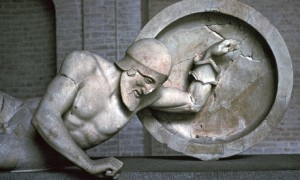
Fallen Warrior from Temple of Aphaia (c 480-470BC)

“There is a tragic pathos to this mighty sculpture of a dying hero from a temple on the Greek island of Aegina,” states the columnist. This pathos is reminiscent of the tragedies of Sophocles, Euripides and Aeschylus which are still performed around the world.
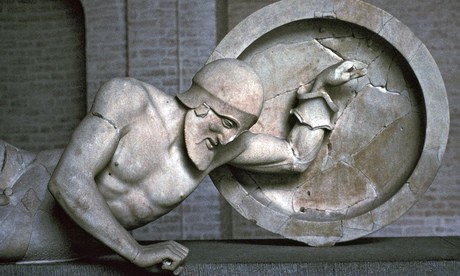
Sculpture of a fallen warrior from the Greek temple of Aphaia at Aegina, 6th century BC.

The Pergamon altar (180-160BC)

As the article underlines, classical Greek art became much more emotional, sensual and even sensationalist in what is called the Hellenistic age. The furious sculptures on the Pergamon altar – which can be seen in its own museum in Berlin – are full of passion and psychological drama.
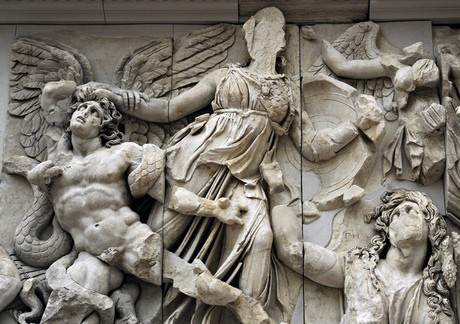
Pergamon Altar. Athena against the giant Alcyoneus.

The Riace bronzes (460-420BC)

These magnificent statues found in the sea off southern Italy in 1972 are extremely important because so few original Greek bronze statues survive. Most of the classical nudes were carved in marble in the Roman era, as reproductions of such rare originals.
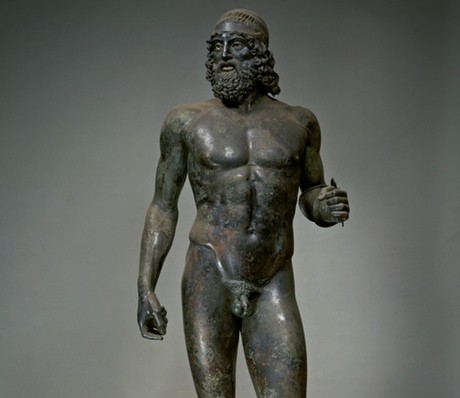
One of the two Riace bronzes: the Warrior

Goddesses from the east pediment of the Parthenon (c 438-432BC)

“Sitting and reclining in graceful unison, these goddesses carved in marble for the Parthenon in Athens are among the most beautiful and mysterious images of the human form ever created,” states Jonathan Jones.
Marble metope from the Parthenon (c 447-438BC)
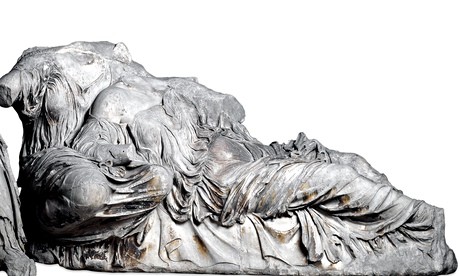
Three goddesses from east pediment of the Parthenon
Marble metope from the Parthenon (c 447-438BC)

Violence is a favorite theme of ancient Greek artists. Inspired by the myth of the Trojan war and experiencing the reality of wars with Persia and between Greek cities, classical artists found new, realistic ways to show conflict. This human fighting a centaur, carved for the Parthenon in Athens, is full of dynamic energy.\

Metope from Parthenon, battle between Centaurs and Lapiths

God from the sea, Zeus or Poseidon (c 470BC)

“This majestic bronze, found in the sea off Greece, conveys the magic of Greek mythology,” says the columnist. The god , who is probably Zeus, lord of Olympus himself, is caught in the act of hurling a thunderbolt. His body is charged with divine power, and yet, it is a human body, the mirror of ourselves.
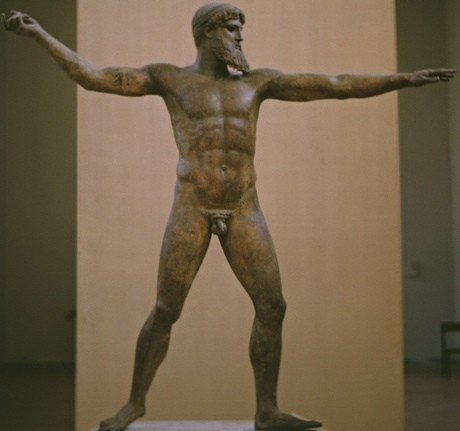
A bronze sculpture of the god Zeus, or possibly Poseidon

The Siren vase (480-470BC)

This powerful painting captures the tension as Odysseus strains at his bonds, trying to resist the seductive yet dangerous song of the sirens that lure sailors to their deaths.
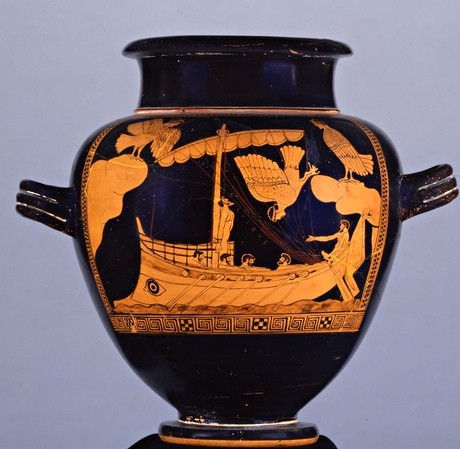
The Siren Vase

The Motya charioteer (c 350BC)
This is one of the most impressive Greek statues to survive. This youth is not technically nude, but wears a tight-fitting garment that instead of hiding his body, heightens every contour.
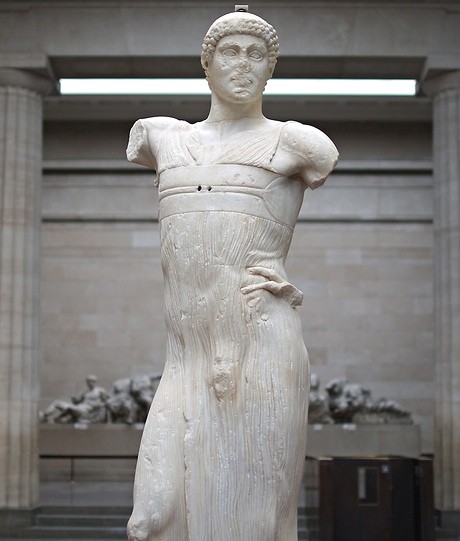
The Motya Charioteer

The Dionysus Cup by Exekias (c 540BC)

Dionysus, god of wine and madness, sails on his boat, surrounded by dolphins, in this delightful painting.
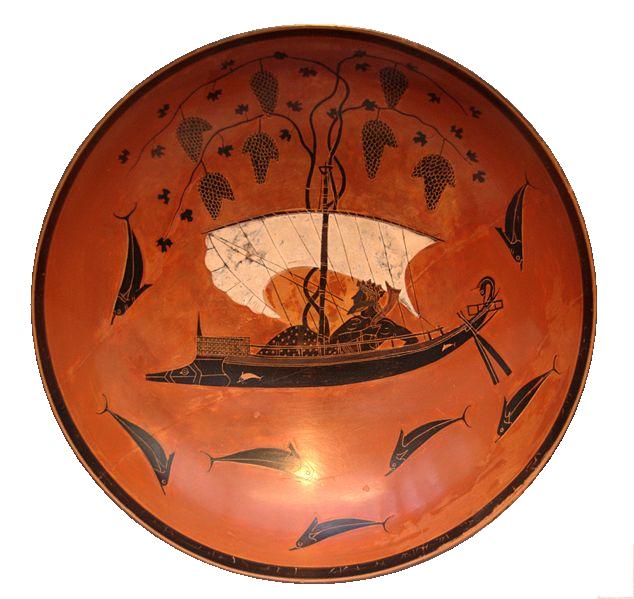
Exekias_Dionysos_white

>Related articles

Easter in Athens: Concerts, theatre and activities – where to go

Maria Callas: Nikos Floros’ monumental sculpture travels to the São Paulo Opera

At Kifissia Cemetery, in a close circle and to the sounds of her favorite songs, the curtain fell for Marinella

Mask of Agamemnon (1550-1500BC)

When archaeologist Heinrich Schliemann discovered this golden mask at Mycenae in 1876, he had no doubt that it must be the death mask of Agamemnon himself, the king who led the Greeks in the Trojan war. Of course there’s no proof of that, but it is one of the most compelling faces in art.
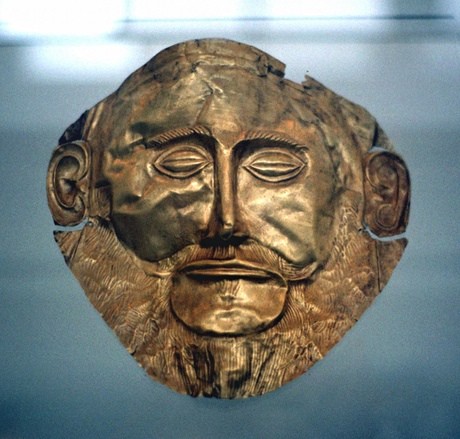
Agamemnon, king of Mycenae. Gold funerary mask

Ask me anything

Explore related questions

> More Culture

Follow en.protothema.gr on Google News and be the first to know all the news

See all the latest News from Greece and the World, the moment they happen, at en.protothema.gr

> Latest Stories

“We neutralized Iranian military leaders in a bombing in Tehran,” Trump claims – Three dead from strikes in Iran, fires in buildings in Kuwait

April 5, 2026

Easter in Athens: Concerts, theatre and activities – where to go

April 5, 2026

Weather: Rain and possible hail at midday, where phenomena will occur

April 5, 2026

Store opening hours today (5/4): What applies to supermarkets and shops ahead of Easter 2026

April 5, 2026

Balcony collapses in Corinth, killing woman and injuring her children – How the tragedy happened

April 4, 2026

Weather: Rain and thunderstorms today, significant temperature drop after Holy Thursday

April 4, 2026

5,400 doctors have left Greece in the past five years – What their top destination country is

April 4, 2026

OPEKEPE: Papakosta’s falsification over… cattle deemed a felony – What the European Public Prosecutor’s findings say about Karamanlis and Livanos

April 4, 2026
All News

> Politics

OPEKEPE: Papakosta’s falsification over… cattle deemed a felony – What the European Public Prosecutor’s findings say about Karamanlis and Livanos

Interventions by the MP for Trikala are attributed to influence OPEKEPE and veterinarians so that livestock farmers in her constituency would receive illegal subsidies – No direct communication between Karamanlis and OPEKEPE – Livanos reportedly said that the Serres MP’s office was requesting payments for producers

April 4, 2026

The background with the reshuffle for OPEKEPE: The messages from Mitsotakis, the ministerial appointment of Schinas, Tourna, and Lazaridis

April 3, 2026

Athanasiou on OPEKEPE: I asked for restoration of injustice to a farmer; there was no illegal act

April 3, 2026

Cabinet reshuffle 2026: Schinas and Lazaridis at the Ministry of Agricultural Development, Tournas at Civil Protection

April 3, 2026

Reshuffle at 12:30: Kefalogiannis, Tsiaras, Vartzopoulos and Kellas out – Schinas, Lazaridis and Tournas enter the government

April 3, 2026
Homepage
PERSONAL DATA PROTECTION POLICY COOKIES POLICY TERM OF USE
Powered by Cloudevo
Copyright © 2026 Πρώτο Θέμα



