





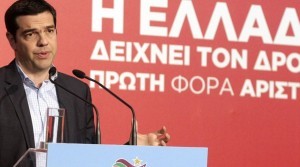
Former German FM Joschka Fischer, whose European leftist credentials are more-or-less without question, delves into the “could have”, “should have” debate swirling around Greece’s ruling SYRIZA party, given that the Greek government appears to have entered the “final stretch” in negotiations to clinch at least a bailout plan extension.
Fischer’s article, in the Huffington Post, reads:
“One can only feel sorry for Greece. For more than five years, the “troika” (the European Commission, the European Central Bank, and the International Monetary Fund) has made it the object of a failed experiment with austerity that has exacerbated the country’s economic crisis. And now Prime Minister Alexis Tsipras’s government seems hell-bent on plunging Greece into the abyss.
It never had to be this way. By the time Tsipras’s leftist Syriza party came to power in January, a new, more growth-oriented compromise had become possible. Even hardcore German proponents of austerity — and certainly Chancellor Angela Merkel — had begun to reconsider their position, owing to their policy prescriptions’ undeniable adverse consequences for the euro and the stability of the European Union.
The Tsipras government, with some justification, could have presented itself as Europe’s best partner for implementing a far-reaching program of reform and modernization in Greece. Measures to compensate the poorest met with considerable sympathy in EU capitals, and favorable sentiment would have strengthened had Greece started to cut its bloated defense budget (as a leftist government might have been expected to do).
But Tsipras squandered Greece’s opportunity, because he and other Syriza leaders were unable to see beyond the horizon of their party’s origins in radical opposition activism. They did not understand — and did not want to understand — the difference between campaigning and governing. Realpolitik, in their view, was a sellout.
Of course, it is precisely the acceptance of necessity that marks the difference between government and opposition. An opposition party may voice aspirations, make promises, and even dream a little; but a government party cannot remain in some imaginary world or theoretical system. And the dreamier an opposition party’s promises are, the bigger the challenge of narrowing the gap with reality if, like Syriza, it actually wins an election and comes to power.
Indeed, Tsipras seems to have forgotten the Marxist tradition’s emphasis on the dialectical unity of theory and practice. If you want to negotiate a change of tack with your creditors, you are unlikely to succeed if you destroy your own credibility and rant and rave about those whose money you need to avoid default. That, at least, is the lesson most of us have learned from theory and practice (also known as life).
But Syriza’s inability to escape its radical bubble does not explain why it formed a coalition with the far-right Independent Greeks, when it could have governed with one of the centrist pro-European parties. I hope that they do not share policy priorities, particularly a change of strategic alliances, which would be equally bad for Greece and for Europe. But two steps by Tsipras soon after he took office have heightened my skepticism: his flirtation with Russian President Vladimir Putin, and his attempt to isolate Germany within the eurozone, which never could have worked.
Within Europe’s monetary union, a consensus has been established that everything possible must be done to keep Greece inside. But Greece’s government needs to understand that other eurozone members will not be willing to accommodate its demands if it means delegitimizing their own painful reforms. More important, with the clock ticking on default (which could come as early as July), the Greek authoritiesneed to persuade their partners through action, not promises.
A disorderly Greek exit from the euro — currently the greatest danger — can be averted only if both sides operate on the assumption that the upcoming negotiations are not about who wins and who loses. This will be not be easy: all sides face significant domestic pressure, and any compromise will leave everyone with some explaining to do back home. But even if there were no troika and no monetary union, Greece would urgently need far-reaching reforms to get back on its feet. What it also needs is time and money, which the EU should provide if, and when, the Greek authorities face up to reality.
But others in Europe need to abandon their illusions as well. The Greek crisis cannot be used either to weaken European conservatives and change the balance of power within the EU, or to remove the Greek left from office.
The current crisis and the negotiations to resolve it are about only one thing: Greece’s future within Europe and the future of the joint European project. To help Greece get back on its feet and keep it in the eurozone is in Europe’s interest, both politically and economically. But any agreement on how that is to be achieved now requires Greece to prove that it shares the same goal.”
Ask me anything
Explore related questions




