





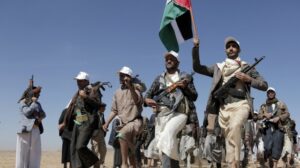
Although the fighting that has unfolded in Yemen in recent weeks and the Houthi attacks on Saudi Arabia have not attracted the same international attention as the hostilities between the United States, Israel and Iran, the conflict that has opened up in this part of the Middle East is particularly bloody and unpredictable.
Houthi strikes on Riyadh and attacks targeting civilian infrastructure, including airports, have killed at least 12 people and injured hundreds. These developments are now calling into question the “red lines” that until recently defined the limits of military escalation.
The Iran-backed group’s continued attacks represent an extremely dangerous gamble that does not serve its own interests. Despite knowing that retaliation could be severe, the Houthis continue to strike Saudi Arabia as part of Tehran’s strategy to heighten tensions ahead of the US midterm elections.
With the conflict showing signs of further escalation, two main scenarios are emerging: a large-scale regional military operation against the Houthis, or a prolonged war of attrition with no clear winner.
Scenario one: A united regional front against the Houthis
In response to the escalating attacks, Saudi Arabia is seeking to secure the broadest possible international support while strengthening its regional and international alliances.
Riyadh’s objective is to establish a united front capable of confronting the Houthis, who are now regarded as a threat to the wider security of the Middle East.
Saudi Arabia’s leadership is expected to turn first to its Gulf neighbours, which are also affected by the conflict. In this context, a growing consensus is emerging that the threat is not limited to Saudi Arabia but extends to all countries in the region.
Under these circumstances, Gulf states, possibly with the exception of Oman, are expected to support Riyadh, either directly or indirectly, in military operations in Yemen.
The role of Turkey and Pakistan – The Mecca agreement
Turkey and Pakistan could play an important role in any potential regional alliance. Both countries have signed a defence agreement with Saudi Arabia known as the “Mecca Pact”.
The agreement is expected to be ratified by the Turkish parliament in the coming days, paving the way for the possible deployment of Turkish military forces to support Saudi Arabia.
Meanwhile, the indirect involvement of both Turkey and Pakistan, through logistical support and intelligence-sharing, is believed to be already under way.
The possibility of US military intervention is also on the table. Recent statements by Donald Trump, in which he blamed Houthi attacks for rising energy prices, may have been intended to “justify” possible US involvement. However, such a development is considered less likely before the US midterm elections, as American voters remain opposed to Washington becoming involved in new military operations in the Middle East.
The goal: Recapturing the western coast and potentially Sana’a
The creation of a broader regional coalition could strengthen the counteroffensive already launched by forces loyal to Yemen’s internationally recognised government.
Such an alliance could provide the necessary impetus to retake the country’s western coastal areas, including territory beyond the strategically important Bab al-Mandab Strait and Dhubab.
Recapturing these areas could reduce threats to shipping in the Red Sea and shift the military balance in favour of the government.
At the same time, opening new fronts in other Yemeni cities and provinces would force the Houthis to disperse their forces and resources, increasing the likelihood of further advances by government troops.
Under this scenario, even the recapture of the capital, Sana’a, could become a feasible military objective.
The main obstacle, however, remains the internal divisions among the various factions within the internationally recognised government.
According to the analysis, these disputes are being exacerbated by detrimental external interference, which deepens divisions and weakens the collective effort to confront the Houthis.
Recent government measures aimed at unifying decision-making and centralising military command have already produced visible results on the battlefield.
Nevertheless, achieving the ultimate goal of recapturing Sana’a would require sustained effort and continued commitment to the military strategy.
The possibility of negotiations with the Houthis
If government forces manage to make significant territorial gains, the Houthis may be forced to offer concessions in exchange for a temporary cessation of hostilities.
The group has adopted a similar tactic in the past. However, the assessment is that such a move would not necessarily be intended to secure lasting peace. Instead, it could be an attempt to buy time to regroup its forces and resume operations at a later stage.
Scenario two: A prolonged war of attrition with no winner
The second scenario involves a protracted conflict if the Saudi-led coalition and the Yemeni government fail to overcome their internal divisions.
In such circumstances, a lack of coordination could slow operations against the Houthis, allowing them to maintain their positions and intensify their attacks.
The rebels could increase pressure on the strategically important city of Taiz while continuing strikes against civilian targets in Saudi Arabia. Such a development would further complicate the war, increase civilian casualties and trigger new waves of displacement.
The conflict could also drag on for a considerable period, with neither side able to secure the gains it seeks.
The economic consequences for Saudi Arabia and the Gulf
A prolonged war of attrition would have significant economic consequences for Saudi Arabia. Riyadh would be forced to prioritise defence spending, making it more difficult to achieve its development objectives.
The negative effects would extend to the other Gulf economies, given Saudi Arabia’s central role in the region.
Furthermore, military successes by the Houthis could contribute to the continuation of the crisis in the Strait of Hormuz, prolonging disruptions to energy exports from the region.
Continued instability along maritime trade routes would have wider repercussions for global energy markets, transport and international trade.
Why Iran could emerge as the winner
In a prolonged war of attrition, Yemen could find itself in a stalemate with neither winners nor losers.
Iran, however, could be the main beneficiary of such an outcome.
The continuation of the conflict along the Red Sea coast would give Tehran valuable time, allowing it to ease the pressure it faces on its own fronts.
At the same time, Iran could use the Houthis as a bargaining tool in its intermittent talks with the international community.
This would give Tehran greater room to raise its demands and impose tougher terms in negotiations.
Why the siege of Taiz could determine the course of the war
The front that has opened up in Taiz is crucial to the future course of Yemen’s civil war.
In recent weeks, the Houthis have encircled the country’s third-largest city, cutting off the main road linking it to Aden. The blockade has forced tens of thousands of people to flee their homes and worsened the humanitarian crisis, with shortages of essential goods and sharp price rises.
Why Taiz is strategically important
Taiz has been on the front line of the conflict since early 2015 and is considered a stronghold of resistance to the Houthis. The city’s population is estimated at nearly 600,000, while government sources report that 80,000 people have fled during the latest fighting.
It is the last major urban stronghold of forces opposing the Houthis in Yemen’s southern highlands. This mountainous region overlooks both Aden, the seat of the internationally recognised government, and the coastal plain surrounding the Bab al-Mandab Strait.
If the Houthis capture the city, government forces will face significant difficulties in continuing their counteroffensive in the strait area and keeping their opponents away from Aden.
At the same time, the loss of Taiz would represent a major symbolic blow to the government and the forces fighting with Saudi support.
Ask me anything
Explore related questions




