





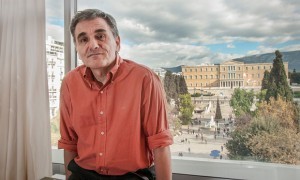
The Guardian’s interview with Finance Minister Euclid Tsakalotos, titled “Euclid Tsakalotos: Greek finance minister on the hard path of post-bailout reform”, focuses on the situation in Greece, described as a country “not far removed from economic meltdown, in its worst recession in post-war history, stricken by debt and dependent on international aid, his is a lot few would crave. Even now – almost five months to the day after it was bailed out for a third time since 2010 – Greece’s future hangs in the balance.”
The Oxford-educated economist told the newspaper that there are “forces” working in all directions and he concedes that it isn’t certain that Athens will come out of the crisis in the way the Radical Left Coalition (SYRIZA) government of Greece would like it to. Tsakalotos points out that the climate has changed radically since the days of Yanis Varoufakis when Greece came close to a Grexit. Now, recapitalization of Greek banks has gone unexpectedly well and Athens has even won praise from German Finance Minister Wolfgang Schaeuble.
As negotiator of a harsh bailout for Greece, Tsakalotos has had to “recalibrate his thinking as an alternative economist with Marxist leanings”. He insists that there was no other choice in “a very difficult compromise”.
“The case that things would have been better if we had left the eurozone in July seems to rely on an assumption that we wouldn’t have had any financing needs and that we wouldn’t have had to go to the IMF for a new loan to cover those financing needs and that the IMF wouldn’t have posed conditions,” he tells the Guardian. “this idea… that outside the eurozone you have a completely free hand to do what you like isn’t backed up by economic theory or economic history.”

Ask me anything
Explore related questions




