






An article in the New York Times paints a bleak picture of the impact of the economic crisis in southern European countries with a substantial drop in birthrates, as an increasing number of women decide to not have children. The article entitled “After Economic Crisis, Low Birthrates Challenge Southern Europe” focuses especially on Greece and the difficulty women face in deciding to not have families of their own due to the harsh economic realities.
As a longtime fertility doctor, Minas Mastrominas has helped couples in Greece give birth to thousands of bouncing babies. But recently, disturbing trends have escalated at his clinic.
Couples insisting on only one child. Women tearfully renouncing plans to conceive. And a surge in single-child parents asking him to destroy all of their remaining embryos.
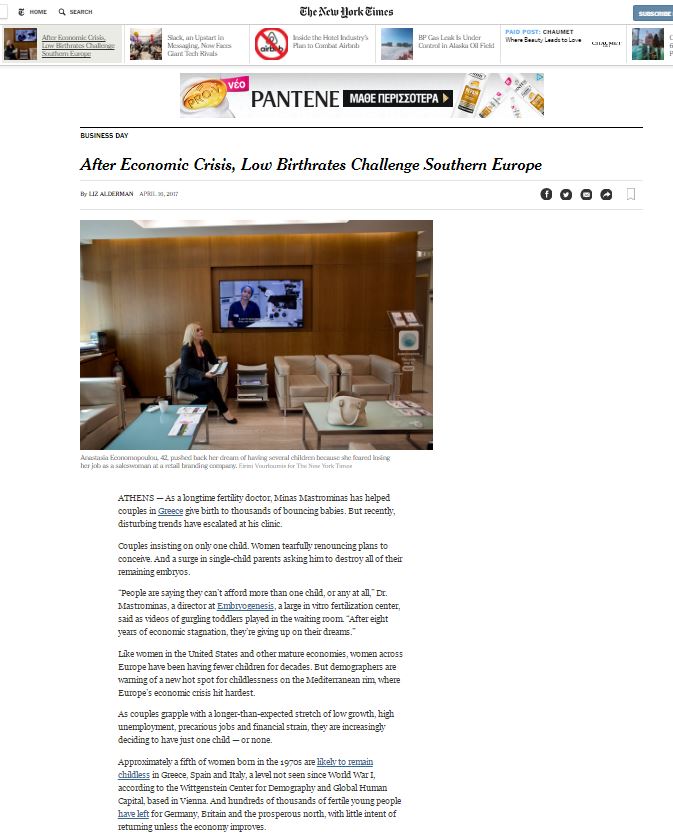
“People are saying they can’t afford more than one child, or any at all,” Dr. Mastrominas, a director at Embryogenesis, a large in vitro fertilization center, said as videos of gurgling toddlers played in the waiting room. “After eight years of economic stagnation, they’re giving up on their dreams.”
Like women in the United States and other mature economies, women across Europe have been having fewer children for decades. But demographers are warning of a new hot spot for childlessness on the Mediterranean rim, where Europe’s economic crisis hit hardest. As couples grapple with a longer-than-expected stretch of low growth, high unemployment, precarious jobs and financial strain, they are increasingly deciding to have just one child — or none.
Approximately a fifth of women born in the 1970s are likely to remain childless in Greece, Spain and Italy, a level not seen since World War I, according to the Wittgenstein Center for Demography and Global Human Capital, based in Vienna. And hundreds of thousands of fertile young people have left for Germany, Britain and the prosperous north, with little intent of returning unless the economy improves.
Birthrates in the region have slid back almost to where they were before the crisis emerged in 2008. Women in Spain had been averaging 1.47 children per household, up from 1.24 in 2000. But those gains have all but evaporated. In Italy, Portugal and Greece, birthrates have reverted to about 1.3.
It adds to the growing concern about a demographic disaster in the region. The current birthrates are well under the 2.1 rate needed to keep a population steady, according to Eurostat.
Maria Karaklioumi, 43, a political pollster in Athens, decided to forgo children after concluding she would not be able to offer them the stable future her parents had afforded. Her sister has a child, and Ms. Karaklioumi is painfully aware that her grandmother already had five grandchildren at her age. Although she has a good job and master’s degrees in politics and economics, “there’s too much insecurity,” Ms. Karaklioumi said.
Unemployment among women stands at 27 percent, compared with 20 percent for men.
“I don’t know if I’ll have this job in two months or a year,” Ms. Karaklioumi added. “If you don’t see a light at the end of the tunnel, how can you plan for the future?”
Whether the demographic decline slows ultimately depends on the financial fortunes in the south, where most countries suffered double-dip recessions. Without significant improvement, the region is trending toward some of the lowest birthrates in the world, which will accelerate stress on pension and welfare systems and crimp growth as a shrinking work force competes with the rest of Europe and the world.
read more at: nytimes.com
Ask me anything
Explore related questions




