





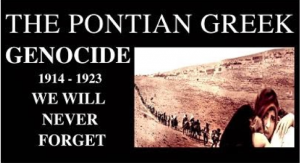
The following article is a summary of the events of the Genocide of the Greeks of Pontos, the memory of which the Greeks around the world honor today:
Pontian and Anatolian Greeks were victims of a broader Turkish genocidal project aimed at all Christian minorities in the Ottoman Empire. A total of more than 3.5 million Greeks, Armenians, and Assyrians were killed under the successive regimes of the Young Turks and of Mustafa Kemal from roughly 1914 to 1923. Of this, as many as 1.5 million Greeks may have died. The end of the genocide marked a profound rupture in the long Greek historical presence on the Asia Minor.
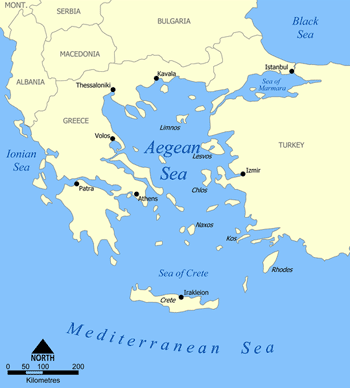
Greek communities began inhabiting Anatolia (Greek for “east”), otherwise referred to as the Asia Minor, since the 12th century BCE. They centered mostly along the Aegean littoral, although some Greeks, known as Pontians, went further east and colonized the southern shores of the Black Sea. Turkic peoples migrated into Anatolia over the first millennium CE and by the 14th century had established the Ottoman Empire. Over the next six hundred years, the Empire organized its ethnically diverse population into the millet system, thereby ensuring cultural and religious pluralism. Under this system, the Ottoman Greeks, like other Christian communities in the Empire, were provided with a degree of autonomy.
The geographic extent and political power of the Ottoman Empire began to decline over the 19th century as subjected peoples, especially the Greeks, began exerting their own nationalist aspirations. With the support of the Great Powers, the Greeks successfully overthrew Ottoman rule during their War of Independence from 1821 to 1830, thereby establishing the modern Greek state as it is currently situated at the tip of the Balkan Peninsula. However, the over two and a half million ethnic Greeks still living in Anatolia, separated from their Balkan compatriots, suffered the scorn of an increasingly vitriolic Turkish nationalism tainted by a bitter sense of humiliation. The Young Turk movement emerged from this context, eventually aiming to turn the multiethnic Ottoman Empire into a homogenous Turkish nation state. Under the banner of the Committee for the Union of Progress (CUP), this ethnic nationalist movement assumed power after a coup d’état in 1913.
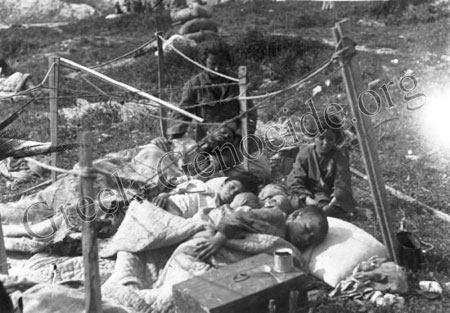
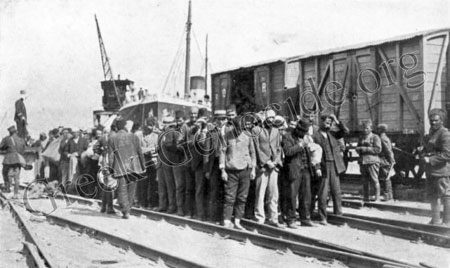
This political revolution occurred in the midst of the Balkan Wars from October 1912 to July 1913, which ultimately ended five centuries of Ottoman rule in the Balkans. Afterwards, there was a brief diplomatic effort between the Greeks and the CUP to arrange a population exchange. However, the outbreak of World War I stunted this effort, and instead the CUP took its own radical initiatives. They began singling out all able-bodied Greek men, forcibly conscripting them into labor battalions which performed slave labor for the Turkish war effort. Greek children were stolen and forcibly assimilated into Turkish society. Greek villages were brutally plundered and terrorized under the pretext of internal security. Indeed, as with the Armenians, the Greeks were generally accused as a disloyal and traitorous “fifth-column,” and eventually most of the population was rounded up and forcibly deported to the interior. This modus operadi was more or less the same for all three Christian victim groups.
(Greek men in Smyrna guarded by Turkish troops for deportation to the interior -September 1922-)
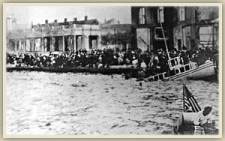
Again with support of the Great Powers, Greece invaded part of Anatolia immediately after the defeat of the Ottomans in World War I. Centered around the Aegean port city of Smyrna (now known by its Turkish name, Izmir), Greek occupation forces brutally subjected local Turks, thereby further stoking interethnic conflagrations. At the same time, Mustafa Kemal Pasha was leading a Turkish resurgence, eventually dispelling the Greek military from Anatolia. Turkish forces retook Smyrna in September 1922, instigating a massive anti-Greek pogrom. On September 13, a fire broke out amidst the chaos, spreading uncontrollably over the next two weeks. The Smyrna catastrophe took the lives of somewhere between 10,000 to 15,000 Greeks. Two months later, diplomatic negotiations between the Kemalist regime and the Great Powers began in Switzerland, leading to the signing of the Treat of Lausanne in February 1923. The sovereign status of a Turkish nation state was thereby affirmed, and the Great Powers essentially condoned the Turkish genocidal project.
The demographic consequences of the Greek genocide are not objectively certain. The prewar population of Greeks was at least 2.5 million. Over the course of 1914 to 1923, about one million had migrated, some voluntarily but most under coercion. As many as 1.5 million Greeks died, either from massacre or exposure, although this figure is not positive. Presently, a miniscule Greek population remains in Turkey. Greek communities annually commemorate the genocide on September 14 in recognition of the Smyrna catastrophe.
Ask me anything
Explore related questions




