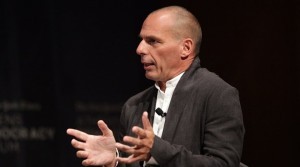
Former Finance Minister of Greece Yanis Varoufakis puts an economic spin on Christmas, by applying his theoretical knowledge to the question of how different schools of economic though might approach “Christmas gifts”.
From Marxists to capitalists, Varoufakis tries to analyse their understanding of presents.
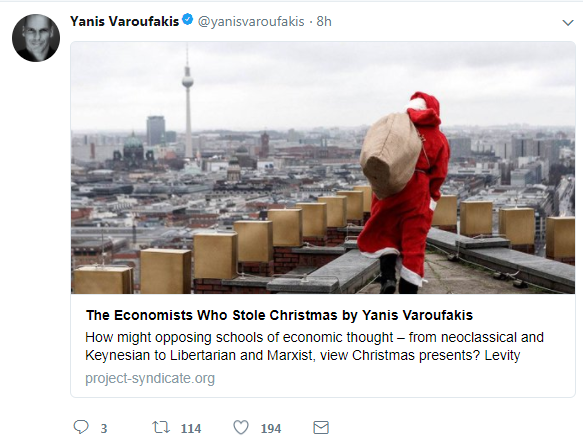
How might opposing schools of economic thought – from neoclassical and Keynesian to Libertarian and Marxist, view Christmas presents? Levity aside, the answer reveals the pompousness and vacuity of each and every economic theory
To welcome the New Year with a cheeky take on the clash of economic ideologies, how might opposing camps’ representatives view Christmas presents? Levity aside, the answer reveals the pompousness and vacuity of each and every economic theory.
Neoclassicists: Given their view of individuals as utility-maximizing algorithms, and their obsession with a paradigm of purely utility-driven transactions, neoclassical economists can see no point in such a fundamentally inefficient form of exchange as Christmas gift-giving. When Jill receives a present from Jack that cost him $X, but which gives her less utility than she would gain from commodity Y, which retails for $Y (that is less than or equal to $X), Jill is forced either to accept this utility loss or to undertake the costly and usually imperfect business of exchanging Jack’s gift for Y. Either way, there is a deadweight loss involved.
In this sense, the only efficient gift is an envelope of cash. But, because Christmas is about exchanging gifts, as opposed to one-sided offerings, what would be the purpose in Jack and Jill exchanging envelopes of cash? If they contain the same amounts, the exercise is pointless. If not, the exchange is embarrassing to the person who has given less and can damage Jack and Jill’s relationship irreparably. The neoclassicist thus endorses the Scrooge hypothesis: the best gift is no gift.
Keynesians: To prevent recessions from turning into depressions, a fall in aggregate demand must be reversed through increased investment, which requires that entrepreneurs believe that increased consumption will mop up the additional output that new investments will bring about. The neoclassical elimination of Christmas gift exchange, or even the containment of Christmas largesse, would be disastrous during recessionary periods.
Indeed, Keynesians might go so far as to argue that it is the government’s job to encourage gift exchanges (as long as the gifts are purchased, rather than handcrafted or home produced), and even to subsidize gift giving by reducing sales taxes during the holiday season. And why stop at just one holiday season? During recessionary times, two or three Christmases might be advisable (preferably spaced out during the year).
But Keynesians also stress the importance of reining in the government deficit, as well as overall consumption, when the economy is booming. To that end, they might recommend a special gift or sales tax during the festive season once growth has recovered, or even canceling Christmas when the pace of GDP growth exceeds that consistent with full employment.
Monetarists: Convinced that the money supply should be the government’s sole economic-policy tool, and that it should be used solely to maintain price stability through equilibration of the money supply vis-á-vis aggregate production, the central bank should gradually increase nominal interest rates once summer ends and reduce them sharply every January. The changes in nominal interest rates they recommend depend on the central bank’s inflation target and the economy’s underlying real interest rate, and must reflect the rates necessary to keep the pace of change in consumption demand and large retailers’ inventories balanced. (Yes, it’s true: Monetarists are the dullest economists to ever have walked the planet!)
Rational Expectations: These Chicago School economists disagree with both Keynesians and monetarists. Unlike the Keynesians, they think a fiscal stimulus of Christmas gift spending in recessionary festive seasons will not encourage gift producers to boost output. Entrepreneurs will not be fooled by government intervention, and will foresee that the current increase in demand for gifts will be offset in the long run by a sharp drop (as government subsidies turn into increased taxation and fewer Christmases are observed during the good times). With output and employment remaining flat, government subsidies and additional Christmases will merely produce more debt and higher prices.
Austrian School libertarians: Supporters of Friedrich von Hayek and Ludwig von Mises have two major objections to Christmas. First, there is the illiberal aspect of the holiday season: the state has no right, and no reason, to force entrepreneurs to close down, against their will (for four days December 25 and 26, and January 1 and 2) over the course of a fortnight. Second, the ever-lengthening pre-Christmas consumption boom tends to expand credit, thus causing bubbles in the toy and electronics market during the fall that will burst in January, with potentially damaging consequences for the rest of the year.
Empiricists: Convinced that observation is our only tool against economic ignorance, empiricists are certain that the only defensible theoretical propositions are those derived from discerning patterns whereby changes in exogenous variables constantly precede changes in endogenous variables, thus establishing empirically (for example, through Granger tests) the direction of causality. This perspective leads empiricists to the safe conclusion that Christmas, and a spurt in gift exchanges, is caused by a prior increase in the money supply and, ceteris paribus, a drop in savings.
Marxists: In societies in which profit is derived exclusively from surplus value “donated” (as part of the capitalist labor process) by workers, and which reflects the capitalists’ extractive power (bequeathed to them by one-sided property rights over the means of production), the Christmas tradition of gift exchange packs dialectical significance.
On one hand, Christmas gift giving is an oasis of non-market exchange that points to the possibility of a non-capitalist system of distribution. On the other hand, it offers capital another opportunity to harness humanity’s finest instincts to profit maximization, through the commodification of all that is pure and good about the festive season. And purists – those who still defend the “law of the falling (long-term) rate of profit” – would say that capital’s capacity to profit from Christmas diminishes from year to year, thus giving rise to social and political forces which, in the long run, will undermine the festive season.
Obviously, none of these theories can possibly account for why people participate, year in and year out, in the ritual of holiday gift giving. For that, we should be grateful.source: project-syndicate.org
Ask me anything
Explore related questions