





The Hurrian songs are a group of stone tablets with music inscribed in the cuneiform writing system. These were unearthed from the ancient Amorite city of Ugarit and date to approximately 1400 BC.
One of these tablets (h.6), contains the Hurrian hymn to Nikkal, making it the earliest markedly entire piece of composed music in the world. On some of the broken pieces, the composers’ names are inscribed, but h.6 is an anonymous work.
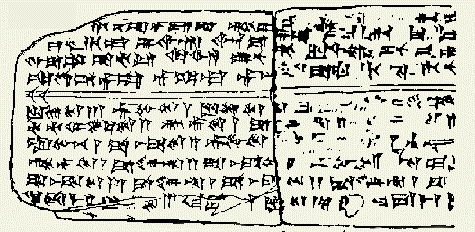
(A drawing of one side of the tablet on which the Hymn to Nikkal is written)
H.6 is one of about 36 such hymns in ancient Sumerian writing, and it’s the only one that remained in a substantially complete form. The other hymns were found on fragments of stone tablets, unearthed in the 1950s from present-day Ras Shamra, Syria, on the site of the ancient Royal Palace at Ugarit. They were discovered in a layer of earth dating from the 14th century BC. An account of the group of hymns was published in 1955 and 1968 by Emmanuel Laroche, who cataloged all of the song tablets with the designation ‘h’ for “Hurrian.” The entire hymn is identified as h.6 in the list; it was revised and published in 1975.
The lyrics of the h.6 tablet are a hymn to Nikkal, a Semitic goddess of orchards. It also contains inscribed directions for a singer playing a nine-stringed sammûm, a type of harp or, more likely, a lyre. Instructions for how to tune the harp are also contained on some of the tablets.
Several other survived early works of music, such as the Seikilos epitaph and the Delphic Hymns, are pre-dated by the Hurrian hymn by nearly a thousand years, but the Hurrian transcription remains contentious. A reconstruction of the lyrics by Marcelle Duchesne-Guillemin may be heard at the Urkesh web page, though this is only one of at least five differing interpretations of the wording, and each one bears an entirely remarkable result.
The composition of the h.6 tablet assigns the Hurrian words of the hymn on the top of the tablet, under which lies a paired division line. The hymn text is written in a continuous spiral, alternating between the front and back sides of the tablet – a layout not found in Babylonian texts. Below this text, there are Akkadian musical instructions, comprised of separated names followed by number signs. The differences in transcriptions focus on the interpretation of the meaning of these paired number signs and the association to the hymn text.
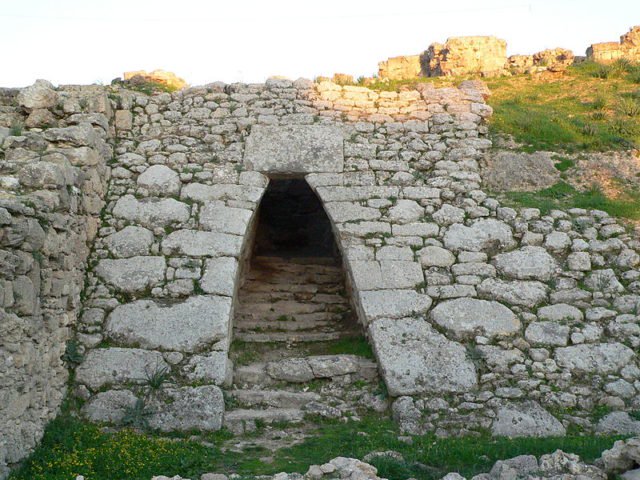
(The Entrance to the royal palace at Ugarit, where the Hurrian songs were found)
Below the musical instructions, there is another dividing line, a single one, underneath which there is an imprint in Akkadian which reads, “this nitkibli [i.e., the nid qabli tuning] song, a zaluzi to the gods… written down by Ammurabi”. This name, along with another scribe’s name, Ipsali, found on one of the other tablets, is Semitic.
There is no songwriter signed for the complete h.6 hymn, but four composer names, which are all Hurrian, are found on five of the other fragmentary pieces
The tablet is now part of a collection at the National Museum of Damascus.
Source: thevintagenews
Ask me anything
Explore related questions




