





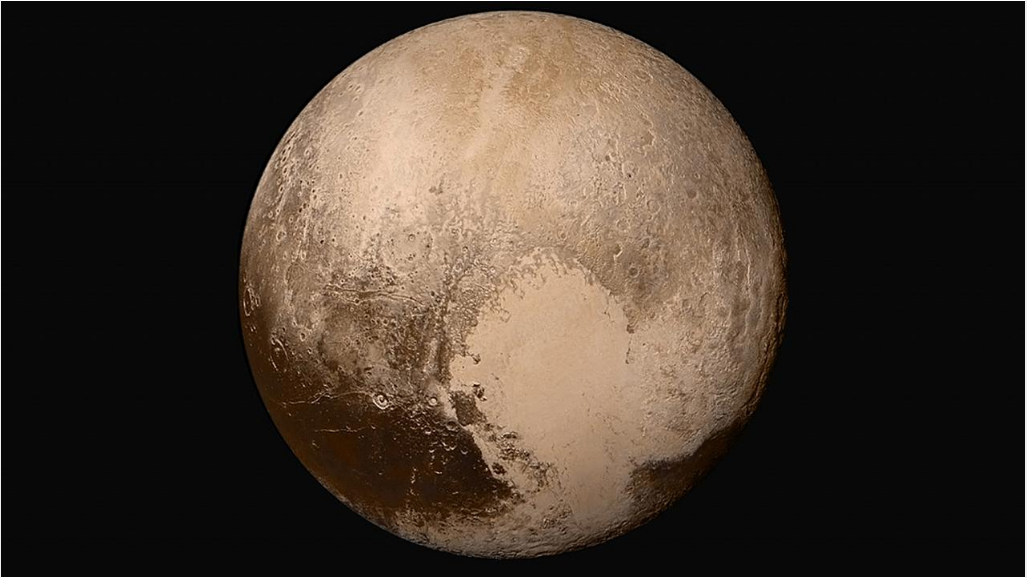
Maybe Pluto is a planet after all.
The icy ball at the outer edge of the solar system was considered a planet from its discovery in 1930 until 2006, when a global astronomy organization made the decision to designate it a dwarf planet instead.
Now a group of scientists has taken aim at that hotly debated decision, arguing in a new paper that the definition of a planet that the International Astronomical Union (IAU) used to downgrade Pluto’s status has been inconsistently applied — not just in recent decades but over the past two centuries.
“What we’re doing is fact-checking,” said Philip Metzger, a planetary scientist at the University of Central Florida and the lead author of the paper, which was published online Sept. 5 in the journal Icarus. “There are 120 examples I found of scientists in the recent published literature violating the IAU definition, calling something a planet even though the IAU definition says it’s not a planet. The reason planetary scientists do this is because the IAU definition is not useful for science.”
According to the IAU, a celestial body is a planet if it meets three key criteria: It must orbit the sun; it must be large enough that it pulls itself into a round shape by its own gravity; and it must clear its orbit of other objects — meaning that it casts out other bodies in its orbit and is gravitationally dominant in its region of space.
It’s the third criterion that the IAU used to ding Pluto. While the other planets have their orbits pretty much to themselves — except for their moons — Pluto is one of thousands of celestial objects in the Kuiper Belt, the region of space beyond the orbit of Neptune. With so many other objects in the region exerting gravitational fields of their own, Pluto can’t be considered gravitationally dominant.
Metzger and his co-authors argue that the IAU definition is invalid because the particular details of an object’s orbit around its host star — in this case the sun — have more to do with the star itself than with the object. For instance, a planet orbiting a massive star will most likely not be able to clear its orbit, whereas that identical planet in orbit around a much smaller star will.
In other words, it doesn’t make sense to base the planet-dwarf planet decision in part on something that is determined by an object’s host star.
“That’s like saying a tiger is not a mammal unless it’s able to clear away all the other predators on the island where it lives,” Metzger said. “That depends not just on what the tiger is, but what else happens to be on the island.”
The scientists argue that a planet should be defined only by its intrinsic properties, with the primary consideration being whether the object in question is big enough — and generates enough gravity — to organize itself into a roughly spherical shape.
By this definition, Pluto is clearly a planet. But Earth’s moon would also be considered a planet, as would the largest moons of Jupiter and Saturn.
“When Galileo described the moons of Jupiter, he described them as planets,” said Kirby Runyon, a planetary geologist at the Johns Hopkins University Applied Physics Laboratory in Laurel, Maryland, and one of the study’s co-authors. “So the actual historical precedent is to consider round worlds that orbit other planets as planets, too. And we consider dwarf planets to be full-fledged planets like Jupiter.”
Not everyone sees the need to reassess the IAU’s definition — or revisit the decision to downgrade Pluto’s status.
Mike Brown, a planetary astronomer at the California Institute of Technology and a self-professed “Pluto killer,” says historical precedence makes for a weak argument. “Historically, we did consider the moon a planet, but the fact that we considered the moon a planet 500 years ago is no reason to consider the moon a planet today,” Brown said.
Expanding the definition of a planet to include a spate of other celestial objects makes for a “poor description of our solar system,” he added. “If the four big moons of Jupiter are planets, the big moons of Saturn are planets, and 200 objects in the Kuiper Belt are planets — it becomes a meaningless word in that sense,” he said.
For now, Pluto remains a dwarf planet. The icy orb, which takes about 248 years to complete one trip around the sun, will complete its first full orbit since its discovery in 2178. Perhaps by then, the debate over its planetary status will be settled.
Source: euronews
Ask me anything
Explore related questions




