

×
GreekEnglish

×
  • Politics
  • Diaspora
  • World
  • Lifestyle
  • Travel
  • Culture
  • Sports
  • Cooking
Friday
26
Jun 2026
weather symbol
Athens 27°C
  • Home
  • Politics
  • Economy
  • World
  • Diaspora
  • Lifestyle
  • Travel
  • Culture
  • Sports
  • Mediterranean Cooking
  • Weather
Contact follow Protothema:
Powered by Cloudevo
> World

Universe’s most massive neutron star spotted

Should It Even Exist?

Newsroom September 18 09:27

Δείτε περισσότερα άρθρα μας στα αποτελέσματα αναζήτησης

Add Protothema.gr on Google

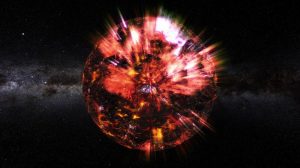
A spinning cosmic cadaver is all that’s left of a weighty star hovering some 4,600 light-years from Earth after having undergone an explosive death. Now, astronomers have found that this corpse is the most massive neutron star ever discovered.

In fact, they say it’s so massive — about 2.14 times the mass of our sun packed into a sphere most likely around 12.4 miles (20 kilometers) across — that it’s near the limit of being able to exist at all.

>Related articles

Elon Musk & SpaceX: How the “failed idea” and the Russians’ “NO” led to the launch of a $2 trillion company

Air leak on the International Space Station: Astronauts prepare for possible evacuation

Steven Spielberg fuels alien theories about life on Earth: “Wouldn’t it be wonderful for the world to know that all of this IS true?”

This neutron star, called J0740+6620, emits beacons of radio waves and spins at a dizzying 289 times a second, making it a pulsar. The new estimate for the pulsar’s mass makes it heftier than the previous record-holder — a spinning neutron star weighing in at about 2.01 times the mass of the sun, said lead author Thankful Cromartie, a graduate student at the University of Virginia. Figuring out the new record holder’s mass “was absolutely thrilling,” she added.

The scientists spotted the opportunity to study the stellar corpse in data collected by radio telescopes at the Green Bank Observatory and the Arecibo Observatory. The data came from a collaboration called the North American Nanohertz Observatory for Gravitational Waves, or NANOGrav, with the goal of observing a bunch of these fast-spinning pulsars all across the sky.

more at livescience.com

Ask me anything

Explore related questions

#discovered#found#massive neutron star#scientists#space#universe
> More World

Follow en.protothema.gr on Google News and be the first to know all the news

See all the latest News from Greece and the World, the moment they happen, at en.protothema.gr

> Latest Stories

WRC Acropolis Rally: Dominant Ogier wins the Ellinikon Super Special Stage

June 25, 2026

UN Suspends ship evacuation plan through the Strait of Hormuz after attack near Oman

June 25, 2026

Sani Festival 2026: Legends Return to the Hill

June 25, 2026

Top-scoring students in Greece’s Panhellenic Exams speak about their success and the dreams that lie ahead: “The hard work and efforts of many years are finally paying off”

June 25, 2026

Papastavrou: No exclusion of Cyprus from COP31 preparatory processes – “Either all 27 or none”

June 25, 2026

Portugal ready to send 50 rescuers to Venezuela after powerful deadly double earthquake

June 25, 2026

Livanios on abolishing the second Sunday in local elections: Goal is genuine legitimacy through higher participation

June 25, 2026

The 27 EU member states gave the final green light for the EU-U.S. trade agreement to take effect before July 4

June 25, 2026
All News

> Greece

In reverence, the emotional deposition in Jerusalem, see photos & video

The Holy Temple of the Resurrection opened after many days due to the war between Israel and Iran

April 10, 2026

In the final stretch for the accreditation of joint master’s degrees: Aiming for their launch in the coming academic year

April 10, 2026

Schedule for Epitaph Procession today (10/4)

April 10, 2026

Perfect weather for Easter excursions, according to Tsatrafyllia’s forecast

April 10, 2026

Easter in Greece: The customs that continue in Greek tradition – From Nafpaktos to Corfu

April 10, 2026
Homepage
PERSONAL DATA PROTECTION POLICY COOKIES POLICY TERM OF USE
Powered by Cloudevo
Copyright © 2026 Πρώτο Θέμα



