

×
GreekEnglish

×
  • Politics
  • Diaspora
  • World
  • Lifestyle
  • Travel
  • Culture
  • Sports
  • Cooking
Sunday
03
May 2026
weather symbol
Athens 14°C
  • Home
  • Politics
  • Economy
  • World
  • Diaspora
  • Lifestyle
  • Travel
  • Culture
  • Sports
  • Mediterranean Cooking
  • Weather
Contact follow Protothema:
Powered by Cloudevo
> World

Voyager spacecraft detects “persistent hum” beyond our solar system

"It's very faint and monotone"

Newsroom May 17 11:04

One of the Earth’s longest-flying spacecraft has detected a “persistent hum” beyond our solar system, according to a new study.

>Related articles

Mytilene: Ferry connection between Lemnos and the port of Canakkale in Turkey begins

Rebrain Greece in London: “Greece 2026 offers significant professional opportunities”, Kerameos says

Economist: Piraeus and Elefsina at the heart of global port rivalry — The U.S.–China “naval battle”

NASA’s Voyager 1 launched on September 5 1977, from Cape Canaveral, Florida, aboard a Titan-Centaur rocket, just weeks after its sister craft, Voyager 2. Although they were initially designed to last five years, more than 43 years after they launched, the crafts are still sending back data as they explore interstellar space.
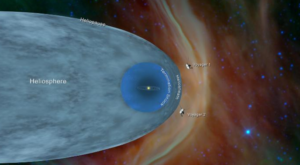
Instruments aboard Voyager 1, which has moved past the edge of the solar system, through the solar system’s border with interstellar space, known as the heliopause, and into the interstellar medium, have detected the sounds of plasma waves, according to research published Monday in the journal Nature Astronomy.

See Also:

Athens: Maintenance works are in progress in the Temple of Olympian Zeus

Bipartisan resolution calls on US President to make Cyprus solution top foreign policy priority

A Cornell University-led team studied data transmitted from the spacecraft, sent from 14 billion miles away and discovered the interstellar gas emissions.
“It’s very faint and monotone, because it is in a narrow frequency bandwidth,” Stella Koch Ocker, a Cornell University doctoral student in astronomy, said in a statement. “We’re detecting the faint, persistent hum of interstellar gas”.
Read more: CNN

Ask me anything

Explore related questions

#Deep Space#discovery#hum#nasa#science#space#technology#Voyager#world
> More World

Follow en.protothema.gr on Google News and be the first to know all the news

See all the latest News from Greece and the World, the moment they happen, at en.protothema.gr

> Latest Stories

Stavros Papastavrou: We are implementing Greece’s largest public solar park in Western Greece

May 3, 2026

lululemon: From Vancouver to Voukourestiou Street

May 3, 2026

Mytilene: Ferry connection between Lemnos and the port of Canakkale in Turkey begins

May 3, 2026

Full Marc Poll for Proto Thema: Strong recovery for New Democracy after measures, Macron visit, and ahead of two new parties

May 3, 2026

Kyriakos Mitsotakis: Definitive end to excessive compound interest — What borrowers gain from the new regulatory framework

May 3, 2026

Rebrain Greece in London: “Greece 2026 offers significant professional opportunities”, Kerameos says

May 3, 2026

Kyriakos Mitsotakis: An end to fine print and irregular practices for loans up to €100,000

May 3, 2026

26 ancient artifacts repatriated to Greece from seizures in the USA, see photos

May 3, 2026
All News

> Greece

In reverence, the emotional deposition in Jerusalem, see photos & video

The Holy Temple of the Resurrection opened after many days due to the war between Israel and Iran

April 10, 2026

In the final stretch for the accreditation of joint master’s degrees: Aiming for their launch in the coming academic year

April 10, 2026

Schedule for Epitaph Procession today (10/4)

April 10, 2026

Perfect weather for Easter excursions, according to Tsatrafyllia’s forecast

April 10, 2026

Easter in Greece: The customs that continue in Greek tradition – From Nafpaktos to Corfu

April 10, 2026
Homepage
PERSONAL DATA PROTECTION POLICY COOKIES POLICY TERM OF USE
Powered by Cloudevo
Copyright © 2026 Πρώτο Θέμα



