





The online platform for registration on the electoral rolls for postal votes is operational from today, Monday 19 February, a few weeks after the adoption of the relevant law.
The activation of the platform marks the introduction, for the first time in Greece, of postal voting as a means of facilitating the exercise of the electoral right of voters for the European elections and national referendums.
This is a substantial opening up to Greeks everywhere by removing all practical obstacles to the exercise of the right to vote by Greek citizens, wherever they may be.
The implementation of the postal vote applies to all Greek citizens who are registered in the electoral rolls and wish to exercise their electoral rights, within or outside the territory.
At the same time, it is recalled that Greek residents abroad may exercise their right to vote in the forthcoming European elections exclusively by postal vote.
Voters in Greece enter the online application via the link epistoliki.ypes.gov.gr and register in the special electoral rolls for postal votes exclusively via taxisnet using their personal credentials.
Greeks residing abroad may enter the above application and register in one of the following ways:
– Via taxisnet (if they have login credentials).
– By submitting the details of their Greek passport and identity card in combination.
– By submitting the details of their Greek passport and dematologio number in combination.
Alternatively, voters within Greece can register in the special postal voter lists through the Citizen Service Centres, while voters outside Greece can contact the competent Greek Consular Authorities (Consulates General, Consulates, Consular Offices of Embassies).
Instructions for using the platform
1. Login to the application
– Voters log in to the application via the link epistoliki.ypes.gov.gr. The home page lists the main dates for the next election procedure
– To authenticate themselves, voters make use of their personal TaxisNet credentials:
– Alternatively, voters outside Greece can log in with a combination of their valid Greek passport details and their police identity card or municipal number:
They then indicate the Address for the Dispatch of Electoral Documents where they wish to receive their postal vote envelope.
If this address is the same as the Address of Residence, voters may select the corresponding field. They also fill in any additional information for delivery (e.g., name on the doorbell, floor).
As a reminder, for the European elections on 9 June 2024, the electoral material will be dispatched by the Ministry of Internal Affairs in May 2024 and can only be collected by the voters themselves or expressly authorised third parties:
At any time during the registration process, voters may select “Temporary Saving” and return at a second time to edit or delete their application.
– Voters receive an email confirmation of their application submission.
Applications become final immediately and voters can now exercise their right to vote by absentee ballot. As a reminder, the deadline for registration is 40 days before the election. That is, for the European elections of 9 June 2024, registration will close on 29 April 2024.
3. Change of data and deletion
– Voters who have already registered can change their data (contact details, residence address, address for sending election material) in case they change.
They log on to the platform and select “Change of data” from the list of their applications and follow the above procedure, modifying the data that have changed:
If voters experience difficulties in using the application, they can contact +302106266222 or select “Report a Problem” at the top right of the screen and submit their problem:
Can I register if I don’t have a valid AFM or Greek passport?
– Yes. All Greek citizens who are registered in the electoral rolls can exercise their right to vote by absentee ballot if they wish to do so.
– Voters who cannot log on to the online application in any of the available ways can contact the “KEP” or the Greek diplomatic authorities abroad in order to register on the special electoral rolls for postal votes.
The officials, after identifying the voter by presenting a valid identification document, will submit a registration application on behalf of the voter, which is then signed by the voter.
Can I register if I have difficulty using a computer?
– Yes. Voters who have difficulties in using a computer can contact the Citizen Service Centres or the Greek Embassies and Consulates in order to register on the special electoral rolls for postal votes.
What does the absentee ballot envelope contain and when will I receive it?
– The envelope is sent to voters by the Ministry of Interior no later than 15 days before the elections, subject to receipt either by the voter or by a third person expressly authorized to receive it, with a signature verification via gov.gr or by a public authority.
– The voter is informed by e-mail of the dispatch of the envelope and a link for tracking its progress (tracking).
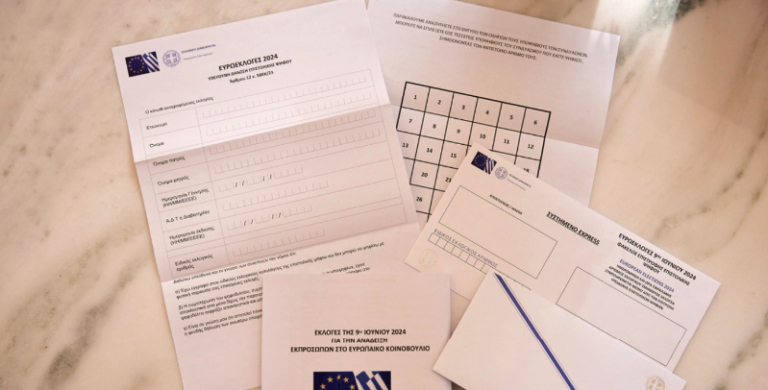
– The envelope includes:
◦ a postal vote return envelope,
◦ a ballot paper,
◦ voting envelope,
◦ an instruction form,
◦ a list of candidates,
◦ application form – solemn declaration.
– Voting envelopes shall be fully anonymised and bear a special authentication mark.
Hoax call about a bomb at the Greek Parliament – The streets are now open
What does the absentee ballot look like?
– The ballot paper is uniform and is printed under the responsibility of the Ministry of the Internal Affairs.
– On the first page, all the parties, combinations and coalitions of parties that are candidates are shown and the voter puts a cross on the one he or she chooses. On this page there is also a distinct option “I do not select any of the above – I vote white”.
– On the second page, a table of numbers from 1 to 42 is displayed. The voter selects from 0 to 4 candidates for the European Parliament of his/her preferred party or combination by clearly marking the number corresponding to each candidate of his/her choice as indicated in the list of candidates. At the end, the voter notes the total number of candidates he or she has chosen, i.e. 0 or 1 or 2 or 3 or 4.
– In the event that the voter makes the wrong choice or the ballot paper is damaged, the voter has the option to print a single new ballot paper from the Ministry of Internal Affairs website, complete it again and place it in the voting envelope.
How do I vote?
– The voter carefully reads the instructions form. He fills in the application form – affidavit in ink or electronically via gov.gr and writes his details in the postal vote return envelope.
– He/she chooses the combination he/she wants and the candidates for the European Parliament or votes for a “no”.
– He puts the ballot paper in the special voting envelope, closes it and puts it in the return envelope. If he has completed the application form – solemn declaration in colour, he puts it in the return envelope, together with the photocopy of his Greek identity card, Greek passport or Greek driving licence.
– He/she sends the envelope to the pre-populated address of the postal vote sorting centre.
Are there any costs involved in the procedures for receiving and sending the envelopes?
– No. The receipt of the postal vote envelope by the voter is free of charge since the cost of mailing the postal vote envelope is covered by the Ministry of Interior. The sending of the postal vote return envelope by the voter is prepaid by the Ministry of Internal Affairs.
Ask me anything
Explore related questions




