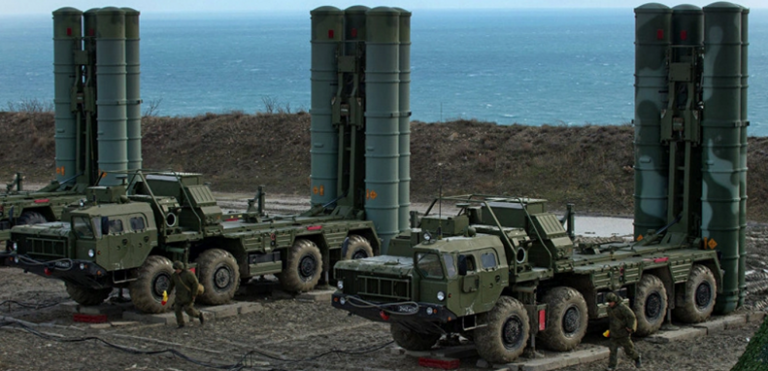
Turkey may deploy its advanced Russian S-400 Triumf air defenses on the Iraqi border for its planned summer offensive against the Kurdistan Workers’ Party, PKK, in Iraqi Kurdistan. Such a move would mark the first operational deployment of the missile system since Ankara received it in 2019 to Western reproach.
Turkiye newspaper reported earlier this month that Turkey’s S-400s may be deployed on the border, implying it will defend against drones allegedly acquired by the PKK. But the system is effective against bigger threats than crude drones. It’s designed to shoot down cruise and ballistic missiles like those fired by Iran in its unprecedented April 13 attack against Israel, and its deployment could worsen tensions with other NATO allies incensed that Turkey even has them.
The deal for the S-400 cost Turkey an estimated $2.5 billion. Indirectly, it has cost it far more than that in losses of over $9 billion it could have made from manufacturing over 900 parts for the global F-35 supply chain.
Washington banned Ankara from buying F-35s over concerns it would give Russian technicians data that spoils the fighter’s stealth. On top of all that, the US slapped sanctions on Turkey’s arms procurement agency.
While enduring these penalties, Turkey never put the S-400 into service. Following the system’s delivery, US officials warned Turkey against “activating” it. Turkey tested its F-16s and F-4 fighters against the S-400’s radar in late 2019. Washington strongly rebuked Ankara in October 2020 for announcing it was testing the system.
Since then, there has been no indication that Turkey’s S-400s have been put into operation. In November 2022, then-Defense Minister Hulusi Akar said Ankara has “no problems with the S-400” and that the system “is in place and ready for use.”
Its purported upcoming deployment on the Iraqi border would be the first time Turkish S-400s have been put into use five years after Ankara received them.
Ali Bakir, a Turkey expert at Qatar University’s Ibn Khaldon Center and nonresident senior fellow at the Atlantic Council’s Scowcroft Middle East Security Initiative, is skeptical of the report but doesn’t outright dismiss the possibility.
“This could be a trial balloon, an operational requirement due to the foreign threat in Northern Iraq, where Turkish troops are stationed, or simply untrue news,” Bakir told Business Insider. “If the S-400 is deployed for operational needs, it could be to counter the potential threat of Iran’s ballistic missiles.”
Even though Turkey’s other air defenses are capable of combating aerial threats from the PKK, Turkey requires an advanced system for intercepting ballistic missiles fired from Iran.
“Considering that Ankara has stationed troops in Northern Iraq, it would be more logical to deploy such a system to protect them during regional escalation or confrontation,” Bakir said. “Iran has used missiles lately against Northern Iraq.”
Bakir said that the recent missile attacks between Israel and Iran may be a further rationale to deploy the S-400 in Turkey’s east.”Such deployment will serve Turkey’s security as well as the security of Iraq, which is improving its ties with Ankara lately in an unprecedented way,” Bakir said.
Deploying S-400s as a contingency to counter Iranian missiles could create “an extremely complex situation” for Turkey, said Suleyman Ozeren, a lecturer at the American University and senior fellow at the Orion Policy Institute.”Such a move might mean that Turkey would be using the Russian weapon system against Russia’s most loyal ally in the Middle East,” Ozeren told BI. “However, Turkey may use the potential threat of Iran-linked militia groups or PKK as a pretext to deploy S-400s.”
He predicts a deployment would serve three primary objectives.
“First, the S-400s have been one of the most expensive yet least productive policy decisions,” Ozeren said. “By deploying them and making a lot of noise about it, the AKP may aim to silence critics at home.”
Putin disrupts aircraft GPS systems from Kaliningrad
The AKP is President Recep Tayyip Erdogan’s party, which decided to buy the S-400 in the late 2010s and has defended the contentious purchase ever since.
“Second, Ankara may want to prove to Moscow that its military cooperation still stands,” Ozeren said. “Third, such a decision may aim to send a message to the West — primarily to the US — that Ankara’s position vis-à-vis Russia and NATO remains unchanged.”
He noted the Turkish S-400 is a “standalone system” incompatible with NATO systems, limiting its use and confirming its “high cost and lack of functionality.”
A Turkish deployment could escalate the lingering dispute with the US.
In January, then-Acting Deputy Secretary of State Victoria Nuland said Washington could discuss readmitting Ankara into the F-35 program if it resolves the S-400 issue.
“The problem is not about where Ankara deploys S-400s but about the S-400 remaining in Turkey’s possession,” Ozeren said.
Bakir argued that weapons are purchased “with the intention of use” for either “offensive or defensive purposes.” “Even if Turkey were to hypothetically trade the S-400, the US could still mishandle the case of the F-35,” Bakir said. “There is no guarantee that Congress will not attempt to pressure Ankara in the future.”
Ozeren, in contrast, reiterated that the fundamental problem is Ankara’s “purely political” decision to purchase S-400s, which he argued was motivated by the AKP’s desire to distance Turkey from NATO.
“Such a goal was unattainable and unrealistic given the extent of Turkey’s integration into the NATO defense system,” Ozeren said. “The S-400 decision has left Ankara in a precarious situation that has remained unchanged.”
“No matter the AKP’s motivations back then, reality dictates that the ruling party reverse its course and go back to a stronger alliance with NATO.”
Source: Business Insider
Ask me anything
Explore related questions