





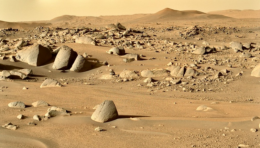
NASA aims to establish a permanent lunar outpost by the decade’s end, with subsequent plans for human exploration of Mars. Creating sustainable base camps beyond Earth will necessitate incorporating ecosystems that include animals. These animals could fulfill crucial roles such as pollinating plants, providing compact food sources like shrimp and fish, and offering insights into radiation resistance through organisms like waterbears.
Despite the clear need for animals in space, there is no consensus on which species should be prioritized. David Catling, an astrobiologist, notes that the development of complex extraterrestrial ecosystems is still more speculative than practical. One significant challenge is reduced gravity; Mars’ gravity is about one-third of Earth’s, and the moon’s is one-sixth. While habitats can mimic Earth’s temperature, pressure, and atmospheric conditions, gravity cannot be altered.
Christopher McKay, a planetary scientist, explains that without data, it’s uncertain how animals might adapt to such environments. Reduced gravity could impair muscle and bone development, making it difficult for larger animals to move properly. Therefore, smaller animals, such as mice and various aquatic species, may be more suitable. Catling agrees, suggesting that simpler animals like insects or crustaceans could be more resilient in the challenging conditions of space.
Space settlements will require efficient resource conservation. Fish and other aquatic animals, supported by buoyancy, might adapt well to changes in gravity, making them suitable for space livestock. Fish are efficient at feeding and produce less waste than terrestrial animals, as noted in a 2021 review from *Frontiers in Astronomy and Space Sciences*. The Lunar Hatch program has been exploring the potential of sending fish eggs to space for hatching since 2019, aiming to provide a high-protein, low-waste food source.
Vanity Fair and Conde Nast Traveller recommend Ios island for the summer
Insects are also considered viable for space livestock, offering a good protein source while using minimal space and water. A 2020 report from the University of South Australia and the International Space University highlights the efficiency of crickets for these purposes. Insects could play vital roles in a closed-loop life-support system on Mars, providing services like pollination, soil turnover, and detritus cleanup. They could also serve as a backup food source if crops fail.
Crustaceans, such as shrimp, can be efficiently raised in small spaces and integrated into aquaponics systems for plant growth. Additionally, tardigrades, or water bears, known for their resilience to extreme conditions, could be studied to understand how to withstand space’s harsh environment. While human colonization of space is still distant, the inclusion of these animals in space habitats could support sustainable ecosystems for future settlers.
Ask me anything
Explore related questions




