





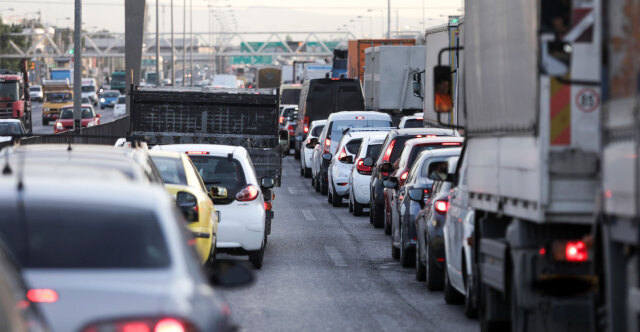
Every day, Athens is one giant parking lot. From early morning until late at night, the electronic maps showing live traffic in the metropolitan area are “red.”
The main avenues of the capital are over-saturated. The situation is no better on the smaller streets. The average speed of vehicles does not exceed 18 km per hour, and a trip from the southern suburbs to the northern suburbs can take – as unbelievable as it seems – as long as it would to travel to a provincial city.
See here the traffic today.
Traffic engineers, official bodies, and citizens agree that to solve Athens’ enormous traffic problem – which causes loss of work hours, environmental impact, noise pollution, an increase in minor accidents, driver frustration, and a series of other issues – there are two ways: One is to undertake infrastructure projects that will absorb part of the traffic load, and the other is to reduce the number of cars on the streets, making public transportation more attractive to citizens. The conclusion reached by experts is that the traffic problem will continue to worsen over time, as there is no plan in place to address it in these two directions.

What two solutions do traffic engineers, official bodies, and citizens propose to solve Athens’ enormous traffic problem?
“Attica needs a strategic transportation plan,” says the president of the Hellenic Transport Engineers Association, Thanasis Tsianos, in an interview with protothema.gr, adding, “It is perhaps the only metropolitan area in the developed world that lacks a transportation plan – from traffic management to parking spaces. People with experience in the field could help, complementing public organizations and utilizing the country’s scientific personnel.” KPMG had conducted a preliminary study for creating such a plan and agency, but, like many infrastructure projects in the capital, it remained on paper.
Measures like the Congestion Charge Zone are outdated and no longer deliver any results, as they are like “aspirin for a seriously ill patient.” Around half a million cars pass daily through the small congestion zone, of which 30% and more are through traffic – drivers passing through to go to other areas. According to traffic engineers, the Congestion Zone has “crashed,” as more cars pass through it than the center of Athens can handle. A similar situation exists throughout the capital. Its network has surpassed its transport capacity – the more than 6 million cars that circulate daily on its streets are too many for it to handle.
“How much worse can things get?” one might wonder while stuck in traffic on Kifisias Avenue. In fact, the president of the Hellenic Transport Engineers Association predicts that in a decade from now, the traffic problem will worsen dramatically, as travel times could double. “The traffic problem will worsen every year, and at some point, it will become unbearable,” explains Tsianos to protothema.gr, continuing, “We will see significant delays on a daily basis on Attiki Odos, Kifisos, Kifisias, and in Elliniko. This is because developments are creating traffic burdens without any measures being taken to service them.” Today, Athens ranks as the 16th city in Europe with the biggest traffic problem, but this is expected to worsen, as every year the average speed of vehicles during peak hours (currently 18 km/h) decreases by 2 to 5 kilometers per hour.

Public Transport is Not… Attractive
Professor and Director of the Department of Transport and Transportation Infrastructure at the National Technical University of Athens, Giorgos Giannis, says that traffic in Athens has not yet reached its peak. “In the next 2-3 years, we will experience a continuous deterioration of the situation, and we will be begging to return to the current state.” He explains that it’s impossible for all of us to drive our private cars during rush hour, and all European cities are trying to serve commuters and transportation needs through public transport. “The solution lies with Public Transport, but to make it attractive, it must meet three criteria: cost, time, and quality,” explains Mr. Tsianos.
One doesn’t need to be a scientist to conclude that public transport in Athens is not chosen by citizens because it’s unattractive. If traffic on the streets is a drama, then public transportation is the perfect tragedy. The Metro could offer solutions, as it is objectively a good means of transportation, but on the one hand, it seems to be saturated (in some cases, the frequency of trains during rush hour can reach 12-13 minutes, while platforms and carriages are packed to the point of suffocation), and on the other, it does not serve a significant number of destinations in areas with very heavy traffic, such as Kifisia Avenue and Kifisos.
The electric railway, which is part of the Metro network, could also offer solutions, but here too, the routes are incomplete (due to the frequency of trains), and a large portion of passengers are put off by the degraded image and safety issues caused by uncontrolled gangs who rob and harass commuters. Furthermore, the project to underground large portions of the electric railway’s surface lines, which could free up space for the development of roadways and the creation of parking areas, had been abandoned. However, there was a ray of hope a few days ago for the Piraeus section, as the city’s mayor, Giannis Moralis, brought the request back to the prime minister, explaining that the city is suffering from traffic congestion, and received a positive response.
And what about the buses? Mr. Giannis says, “Obviously, Athens needs more metro lines. We still have a lot of work to do, as we need 200 metro stations, but we only have 80. Nevertheless, the metro in Athens with the existing network serves many areas, and until the additional metro lines are built, we can have good service with public transport if we prioritize them. Studies worldwide, including in Athens, show that commuters will change their mode of transport only when they save time. The most important thing is time. If we make it faster for them to travel by bus, they will choose it.”
Buses, however, are the definition of unattractive transport. It’s not just the condition of the fleet – which, however, is being renewed – with buses that constantly break down due to malfunctions and that aesthetically repel passengers due to their old appearance, nor incidents like yesterday’s, where a bus driver was arrested for driving drunk – something that is not exactly a rare occurrence (and could be solved with the addition of alcohol-testing devices like in cities abroad).
The main problem (with buses too) is time. The bus schedules are unstable, as buses don’t have priority. On their routes, they get stuck in traffic, which even affects the bus lanes, as illegally parked cars and delivery vehicles block their lanes. As a result, buses are frequently immobilized, causing delays. In addition, there are other problems, such as the fact that a significant portion of them – 39%, according to the Ministry of Infrastructure and Transport – is not accessible to people with disabilities, forcing that part of the population to use private cars.

Infrastructure Projects Exist… But Only on Paper
Public transportation is one solution, but since a large portion of the traffic load concerns logistics, such as the supply of stores and businesses in the capital, infrastructure projects are essential. Plans and ideas for such projects that would provide “breathing room” for the most important road junctions in the capital and alleviate the city from nightmarish traffic congestion exist. The problem is that they have remained on paper. When journalists inquire about updates on these projects, the answer from the relevant officials is… “nothing.” There is no news regarding them. Additionally, there is the issue of jurisdiction over each road junction, as there is no central authority coordinating them.
The reason for the “freezing” of infrastructure projects, such as the construction of new roads and junctions that would ease traffic on major and minor roadways, is the lack of funding. The public sector does not have the financial capacity to fund them 100%, and the European Union has stopped approving funding for road projects, especially in the capital, as EU funds are now targeted towards the economically weaker regions of the country.
Thus, projects such as the widening of Kifisos Avenue (which falls under the jurisdiction of the Region) remain in a “frozen” state. This road has the uniqueness of narrowing suddenly, creating the “bottle neck” phenomenon. Other projects stuck in planning or indefinitely delayed include the construction of a junction at the height of Metamorphosis to relieve traffic towards the Attiki Odos, the Elefsina – Oinoi road section to ease traffic on Kifisos, the Logistics Center in Fyli (under the jurisdiction of the Hellenic Republic Asset Development Fund – TAIPED), the double Skaramagkas junction, undergrounding projects, upgrading the Aigaleo ring road, and the extension of Kymi Avenue, which will connect the Attiki Odos with the PATHE highway, as well as undergrounding projects and the extension of the Hymettus ring road towards Vouliagmeni Avenue and the coastal front.
A notable example is the extension of the Hymettus ring road, which involves constructing a tunnel with three traffic lanes in each direction, without exits. The tunnel would be underground from the area of Kaisariani to its connection with Vouliagmeni Avenue, between the metro stations of Agios Dimitrios and Ilioupoli. This project would reduce the travel time, which currently takes at least half an hour during peak hours, to just a few minutes. It would also provide a “lifeline” for the expected traffic burden that will be added to the southern suburbs by the Hellinikon development. Nevertheless, this project remains in the planning stages.
Another significant example is the triple Skaramagkas junction, which could offer relief to the National Road/Kifisos Avenue, where it can currently take hours to travel just a few kilometers. The creation of an overpass would also ease traffic on Skistou and Athens Avenues, and there would be an option to connect to the Aigaleo ring road, which is currently only accessible via a difficult road network through Aspropyrgos.
The goal of this project is to offer more options to drivers moving through the Thriasio Pedio, an area experiencing rapid development in logistics and industry, leading to serious traffic problems. It is a much-needed project for Western Attica. With the construction of the triple junction, there would be a direct connection between the National Road and Skistou Avenue, linking the southern end of the Aigaleo ring road, while the long-dormant “ghost tunnels” near Skaramagkas and before Koumoundourou Lake would also be completed and operational.
This project began construction in 2000, with a total budget of 55 million euros at the time, and has two open but incomplete tunnels. If construction resumes, the current condition of these tunnels will need to be assessed.
Ask me anything
Explore related questions




