





Broomhall House, Scotland. The ancestral mansion, for 300 years the seat of the Bruce family, Earls of Elgin, remains a respected landmark in the third decade of the 21st century. A historic gem of Renaissance classical architecture on the Fife Peninsula. Available for group tours, private dinners, advertising campaigns, product launches, corporate events, high-level receptions, and film shoots.
It is surrounded by a private estate of approximately 10,000 acres. For decades, malt barley, the main ingredient in whiskey, has been cultivated there, alongside the rearing of the famed Aberdeen Angus cattle and grazing of local black-faced sheep. What place does the admirable art of ancient Greek architecture and sculpture have in this verdant, pastoral, and commodified landscape? A glance at the imposing interior of the vast structure resolves the question. Among other select relics, the space is decorated with ancient Greek capitals, funerary inscriptions, sculpture fragments, and plaster casts of carved statuettes.
All fragments of the Parthenon Sculptures. Along with the bulk of the dismembered sculptures from the pediments, metopes, and frieze of the Parthenon housed in the British Museum in London, they are the result of vandalism, looting, and mass smuggling of the materialized inspiration of Ictinus, Callicrates, and Phidias. Torn violently from the glorious monuments of the Acropolis of Athens: the Parthenon, the Propylaea, the Temple of Athena Nike, and the Erechtheion.
The Tower in Scotland
The perpetrator of the infamous embezzlement of the classical Greek heritage was Thomas Bruce, 7th Earl of Elgin and Kincardine, known in his time as Lord Elgin. For the barbaric dismantling, removal, and theft of the Parthenon Sculptures, he claimed that their transfer to Britain would be “beneficial for the advancement of fine arts.” In reality, the Scottish aristocrat, who had only superficial knowledge of Pericles of the Golden Age, sought merely to embellish his cultural credentials.
Above all, he desired to adorn his ancestral residence, Broomhall House, with the highest expression of culture embodied by ancient Greek grandeur. He had begun renovating an old section of the house and constructing new parts in 1798 in a classical Greek style, which was the leading architectural trend of the time. The architect overseeing the repairs, expansions, and new constructions, the antiquarian Thomas Harrison, encouraged him to acquire drawings on paper and canvas of the monuments, as well as casts of surviving objects from the classical period, to achieve enviable decoration for the house. This suggestion aligned with Elgin’s predatory greed, which in turn converged with the circumstances, earning him eternal notoriety as a scandalous plunderer and looter.
At the age of 33, just before the dawn of the 19th century, Elgin was a bachelor with fragile health. He suffered from a rare skin disease that ravaged his face and gradually eroded his nose. Although not syphilitic, he also endured asthma and rheumatism. Despite his physical misfortunes at the time, he was educated at excellent schools and retained dignity due to his advancement in military ranks.
He had achieved the rank of lieutenant colonel by the age of 29, had created and commanded his own regiment, the Elgin Highland Fencibles, and of course, his aristocratic credentials and diplomatic missions were impeccable. His estate, Broomhall, which he leased to various farmers, provided relatively low annual returns, insufficient to support the lifestyle he envisioned. A substantial dowry was a promising solution for his ambitious dreams. He courted and married Mary Nisbet of Earlton, the wealthy only daughter and heir of the military officer, MP, and noble landowner William Hamilton Nisbet. The marriage secured him a lavish lifestyle. That same year, he caught wind that the British government planned to send an ambassador to the Sublime Porte of Ottoman Sultan Selim III.
The so-called “firman“
He promptly applied for the position and was appointed. He assumed that the warmer climate of Constantinople might cure his ailments.
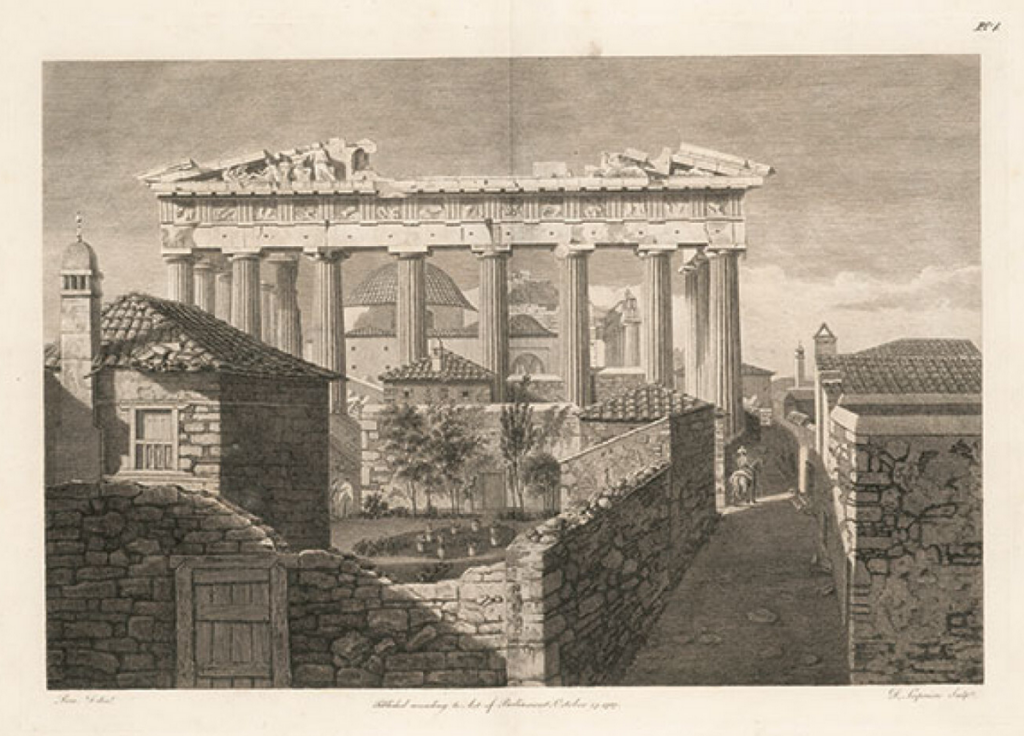
He arrived flamboyantly by ship in Constantinople in the summer of 1799, accompanied by his wife, a retinue of artists, musicians, and numerous servants. The Turkish authorities welcomed and treated him as if he were the heir to the British throne. However, prior to this, he had made a stop in Naples. In the capital of Campania, he hired Neapolitan painter Giovanni Battista Lusieri to travel to Athens with his secretary, William Richard Hamilton, to commence the project of producing painted replicas and molds of the sculptures and buildings of the Acropolis. In subjugated Athens, the unscrupulous Turkish Disdar, the Acropolis garrison commander and Aga of the fortified Castle, was generously bribed to turn a blind eye to Elgin’s “team.” The soldiers stationed on the Sacred Rock, living in miserable mudbrick huts with leaky roofs built among the monuments, also received their baksheesh. During his diplomatic routine in the City, Elgin dreamed of grandeur, as his appetite grew insatiably with each taste of success.
At the end of the day, any foreign traveler passing through Athens would pocket an ancient artifact as a souvenir for their home. Even more so, the French diplomat Louis-François-Sébastien Fauvel, former ambassador of his country to the Ottoman Sultan, had settled permanently in Athens since 1793 and had become the most distinguished antiquities smuggler and systematic thief of relics. He had already sent a metope and a section of the Parthenon frieze to the Louvre, while his house in Plaka groaned under the weight of a large collection of embezzled antiquities.
At that point, he lacked the key person, the “tool” for the dirty work. He found it in the person of Dr. Philip Hunt, the chaplain of the British Embassy chapel in Constantinople. The “true arch-swindler,” as Melina Mercouri described him in her historic 1986 speech at Oxford University about the Parthenon Marbles. He irregularly obtained the document of kaymakam Segut Abdullah, a senior administrative official standing in for the grand vizier Yusuf Giza, who was away on a trip to Egypt. According to this document, the removal of stones and sculptures from the Acropolis was permitted. This simple personal letter signed by a pasha, in contrast to a firman signed by a sultan—which would offer absolute legitimization for actions within Ottoman territory—had questionable, if not outright invalid, authority. It never granted permission to remove antiquities, only consent to visit the site. However, Hunt exploited the text’s vagueness, the general ambiguity, the Persian-Arabic script, the uncertain translation into Italian, and, of course, its presentation to uneducated people as proof to justify the impending plundering.
The shipwreck
The sultan had no clue what had transpired behind his back. Did it matter? Eight years later, he would be strangled to death in the seraglio, and his body would be inhumanly thrown from the city walls. For the lord, however, the forged document he touted as genuine sufficed. He sent Reverend Hunt to Athens, hired about 300 unskilled workers and laborers, transported primitive and crude dismantling tools, used rickety scaffolding, pulleys, ropes, saws, hammers, and chisels, and began the clumsy disassembly of sacred monuments. In August 1801, he dismantled the first metopes from the Parthenon.
He resided in Athens at the Logothetis mansion, on Areos Street 14, next to the Ottoman bazaar, opposite the voevodaliki (administrative office), and in front of Hadrian’s Library. The mansion owner, Nikolaos Logothetis from Kea, was the British consul, a diplomatic appointment he inherited from his father-in-law, Bernardos Kapetanakis, the elder, leader, or chief of Athens. In the courtyard of the British “consulate” in Monastiraki, then called the “broad street of the lower fountain,” the dismantled Marbles were packed into crates. Fragments of the Sculptures that didn’t fit into the crates were not meticulously recorded but roughly marked before being broken into pieces. They would be reassembled in Scotland.
The lord’s constant concern was that the British ships didn’t load all the overweight crates, leaving them exposed for months at the port of Piraeus to be eroded by the salt air. In a hurry, he purchased a private ship with borrowed funds from his creditors. He named it Mentor and stayed aboard its deck over Christmas 1801 to supervise the greedy loading. Once the frigate was fully loaded, he returned to Constantinople. Before it could reach its destination by sea, the overloaded Mentor and its precious cargo sank to the seabed off Avlemonas in Kythera. The sailors swam to the shore to save themselves. The lord, narrowly avoiding a stroke, hired experienced divers from Kalymnos to retrieve the crates from the sea floor. The operation lasted two years, recovering 16 crates.
How the Lion Gate was saved
He paid 655 groschen to Theodorakis Vlassopoulos, the beratli (consul) of the British in Argos, to excavate the “Treasury of Atreus” on his behalf. The hired local magnate, after destroying and plundering the monument, delivered to him the fragments he discovered. Fortunately, due to its enormous size and weight, the famous Lion Gate at the ancient site of Mycenae was spared from being transported to Britain.
When in 1803 he was recalled from his ambassadorial duties in Constantinople, he ensured that his household belongings were safely transferred to his homeland. In May 1803, while in Lyon, war broke out between Britain and France. He was declared a prisoner of war by the French and imprisoned by Bonaparte at the fortress of Lourdes. He was released on the condition that he not leave France. In October 1805, the French allowed Lady Elgin, who was pregnant with their fifth child, to return to England out of compassion. He remained a prisoner at Pau, near the Spanish border, until 1806. Upon his return, fate dealt him even harsher blows. His wife had left him and formed a relationship with another man. Sordid and undignified, without magnanimity, he caused a scandal by accusing his wife of adultery and demanding compensation from her lover. After obtaining a divorce, despite being disfigured in the face, he remarried in 1810 to Elizabeth Townsend, the daughter of a Scottish Member of Parliament, with whom he had four more children.
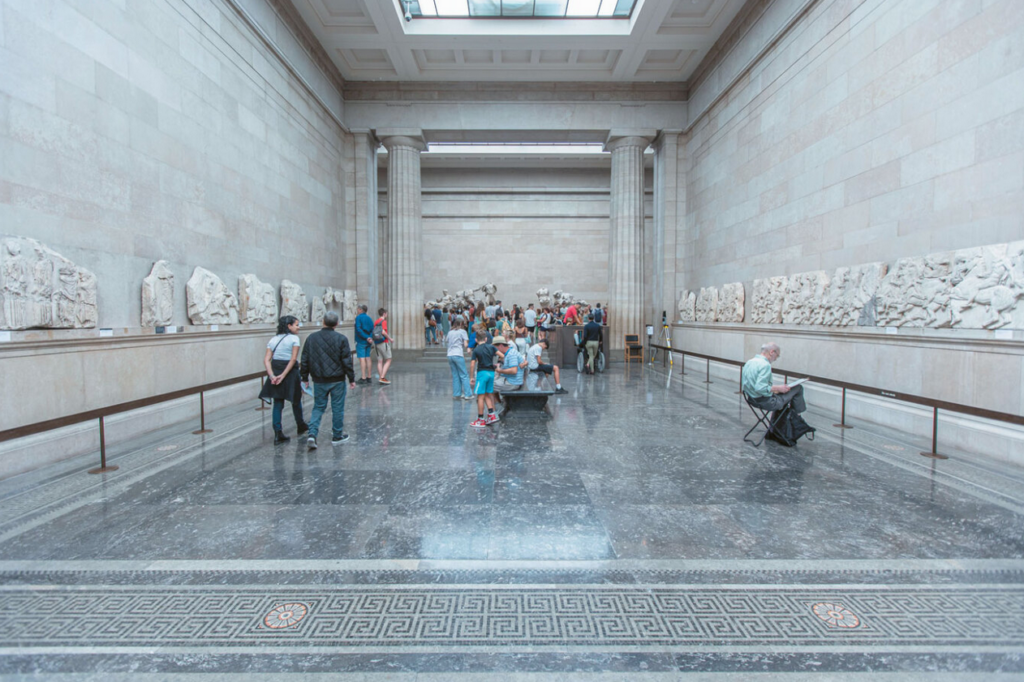
As for the Parthenon Sculptures, he displayed them blackened from mold and neglect under miserable conditions in a coal warehouse of a house he rented in Park Lane, near Piccadilly, in London. Deep in debt, he begged for their sale to the British Crown.
The purchase
The prevailing question in public opinion was whether these should be purchased with public funds. And to what extent it was legal for Britain to buy stolen goods from Greece. In 1816, the Parliamentary Committee set the purchase price of the Marbles at £35,000, while Elgin himself demanded double, claiming he had spent £74,000. Ultimately, Parliament approved their purchase by a narrow margin: 82 votes in favor and 80 against. During the vote, the critical words of MP Sir John Newport hovered in the room: “Elgin pillaged what the Turks and other barbarians considered sacred.”
In his homeland’s society, there was a widespread sense that the dishonest and pompous Elgin had shamelessly gone too far. Initiated into the Freemasons of the Scottish Rite in 1819, he had been elevated to the rank of Knight of the Royal Arch. It offered him no solace or relief. Pursued by his creditors, he fled to Paris, now without a nose on his face, where he died at the age of 75, scorned and stigmatized as a modern Herostratus. Forever beneath the earth, he would be accompanied by “Athena’s Curse” from Lord Byron’s poem of the same name: “Oh, cursed be his life and his grave, and wrath shall follow his sacrilegious crave! And may my curse go beyond his grave.”
However, if Elgin deserved punishment for his plunder, it would not be borne after his death. He paid the heavy penalty for the sacrilegious crime he committed during his lifetime.
Ask me anything
Explore related questions




