





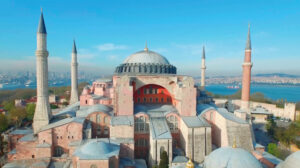
An unprecedented architectural miracle in the world, which took place some 15 centuries ago, has been brought back into the news by the news of the forthcoming conservation work on the emblematic dome of Hagia Sophia, which is deemed necessary for the restoration and protection of this priceless UNESCO World Heritage Site. Because the impressive dome of the centre of Orthodoxy and Hellenism for more than a thousand years, which is the crowning glory and the crowning glory of the most brilliant Byzantine imperial temple throughout the centuries, symbolizes, in essence, the conquest of the impossible!
It is said that an angel appeared before autocrat Justinian and revealed to him the plan of a magnificent temple, the largest in the world at that time, in a square shape, symbolic of the Christian church, but with a round dome, as a symbol of secular power, with the largest possible diameter, a dizzying height touching the sky, but with the fewest possible supports. All of this was, in practice, a reference to something hitherto impossible, namely the transformation of a huge square into a colossal circle.
Justinian’s grandiose vision was undoubtedly an unprecedented challenge and constituted an architectural miracle that no one had been able to achieve until then, although there were many who had, in the past, attempted to place a round dome on a square structure. The emperor, who had full knowledge of the enormous degree of difficulty of the undertaking, entrusted it to the two best architects-engineers of the time, Anthemios of Trallies and Isidoros of Miletus.
They were chosen by the architect and engineer of the same name, from Alexandros of Alexandria and from Miletus of Alexandria.
The solution of the arch
How, then, can a square be turned into a circle? This was the fundamental and hitherto unanswered question to which the two architects were called upon to answer. After countless studies, they concluded that the key to solving this architectural problem was an old technique of the Roman Empire, the arch. They were to support the circular, 31-meter diameter and 54-meter high, square dome of the square temple, which had a base of 30.95-meter sides, on four colossal arches which, in turn, were to be supported by four oversized pessaries, i.e. built square pillars with a base of 400 square meters each and 30 meters apart from each other, to absorb their weight so that they would not collapse.
In addition, by devising and constructing four niches, that is, triangular sections that fill the gaps between the arches, the same number of curvilinear supports are created which round the corners of the square, transforming it into a circle, which was the main objective. All this was not just another inspired design, but an entirely new architectural style.
Stability
The 40 windows at the base of the architecturally perfect dome of Hagia Sophia played a decisive role, however, in maintaining the static nature of the dome. The main purpose of their placement was not aesthetic, that is, to allow sunlight to enter the temple from above, giving the visitor the feeling that the dome is floating – “one can say that it is not illuminated by the rays of the sun, but that it encloses the source of light within itself”, wrote the Byzantine historian Procopius characteristically about Hagia Sophia – but to ensure the greatest possible static stability of the magnificent dome.
Studying carefully the similar circular dome that had been constructed in the Pantheon of Rome, the genius Anthemius found that the cause of the large cracks that had developed in it was the annular pressures exerted by its excessive weight. So, to prevent the Hagia Sophia from facing similar problems, he incorporated these diametrically aligned windows into the base of the dome to absorb the corresponding pressures and prevent the formation of cracks. And the miracle happened! On 27 December 537 AD, after six consecutive years of uninterrupted work involving 10,000 craftsmen, the inauguration of Hagia Sophia took place with great splendor, with Justinian, amazed at its superiority over the enviable temple of Solomon, exclaiming: “Praise God for the work you have done. Nenikika to Solomon.”
This architectural marvel is said to have cost 145 tons of gold, equivalent to $2 billion today.
Seismic materials
And the materials used for the construction of the colossal dome of Hagia Sophia, the bricks and mortar, were no accident. It seems that the two architects factored into their design the geophysical, political and religious instability of the region. According to the numerous relevant scientific studies that have been conducted, the basic material is a type of refractory brick, much lighter than conventional brick, which was baked at relatively low temperatures to achieve the right reaction between the materials and was highly resistant to earthquake and fire.
The mortar used, however, which resembled today’s cement, contained a special material whose characteristic feature was to absorb the energy of seismic vibrations. The choice of builders to put a larger amount of mortar between the bricks, to work faster, led to the creation of a type of reinforced cement.
Nevertheless, the great earthquake of 553 hit the temple of unprecedented size and splendor hard, causing major problems to its dome, part of which, coming from its eastern arch, finally detached in 557, after another 7.5 magnitude earthquake struck Constantinople, causing damage to its interior as well. The main frame of Hagia Sophia, however, held up, unlike most buildings in the area that collapsed like a pack of cards.
Since the two great architects of the temple were no longer alive, the restoration of the damage was undertaken by the nephew of one of them, Isidore the Younger, who was also renowned for his technical skills. It took five long years of intensive work to complete the restoration project. The new architect, in fact, in an attempt to better shield the sacred structure, raised the dome by nine meters, shifting the centre of gravity to the arches, and constructed external buttresses.
Restoration plan
Any kind of intervention in a building of great historical-cultural value requires a well-organized plan, careful steps, and surgical movements. All the more so when this building is one of the most important monuments of world cultural heritage. The scientific team that has undertaken the demanding task of restoration of the dome of Hagia Sophia, which was deemed necessary after the incidents of falling fragments and damage from time, is well aware of this. It was these warning signs, along with the deterioration that has occurred since 2020 when the Byzantine temple was converted from a museum to a mosque, in a provocative decision by Recep Tayyip Erdogan that was met with strong reactions from the civilized world, leading to the decision of an extensive protection and restoration operation that began last year.
According to the roadmap for the salvage work on the dome of the structure, which is scheduled to begin in the spring of 2025, the only permitted solution for Byzantine church domes with mosaic interior decoration will be followed, which is the dismantling of the flexible sheets of their lead coating. This will enable the structural condition of the exterior of the dome to be thoroughly checked and the damage caused to the dome to be restored, strictly using materials and techniques that are consistent with its original construction.
However, given that until the maintenance work is completed, the dome of Hagia Sophia will remain exposed to the weather, it is expected that a large-scale canopy will be installed to provide the required protection. From all of the above, it can be concluded that this is an extremely complex project which must be carried out by teams of specialised scientists and crews experienced in the management of similar cases. And, of course, in this particular case, time will run against them, as the longer the work takes, the greater the risk posed by the negative effects that weather conditions may have on the monument.
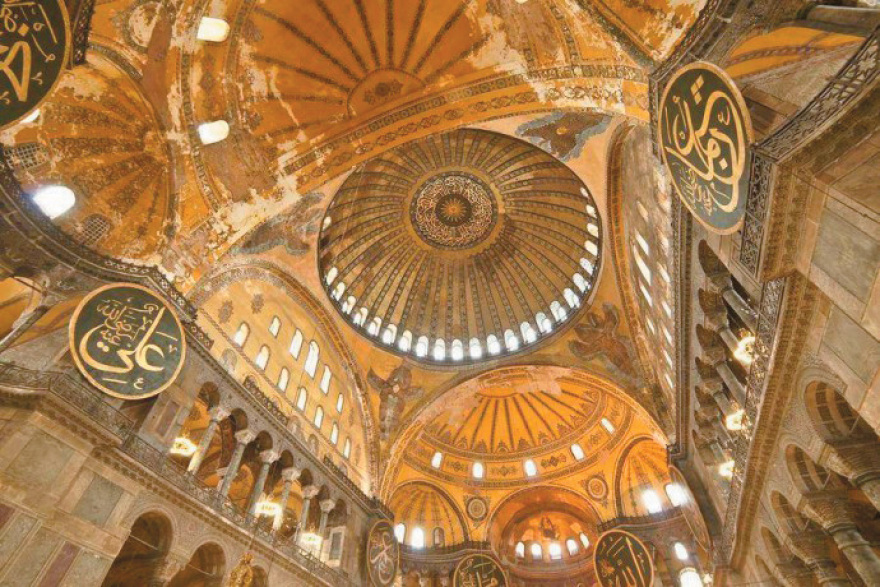
The whole process will also be closely monitored by UNESCO, which in recent years has carried out three extensive autopsies on Hagia Sophia, to determine whether any damage has been caused during its time as a Muslim mosque, which requires immediate intervention.
So far, however, it is not known whether during the work on the dome of Agias Sophia, its operation as a mosque will be interrupted. Such a development, of course, would be opposed by several suspicious Turks, who reacted to the initial announcement of the plan to preserve and protect the monument, as they felt it was a ploy to disrupt, even temporarily, the new use of the world monument.
Ask me anything
Explore related questions




