





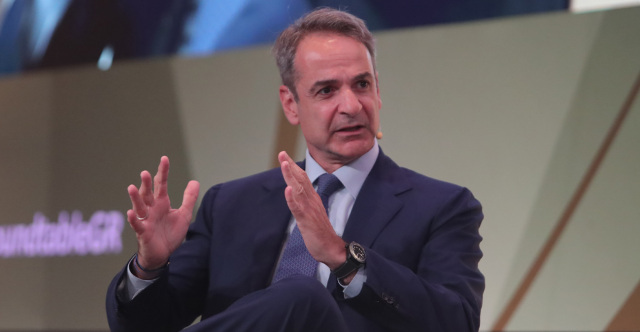
Prime Minister Kyriakos Mitsotakis criticised the Greek media’s “exaggeration” over Turkey’s potential acquisition of American F-35 fighter jets, saying he is “always surprised” by the embellishment in reporting within parts of the Greek media.
Speaking at The Economist’s 30th Annual Roundtable with the Greek Government, Mitsotakis said the focus of the recent NATO Summit should be on Europe’s broader defense strategy rather than speculation surrounding the F-35 issue.
“I’m always surprised by how some parts of the Greek media report this news with such a high degree of exaggeration and an inability to grasp the complex dynamics we’re facing,” he said.
On Greek-Turkish relations, the prime minister stressed that such matters are handled through direct communication between the two countries, adding that he had nothing further to say about the F-35 issue.
Instead, he argued that the summit’s key outcome was Europe’s commitment to significantly increase defense spending.
“The important message coming out of the Summit is that Europe will spend more on defense. That is the only way to convince the United States that we take our defense seriously.”
Europe must take greater responsibility
Mitsotakis described the NATO Summit as “extremely successful,” saying it reinforced last year’s decisions on strengthening Europe’s role in its own security.
He said the European Union must assume greater responsibility for defence, linking the issue to Europe’s strategic autonomy and the development of its defense industry.
The prime minister also highlighted Greece’s defence spending, saying the country has already reached the NATO target originally set for 2035.
“Greece has already achieved, as of 2026, the target set for 2035. This places us among an elite group of just five NATO members that have already reached this milestone.”
Migration no longer a top concern
Mitsotakis also defended the government’s migration policy, arguing that migration has fallen sharply as a concern for Greek citizens.
“When we took office in 2019, there were 30,000 migrants on Lesbos. Today there are about 300,” he said.
He attributed the decline to stronger border protection, cooperation with Turkey, and a clear government policy aimed at discouraging illegal crossings. He also said Greece had helped steer the European debate toward a more pragmatic approach on migration while continuing to save lives at sea.
Investment, defense and EU enlargement
The prime minister called for greater private investment in data centers and innovation, saying Greece has strong momentum in the start-up sector but warning that Europe has created excessive regulation that discourages investment.
He also said Europe should consider forming a group of countries willing to move faster on defence cooperation, adding that the SAFE mechanism would make joint defense procurement easier.
On EU enlargement, Mitsotakis said Montenegro has a realistic chance of becoming the Union’s 28th member within the next two years, reaffirming Greece’s support for the Western Balkans’ European aspirations.
Metsola: Europe has dramatically increased defense spending
European Parliament President Roberta Metsola, who joined Mitsotakis in discussion, said Russia’s invasion of Ukraine had fundamentally reshaped Europe’s priorities, with defense budgets rising sharply across the continent.
She noted that ten countries are currently seeking EU membership and said both Canada and the United Kingdom have expressed interest in participating in the SAFE defense initiative.
Metsola also said migration pressures have eased as irregular arrivals have declined, but stressed that lasting solutions require legislation, dialogue and cooperation with countries of origin. Looking ahead, she noted that 2027 will be a major election year across Europe, including in Greece, France and Poland.
Ask me anything
Explore related questions




