





In May 2026, Constantinople hosted the inaugural World Decolonization Forum, the first installment of a planned three-part series stretching to 2030. Organized by the Turkish think tank Institute Social and the NUN Foundation for Education and Culture, the event framed itself as an intellectual exercise in “decolonizing knowledge production and circulation.” In reality, it advanced a coordinated challenge to Western intellectual, institutional, and civilizational foundations under the banner of multipolarity and anti-colonial rhetoric.
The forum’s roadmap is explicit:
– The 2026 gathering targeted knowledge production
– 2028 will address institutions and organizations
– 2030 aims at “decolonization in practice” with concrete proposals for society.
Participants included decolonial theorists such as Walter Mignolo, Islamic scholars and activists including Hatem Bazian, Joseph Massad and Salman Sayyid, Chinese academics with documented ties to the Chinese Communist Party’s united front structures, and Western left-leaning figures. The result is a Red-Green alliance that blends Marxist critiques of the West with Islamist civilizational ambitions, all coordinated from Turkish state-linked platforms.
Central to the enterprise is Dr. Esra Albayrak, daughter of Turkish President Recep Tayyip Erdogan and chair of the NUN Foundation. In her opening remarks she declared that Western centers of knowledge in Paris, London, Amsterdam and New York have reached their limits. The world, she argued, now requires new centers of wisdom in Constantinople, Jakarta, Addis Ababa, Rabat, Cairo and…Gaza. Albayrak insisted the project is not about eliminating the West but inviting it to accept its own “decolonization”(sic). This is not neutral academic discourse. It is a strategic call to displace the scientific authority of the open societies that produced modern science, liberal institutions and individual rights, and to elevate alternatives that include authoritarian and theocratic models.
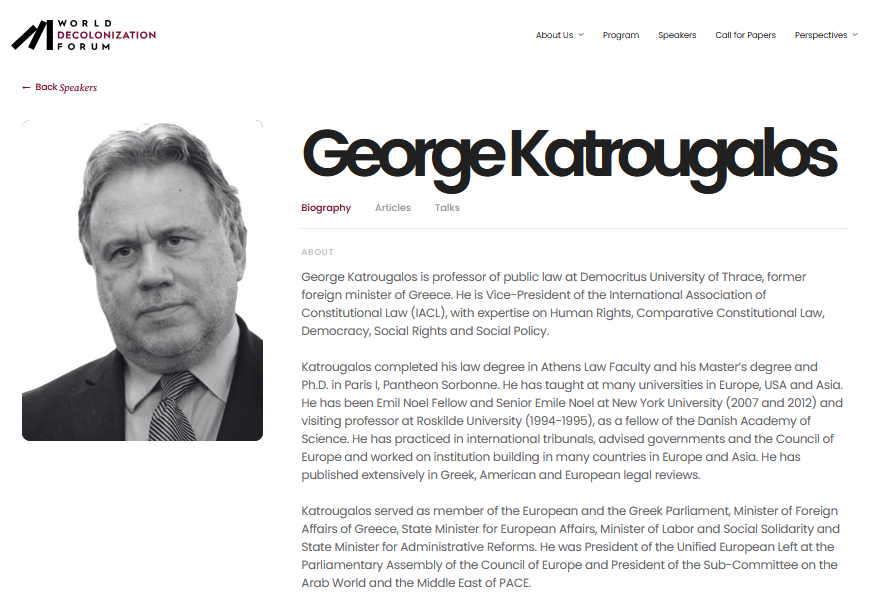
A notable European participant appears to have been George Katrougalos, former Foreign Minister of Greece and a jurist specializing in comparative constitutional law. Is true, his presence lent the gathering a veneer of Western legitimacy even as the agenda sought to undermine the very liberal order Greece has long belonged to. That a senior Greek politician would join an initiative hosted by institutions closely tied to Erdogan’s government – itself marked by neo-Ottoman assertiveness and support for revisionist causes – raises serious questions about the judgment of European “elites” willing to platform such projects.
The dangers of this approach are profound: By reframing Western knowledge systems as inherently colonial and illegitimate, the forum seeks to erode the standards of evidence, free inquiry and universal reason that undergird scientific progress and democratic governance. Replacing them with identity-based or ideologically filtered “wisdom” from selected non-Western capitals risks elevating narratives that tolerate or excuse authoritarianism, religious supremacy and rejection of Enlightenment values. When Gaza is listed alongside Constantinople as a future intellectual capital, the political signal is unmistakable: grievance politics and militant resistance are to be normalized as sources of global authority.
Such projects do not merely critique history; they seek to restructure the present. They align Turkish soft power with Chinese multipolar ambitions and radical decolonial currents in Western woke academia. The long-term effect would be the progressive hollowing out of Western self-confidence, the relativization of democracy, and the gradual legitimization of illiberal alternatives. Free societies that fail to recognize this as a strategic ideological offensive risk surrendering the intellectual ground on which their prosperity and liberties rest.
The World Decolonization Forum is not an innocent seminar. It is an organized effort to reorient global knowledge production away from the West and toward centers sympathetic to the agendas of its sponsors. Europeans and North Americans should treat it with the seriousness it deserves: as a challenge that must be met with clear-eyed defense of the open, critical and universalist traditions that remain the best available foundation for human flourishing.
Ask me anything
Explore related questions




