





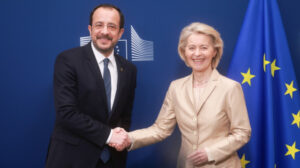
Cypriot President Nikos Christodoulides spoke by phone this morning with both European Commission President Ursula von der Leyen and European Council President António Costa to discuss the issues raised at last night’s dinner. According to Cypriot Government Spokesperson Konstantinos Letympiotis, the position conveyed by the EU institutions was unambiguous: the matters on which Turkey is seeking progress in its relationship with the bloc remain directly linked to progress on Cyprus, the island nation that has been divided since Turkey’s 1974 invasion and remains an EU member state.
Nicosia reads Ankara’s recent overtures as a sign of renewed Turkish interest in warming ties with Brussels, with Turkey said to be pushing for closer economic cooperation, trade, customs union arrangements, and cooperation on migration and security. The response coming back from European capitals, at least as Nicosia presents it, is that Turkey cannot expect to reap the benefits of closer EU ties while remaining inflexible on Cyprus.
“Cyprus-related obligations are European obligations”
Letympiotis stressed that Turkey’s obligations relating to Cyprus are, in effect, European obligations. In practical terms, Nicosia argues, this means any progress Ankara seeks in its dealings with the EU must be matched by a constructive and decisive Turkish stance on the Cyprus dispute.
The spokesperson said this now reflects the shared position of the EU’s 27 member states and its institutions, built around a framework of gradual, proportionate and reversible steps in EU-Turkey relations. Under that approach, Ankara may see movement from the EU side, but only in tandem with substantive steps of its own on Cyprus. Concessions, Nicosia insists, will not be offered in advance of a genuine shift in Turkey’s position.
The Christodoulides’ government regards this framework as the product of a sustained diplomatic effort mounted since the start of its presidential term, and is using Turkey’s evident interest in EU rapprochement as leverage to push Ankara back toward substantive talks under the long-standing United Nations framework for a settlement.
The informal multilateral meeting: a test for Ankara
The Cypriot government spokesman said Turkey’s public backing for the efforts of UN Secretary-General António Guterres now needs to be borne out in practice, a point that was also reflected in the joint statement issued by Fidan, EU High Representative for Foreign Affairs and Security Policy Kaja Kallas, and the two European commissioners who held talks with the Turkish delegation.
Nicosia says rhetoric alone will not suffice. Its stated goal is the convening of an informal multilateral conference under the auspices of the UN Secretary-General, one that would pave the way for a formal resumption of substantive negotiations.
Letympiotis was equally clear that responsibility for breaking the impasse lies with Turkey, which he said must abandon its own intransigence. As Nicosia sees it, any informal multilateral meeting must have real substance, clear direction and tangible outcomes; convening such a gathering, he added, is not an end in itself but a means of restarting talks toward a comprehensive settlement of the Cyprus problem.
The EU’s role alongside the UN
Nicosia places particular weight on cooperation between the EU and the UN on the Cyprus file. Both Costa and von der Leyen have voiced the EU’s willingness to support Guterres’s efforts, and the Cypriot government believes Brussels can play a useful supporting role in the process.
For Nicosia, the Cyprus issue remains fundamentally an international matter of invasion and occupation, but it is simultaneously a European one, given that it concerns the territory of an EU member state. That, officials say, is precisely the point Nicosia is trying to impress upon Ankara: Turkey cannot leave its outstanding disputes with the Republic of Cyprus unresolved while simultaneously seeking unimpeded progress in its relationship with the EU.
“Concrete steps” contingent on substantive progress
Asked whether Nicosia might be prepared to lift its objections on matters of interest to Turkey, Letympiotis said that, provided there is substantive progress on the Cyprus issue, the Republic of Cyprus stands ready to support concrete steps forward in EU-Turkey relations.
The substance of any Turkish shift, however, remains the sticking point. Nicosia is not prepared to trade a general Turkish statement of support for the Guterres initiative for European concessions; what it is seeking instead is a clear and demonstrable shift by Ankara toward the UN-led process, with a view to resuming negotiations within the established framework.
The wording carries particular weight given that Turkey and Turkish Cypriot officials have in recent years pressed claims of “sovereign equality” and a two-state solution, positions that fall outside the parameters set by UN Security Council resolutions and the internationally agreed framework for a settlement. For Nicosia, any meaningful discussion of progress must return to the model of a bizonal, bicommunal federation, as defined by the United Nations.
Ask me anything
Explore related questions




