





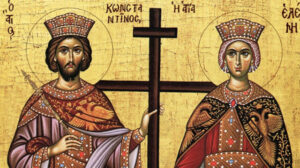
On this day, people named Constantine (Konstantinos), Constantina (Konstantina), Helen (Eleni), and related name variations celebrate their name day.
Saint Constantine and Helen: A major Orthodox feast on May 21
Constantine the Great (272–337) ruled from 306 until his death. Through the Edict of Toleration in 313, he ended the persecution of Christians, helping establish freedom of worship and enabling Christianity to spread. In 325, he convened the First Council of Nicaea in Nicaea of Asia Minor and personally addressed the gathering. This council was pivotal in Christian history because it condemned Arianism and helped shape Christian doctrine through the Creed (“Symbol of Faith”). Shortly before his death, Constantine was baptized as a Christian.
The Roman Catholic Church does not recognize Constantine the Great as a saint, as historical research attributes to him orders for the execution of his son Crispus (from his first wife Minervina) and his second wife Fausta. According to later historical interpretations, Crispus and Fausta may have had an affair. In contrast, besides the Orthodox Church, the Anglican Communion and various Lutheran denominations honor his memory.
Saint Helena (c. 246/250–327/330) is traditionally believed to have discovered the True Cross in the Holy Land and financed the construction of Christian churches throughout the empire. The Roman Catholic Church commemorates her on August 18.
Apolytikion (Hymn)
“Having seen the sign of Your Cross in the heavens, and like Paul receiving the calling not from men, Your apostle among kings, O Lord, entrusted the imperial city to Your hand; preserve it always in peace, through the intercessions of the Mother of God, O only Lover of mankind.”
Constantine the Great: The Roman emperor who became a saint
Constantine was called “the Great” because of his wide-ranging achievements, which directly and indirectly shaped world history. The Orthodox Church proclaimed him both a saint and “Equal-to-the-Apostles” for his support of Christianity. His feast day is celebrated jointly with that of his mother, Saint Helena, on May 21.
Born as Flavius Valerius Aurelius Constantinus on February 27, 272, in Naissus (modern-day Niš), he was the son of Roman officer Constantius Chlorus and Helena. He joined the Roman army at a young age and became known for his military and administrative abilities.
In 305, he accompanied his father on a campaign to Britain, and after his father’s death in 306, he was proclaimed emperor by the troops at Eboracum (modern-day York).
A decisive moment came in October 312, before the Battle of the Milvian Bridge, when Constantine reportedly saw a vision in the sky of a cross accompanied by the phrase “By this sign, conquer” (“In hoc signo vinces” / “Εν τούτω Νίκα”). He interpreted it as divine guidance and defeated his rival Maxentius, becoming ruler of the Western Roman Empire.
Though not originally Christian, Constantine recognized Christianity’s growing influence and integrated it into imperial policy. In 313, together with Licinius, he signed the Edict of Milan, establishing religious tolerance and freedom of worship.
After defeating Licinius in 324, Constantine ruled the entire empire. He introduced reforms to strengthen imperial unity, stabilized the economy with a new gold coin (the solidus), and moved the capital from Rome to Constantinople (New Rome), officially inaugurated in 330.
His support for the Church included convening the First Council of Nicaea in 325 to address theological divisions, especially the Arian controversy, and define Christian doctrine.
Shortly before his death on May 22, 337, Constantine was baptized a Christian.
Constantine married twice: first to Minervina, with whom he had a son, Crispus, and later to Fausta, with whom he had five children. In 326, he ordered the deaths of Crispus and Fausta, reportedly because he suspected an affair between them — one of the reasons the Roman Catholic Church does not venerate him as a saint.
Ask me anything
Explore related questions




