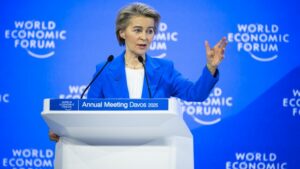
Ursula von der Leyen expressed her displeasure over Trump’s decision to impose tariffs on European steel and aluminum exports, emphasizing that the European Union will do whatever it takes to protect workers, businesses, and consumers.
“I deeply regret the U.S. decision to impose tariffs on European steel and aluminum exports. The EU will take action to safeguard its economic interests. We will protect our workers, businesses, and consumers,” she wrote in a post on X.
Tariffs on Steel and Aluminum Effective March 12
The U.S. tariffs of 25% on steel and aluminum will take effect on March 12, according to the executive order signed yesterday, Monday, by President Donald Trump, who continues his trade war through high tariffs.
“I have determined that imports of steel (…) pose a risk to national security,” Trump wrote in his statement, explaining that he is ending the current trade rules “as of March 12.” The Republican issued a separate order for aluminum imports.
“It’s time for our great industries to return to America,” Trump said while signing the orders at the White House.
The tariffs are part of Trump’s aggressive strategy to reshape global trade, arguing that tax increases on individuals and companies buying foreign-made products will ultimately boost domestic production.
Which Countries Are Affected by the Tariffs
The tariffs announced by Trump will particularly impact Canada, the primary supplier of steel and aluminum to the U.S.
Brazil, Mexico, and South Korea are also major suppliers of these metals.
The UK steel federation, UK Steel, expressed concern over the “devastating blow” to an industry that was already struggling.
The announcement may also have a toxic effect on certain sectors within the U.S. economy.
“Steel and aluminum are critical raw materials for American industries, including export-oriented ones,” warned Maurice Obstfeld, an expert at the Peterson Institute for International Economics.
The tariffs could cause a “major” supply shock, he added in an interview with Agence France-Presse.
During his first term (2017–2021), Donald Trump had already imposed 25% tariffs on steel and 10% on aluminum.
These measures were later mostly lifted, first by Trump himself and then by his Democratic successor, Joe Biden.
Furthermore, Donald Trump announced last Sunday that he would unveil new “reciprocal tariffs” on Tuesday or Wednesday to balance the taxation of imported goods with the way American products are taxed abroad.
Tariffs are a key lever of Trump’s economic policy, aimed at reducing the U.S. trade deficit by pressuring its economic partners.
Reactions have been mixed, ranging from threats of retaliation to attempts at de-escalation.
The EU Will Retaliate
French Foreign Minister Jean-Noël Barrot assured yesterday that the European Union will “retaliate,” just as it did during Trump’s first term. Back then, the EU targeted iconic American products, such as bourbon whiskey and Harley-Davidson motorcycles.
“There is no hesitation when it comes to defending our interests,” said the French foreign minister on TF1 television.
In Germany, Europe’s largest economy, Economy and Climate Minister Robert Habeck called for “continued cooperation with the U.S.”
The European Commission, for its part, stated that it had not received “any notification” regarding new tariffs.
China: The Big Rival
So far, Trump has been pressuring both U.S. allies and its biggest competitor: China. Since last Tuesday, all imported Chinese products have been hit with an additional 10% tariff on top of existing tariffs.
China’s retaliatory measures, targeted tariffs on selected U.S. goods, took effect yesterday. These cover American exports worth $14 billion. Meanwhile, Trump’s tariffs affect Chinese goods worth $525 billion.
Chinese Foreign Ministry spokesperson Guo Jiakun reiterated Beijing’s long-standing position that “no one wins in a trade or tariff war.”
A week ago, Trump threatened Mexico and Canada with blanket 25% tariffs, only to postpone the decision for a month before it could even take effect.
As for China, Trump decided not to impose tariffs on parcels worth at least $800, which would have hit platforms like Shein and Temu.
Hong Kong to File Complaint with WTO
Hong Kong will file a complaint with the World Trade Organization (WTO) over the recent U.S. tariffs imposed on the region, local government leader Eric Chan announced today, arguing that Washington has completely ignored the city’s special customs status.
Ask me anything
Explore related questions