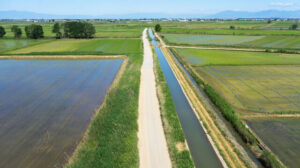
In recent years, the cultivation of rice has been increasingly developing in Greece. According to estimates by those involved in this crop, rice areas in Greece now amount to 300,000 hectares, with production reaching 270,000 tonnes of rice with husk or 150,000 tonnes of “pure” rice. In addition, the same estimates point to a large number of rice producers, reaching up to 10,000 in Greece, a number that would not be surprising if it were to increase, considering the good prices in rice relative to those in cotton and corn.
Greece is in third place among European Union member states behind first Italy and second Spain, with Portugal in fourth place.
“Last year the cultivated areas increased by 10%, while this year they may increase by up to 15%” the President of the Interprofessional Organization of Rice, Giannis Arnaoutelis, told the AP, saying, however, that “all this, of course, in order to happen we must have sufficient water.
Climate change has understandably affected this crop. The scarce rain and snowfall in previous years has resulted in insufficient water and producers are facing difficulties. All this, considering that rice farming is a crop that is literally produced in water.
“Due to the shortage of water, yields in the field have been affected. Of course, water scarcity is a major issue for us. If it doesn’t rain and snow there are problems,” said Mr. Arnaoutelis and added “but this year is expected to be an excellent year” and he explained “already there are significant amounts of water from the rainfall and from the snow that fell in the past months in our country.”
The water issue is most important in Macedonia, a region where up to 70% of Greece’s total production is located. According to the president of the Interprofessional Association, farmers there have to deal with water shortages due to the management of rivers from other countries where they initially pass through.
“Apart from the Aliakmon, which is managed entirely by us, there is the Axios River, which before it reaches our country, passes through the neighboring country, which ‘arranges’ the quantities that will eventually reach us, after they first meet their own needs,” he said and continued “the same is true in the Evros region, where the river is also controlled by Bulgaria before it ends up spilling into the Aegean.
Two-thirds of production is exported
The high quality of Greek rice also seems to be preferred by foreign countries, destination of 2/3 of the total production.
“One third of the total production covers domestic needs and the remaining two thirds are destined for export,” Arnaoutelis said.
The main destination of Greek rice on international markets are the countries of the Mediterranean basin, Poland, Turkey and, above all, the Middle East.
The problems
As it is logical, not everything is rosy for the industry which, apart from the lack of water, is the weather conditions that prevail during the harvesting of the final product.
The price is also an issue. “This product is marketable. We have to compete with traditional countries in rice cultivation, such as Italy and Spain, which is not easy,” he noted.
Another issue, according to the president of the Interprofessional Rice Organization, is the strictness of the European Union regarding the use of pesticides. “The EU is strict with food quality assurance and with pesticides. That is why it wants producers to use more ‘light’ pesticides to fight pests in their productions,” Arnaoutelis told APE-MPA.
He continued “this results in the need for larger quantities of pesticides, increasing costs for farmers and at the same time reducing their production. If more efficient pesticides are not used, then production goes down.”
Finally, speaking about the establishment of the Interprofessional Committee for Rice, he stresses that it has resulted in “bringing production and processing closer together. This has resulted in us sitting together, trying to find solutions to the problems we have. In addition, we are trying through programs to put Greek rice in new, more profitable markets.”
Ask me anything
Explore related questions